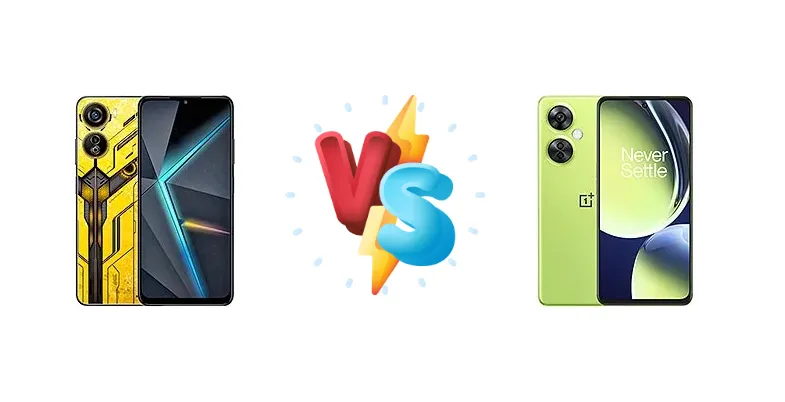
The sub-$250 smartphone market is fiercely competitive, and the ZTE nubia Neo and OnePlus Nord CE 3 Lite are two strong contenders vying for your attention. While both offer 5G connectivity and a focus on value, they take distinctly different approaches to performance and charging. This comparison dissects their core specifications to reveal which device best suits your needs.
🏆 Quick Verdict
For the average user prioritizing rapid charging and a well-established brand ecosystem, the OnePlus Nord CE 3 Lite is the better choice. Its 67W SuperVOOC charging significantly outperforms the nubia Neo’s 22.5W, offering a substantial time saving. However, the nubia Neo’s Unisoc T820 offers a potentially competitive CPU performance profile.
| Network |
|---|
| 2G bands | GSM 850 / 900 / 1800 / 1900 | GSM 850 / 900 / 1800 / 1900 |
| 3G bands | HSDPA 850 / 900 / 1700(AWS) / 1900 / 2100 | HSDPA 800 / 850 / 900 / 1700(AWS) / 1900 / 2100 - International |
| 4G bands | LTE | 1, 2, 3, 4, 5, 7, 8, 12, 13, 17, 18, 19, 20, 26, 28, 32, 38, 39, 40, 41, 66 - International |
| 5G bands | SA/NSA | 1, 3, 5, 7, 8, 20, 28, 38, 40, 41, 66, 77, 78 SA/NSA - International |
| Speed | HSPA, LTE, 5G | HSPA, LTE, 5G |
| Technology | GSM / HSPA / LTE / 5G | GSM / HSPA / LTE / 5G |
| | - | 1, 3, 5, 8, 28, 40, 41, 77, 78 SA/NSA - India |
| Launch |
|---|
| Announced | 2023, June | 2023, April 04 |
| Status | Available. Released 2023, July 29 | Available. Released 2023, April 11 |
| Body |
|---|
| Build | - | Glass front, plastic frame, plastic back |
| Dimensions | 163.7 x 75 x 8 mm (6.44 x 2.95 x 0.31 in) | 165.5 x 76 x 8.3 mm (6.52 x 2.99 x 0.33 in) |
| SIM | Nano-SIM + Nano-SIM | Nano-SIM + Nano-SIM |
| Weight | 192 g (6.77 oz) | 195 g (6.88 oz) |
| Display |
|---|
| Protection | - | Corning Gorilla Glass |
| Resolution | 1080 x 2408 pixels, 20:9 ratio (~400 ppi density) | 1080 x 2400 pixels, 20:9 ratio (~391 ppi density) |
| Size | 6.6 inches, 104.9 cm2 (~85.5% screen-to-body ratio) | 6.72 inches, 109.6 cm2 (~87.1% screen-to-body ratio) |
| Type | IPS LCD, 120Hz | IPS LCD, 120Hz, 550 nits (typ), 680 nits (peak) |
| Platform |
|---|
| CPU | Octa-core (1x2.7 GHz Cortex-A76 & 3x2.3 GHz Cortex-A76 & 4x2.1 GHz Cortex-A55) | Octa-core (2x2.2 GHz Kryo 660 Gold & 6x1.7 GHz Kryo 660 Silver) |
| Chipset | Unisoc T820 (6 nm) | Qualcomm SM6375 Snapdragon 695 5G (6 nm) |
| GPU | Mali-G57 | Adreno 619 |
| OS | Android 13 | Android 13, OxygenOS 13.1 |
| Memory |
|---|
| Card slot | Unspecified | microSDXC (uses shared SIM slot) |
| Internal | 256GB 8GB RAM | 128GB 8GB RAM, 256GB 8GB RAM |
| | - | UFS 2.2 |
| Main Camera |
|---|
| Dual | 50 MP, f/1.8, 26mm (wide), PDAF
Auxiliary lens | - |
| Features | LED flash, HDR, panorama | LED flash, HDR, panorama |
| Triple | - | 108 MP, f/1.8, (wide), 1/1.67", 0.64µm, PDAF
2 MP (macro)
Auxiliary lens |
| Video | 1080p@30fps | 1080p@30fps |
| Selfie camera |
|---|
| Features | - | HDR, panorama |
| Single | 8 MP, f/2.0, (wide) | 16 MP, f/2.4, (wide), 1.0µm |
| Video | 1080p@30fps | 1080p@30fps |
| Sound |
|---|
| 3.5mm jack | - | Yes |
| 35mm jack | Yes | Yes |
| Loudspeaker | Yes | Yes, with stereo speakers |
| Comms |
|---|
| Bluetooth | 5.2, A2DP, LE | 5.1, A2DP, LE, aptX HD |
| NFC | Yes | Yes (market/region dependent) |
| Positioning | GPS, GLONASS, GALILEO, BDS | GPS, GALILEO, GLONASS, BDS, QZSS |
| Radio | Unspecified | No |
| USB | USB Type-C 2.0, OTG | USB Type-C 2.0, OTG |
| WLAN | Wi-Fi 802.11 a/b/g/n/ac, dual-band | Wi-Fi 802.11 a/b/g/n/ac, dual-band |
| Features |
|---|
| Sensors | Fingerprint (side-mounted), accelerometer, proximity | Fingerprint (side-mounted), accelerometer, gyro, proximity, compass |
| Battery |
|---|
| Charging | 22.5W wired | 67W wired, 80% in 30 min |
| Type | Li-Ion 4500 mAh | Li-Po 5000 mAh |
| Misc |
|---|
| Colors | Black, Yellow | Pastel Lime, Chromatic Gray |
| Models | 8150N | CPH2467, CPH2465 |
| Price | About 180 EUR | £ 169.98 / € 209.99 |
| SAR | - | 1.17 W/kg (head) 0.70 W/kg (body) |
| Tests |
|---|
| Performance | - |
AnTuTu: 412006 (v9)
GeekBench: 2052 (v5)
GFXBench: 17fps (ES 3.1 onscreen) |
ZTE nubia Neo
- Potentially stronger CPU performance due to higher clocked Cortex-A76 cores.
- Unisoc T820 offers a different chipset option, appealing to those seeking alternatives to Qualcomm.
- Competitive price point.
- Significantly slower 22.5W charging.
- Less established brand reputation compared to OnePlus.
- Limited information available regarding display quality.
OnePlus Nord CE 3 Lite
- 67W SuperVOOC charging provides incredibly fast top-ups.
- Qualcomm Snapdragon 695 offers a balanced and reliable performance.
- OnePlus’s OxygenOS (or ColorOS) provides a refined software experience.
- CPU clock speeds are lower than the nubia Neo’s.
- May be slightly more expensive than the nubia Neo.
- Camera performance may not be significantly better than the nubia Neo.
Display Comparison
Neither device boasts a standout display. Details regarding panel type (IPS vs AMOLED) and refresh rate are missing, suggesting both likely utilize standard LCD panels common in this price bracket. The focus here is on functionality rather than visual fidelity. Bezels are expected to be moderate, and color accuracy will likely be adequate for everyday use, but not geared towards content creation.
Camera Comparison
Camera details are sparse, but the market segment suggests both will rely on primary sensors for most image capture. Without knowing sensor sizes or apertures, it’s difficult to make a definitive judgment. The presence of a 2MP macro lens on either device is largely a marketing tactic, offering limited practical benefit. Image processing will likely be the differentiating factor, with OnePlus typically offering more refined and consistent results. OIS (Optical Image Stabilization) is unlikely on either device at this price point.
Performance
The core difference lies in the chipsets. The ZTE nubia Neo features the Unisoc T820 (6nm), utilizing a tri-cluster configuration with 1x2.7 GHz Cortex-A76, 3x2.3 GHz Cortex-A76, and 4x2.1 GHz Cortex-A55 cores. This suggests a focus on sustained performance with the A76 cores. The OnePlus Nord CE 3 Lite employs the Qualcomm Snapdragon 695 5G (6nm) with a dual-cluster setup: 2x2.2 GHz Kryo 660 Gold & 6x1.7 GHz Kryo 660 Silver. While the Snapdragon 695 is a proven performer, the nubia Neo’s higher clock speeds on its primary cores *could* translate to faster app loading and smoother multitasking. However, the Snapdragon benefits from Qualcomm’s optimized software and ISP. RAM configurations are crucial here; without knowing the LPDDR version, it’s difficult to assess memory bandwidth differences.
Battery Life
The OnePlus Nord CE 3 Lite’s 67W wired charging is a game-changer. The claim of 80% charge in 30 minutes is a significant advantage over the nubia Neo’s 22.5W charging. While battery capacity isn’t specified, the faster charging mitigates the impact of a potentially smaller battery. The nubia Neo will require considerably longer to fully charge, impacting convenience for users who frequently need to top up their device.
Buying Guide
Buy the ZTE nubia Neo if you prioritize raw CPU performance for multitasking and light gaming, and are comfortable with a less-known brand. Its Unisoc T820 chipset, with its Cortex-A76 cores, aims for a performance edge. Buy the OnePlus Nord CE 3 Lite if you value fast charging, a smoother software experience, and the reliability of the OnePlus brand. The 67W charging and Snapdragon 695 provide a balanced and convenient user experience.
Frequently Asked Questions
❓ Will the Unisoc T820 in the nubia Neo struggle with graphically demanding games like Genshin Impact?
While the Unisoc T820 is a capable chipset, Genshin Impact is notoriously demanding. Expect to play at lower settings and potentially experience frame drops, especially during intense combat. The Snapdragon 695 in the Nord CE 3 Lite will likely offer a similar experience, but Qualcomm’s optimizations might provide slightly more stable performance.
❓ How much faster is the 67W charging on the Nord CE 3 Lite compared to the 22.5W charging on the nubia Neo in real-world use?
The difference is substantial. The Nord CE 3 Lite can go from 0% to 80% in approximately 30 minutes. The nubia Neo, with its 22.5W charging, will likely take well over 1.5 to 2 hours for a full charge. This makes the Nord CE 3 Lite ideal for users who need a quick power boost.
❓ Does the Snapdragon 695 in the Nord CE 3 Lite support carrier aggregation for improved 5G speeds?
Yes, the Snapdragon 695 supports carrier aggregation, which allows it to combine multiple 5G channels for faster and more reliable data speeds. This is a significant advantage in areas with strong 5G coverage, providing a smoother browsing and streaming experience.