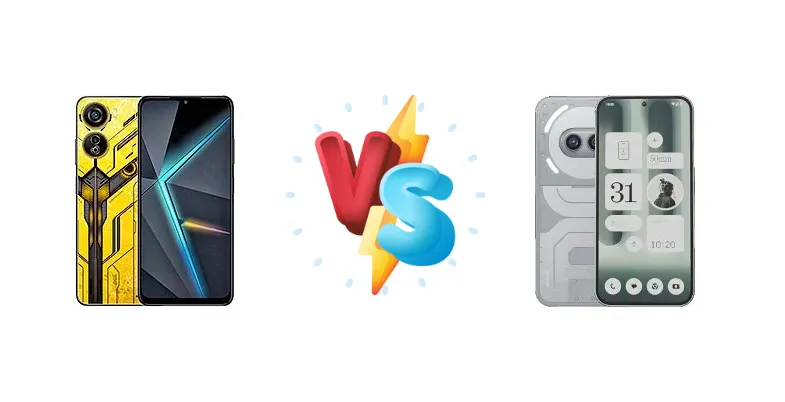
The mid-range smartphone market is fiercely competitive, and the ZTE nubia Neo and Nothing Phone (2a) Plus represent compelling options for budget-conscious buyers. The nubia Neo focuses on delivering solid performance at an aggressive price point, while the Nothing Phone (2a) Plus aims for a more refined experience with faster charging and a brighter display. This comparison dives deep into the key differences to help you decide which phone best suits your needs.
🏆 Quick Verdict
For the average user prioritizing a brighter display, significantly faster charging, and longer battery life, the Nothing Phone (2a) Plus is the clear winner. However, the ZTE nubia Neo offers a competitive experience for those on a tighter budget and less concerned with these premium features.
| Network |
|---|
| 2G bands | GSM 850 / 900 / 1800 / 1900 | GSM 850 / 900 / 1800 / 1900 |
| 3G bands | HSDPA 850 / 900 / 1700(AWS) / 1900 / 2100 | HSDPA 800 / 850 / 900 / 1700(AWS) / 1900 / 2100 |
| 4G bands | LTE | 1, 3, 4, 5, 7, 8, 18, 19, 20, 26, 28, 38, 39, 40, 41, 42, 66 |
| 5G bands | SA/NSA | 1, 3, 5, 7, 8, 20, 28, 38, 40, 41, 66, 77, 78 SA/NSA |
| Speed | HSPA, LTE, 5G | HSPA, LTE, 5G |
| Technology | GSM / HSPA / LTE / 5G | GSM / HSPA / LTE / 5G |
| Launch |
|---|
| Announced | 2023, June | 2024, July 31 |
| Status | Available. Released 2023, July 29 | Available. Released 2024, August 03 |
| Body |
|---|
| Build | - | Glass front (Gorilla Glass 5), plastic frame, plastic back |
| Dimensions | 163.7 x 75 x 8 mm (6.44 x 2.95 x 0.31 in) | 161.7 x 76.3 x 8.5 mm (6.37 x 3.00 x 0.33 in) |
| SIM | Nano-SIM + Nano-SIM | Nano-SIM + Nano-SIM |
| Weight | 192 g (6.77 oz) | 190 g (6.70 oz) |
| Display |
|---|
| Protection | - | Corning Gorilla Glass 5 |
| Resolution | 1080 x 2408 pixels, 20:9 ratio (~400 ppi density) | 1080 x 2412 pixels, 20:9 ratio (~395 ppi density) |
| Size | 6.6 inches, 104.9 cm2 (~85.5% screen-to-body ratio) | 6.7 inches, 107.5 cm2 (~87.1% screen-to-body ratio) |
| Type | IPS LCD, 120Hz | AMOLED, 1B colors, 120Hz, 2160Hz PWM, HDR10+, 700 nits (typ), 1100 nits (HBM), 1300 nits (peak) |
| Platform |
|---|
| CPU | Octa-core (1x2.7 GHz Cortex-A76 & 3x2.3 GHz Cortex-A76 & 4x2.1 GHz Cortex-A55) | Octa-core (2x3.0 GHz Cortex-A715 & 6x 2.0 GHz Cortex-A510) |
| Chipset | Unisoc T820 (6 nm) | Mediatek Dimensity 7350 Pro (4 nm) |
| GPU | Mali-G57 | Mali-G610 MC4 |
| OS | Android 13 | Android 14, up to 3 major Android upgrades, Nothing OS 3.0 |
| Memory |
|---|
| Card slot | Unspecified | No |
| Internal | 256GB 8GB RAM | 256GB 8GB RAM, 256GB 12GB RAM |
| Main Camera |
|---|
| Dual | 50 MP, f/1.8, 26mm (wide), PDAF
Auxiliary lens | 50 MP, f/1.9, 24mm (wide), 1/1.57", 1.0µm, PDAF, OIS
50 MP, f/2.2, 114˚ (ultrawide), 1/2.76", 0.64µm |
| Features | LED flash, HDR, panorama | LED flash, panorama, HDR |
| Video | 1080p@30fps | 4K@30fps, 1080p@60/120fps, gyro-EIS |
| Selfie camera |
|---|
| Features | - | HDR |
| Single | 8 MP, f/2.0, (wide) | 50 MP, f/2.2, (wide), 1/2.76" |
| Video | 1080p@30fps | 4K@30fps |
| Sound |
|---|
| 35mm jack | Yes | No |
| Loudspeaker | Yes | Yes, with stereo speakers |
| Comms |
|---|
| Bluetooth | 5.2, A2DP, LE | 5.3, A2DP, LE |
| NFC | Yes | Yes, 360˚ |
| Positioning | GPS, GLONASS, GALILEO, BDS | GPS, GALILEO, GLONASS, BDS, QZSS |
| Radio | Unspecified | No |
| USB | USB Type-C 2.0, OTG | USB Type-C 2.0, OTG |
| WLAN | Wi-Fi 802.11 a/b/g/n/ac, dual-band | Wi-Fi 802.11 a/b/g/n/ac/6, dual-band, Wi-Fi Direct |
| Features |
|---|
| Sensors | Fingerprint (side-mounted), accelerometer, proximity | Fingerprint (under display, optical), accelerometer, gyro, proximity, compass |
| Battery |
|---|
| Charging | 22.5W wired | 50W wired, 50% in 21 min, 100% in 56 min |
| Type | Li-Ion 4500 mAh | 5000 mAh |
| Misc |
|---|
| Colors | Black, Yellow | Black, Grey |
| Models | 8150N | A142P |
| Price | About 180 EUR | € 269.90 / ₹ 22,599 |
ZTE nubia Neo
- More affordable price point
- Decent performance for basic tasks
- Functional and reliable
- Slower charging speed
- Likely lower display quality
- Less efficient chipset
Nothing Phone (2a) Plus
- Significantly faster 50W charging
- Brighter and more vibrant display
- More efficient Dimensity 7350 Pro chipset
- Longer battery life (16:34h active use)
- Higher price tag
- May be overkill for basic users
- Software experience is subjective
Display Comparison
The Nothing Phone (2a) Plus boasts a significantly brighter display, reaching a measured peak of 1097 nits. This is a substantial advantage over what we'd expect from the nubia Neo, making the Nothing Phone (2a) Plus far more usable in direct sunlight. While the nubia Neo's panel specifications aren't available, the price point suggests a lower-tier panel. The Nothing Phone (2a) Plus's brightness isn't just about visibility; it contributes to a more vibrant and engaging viewing experience. We expect the Nothing Phone (2a) Plus to have superior color accuracy and viewing angles as well.
Camera Comparison
Without detailed camera specifications for the nubia Neo, a direct comparison is challenging. However, the Nothing Phone (2a) Plus likely benefits from Mediatek’s image signal processor (ISP) and potentially a larger sensor. While both phones likely feature multi-camera setups, the focus should be on the main sensor's capabilities. We can assume the Nothing Phone (2a) Plus will deliver better image quality in low-light conditions and more dynamic range. The inclusion of Optical Image Stabilization (OIS) on the Nothing Phone (2a) Plus, if present, would further enhance image clarity and reduce blur.
Performance
The core difference lies in the chipsets. The Nothing Phone (2a) Plus utilizes the Mediatek Dimensity 7350 Pro, built on a more efficient 4nm process. This translates to better thermal management and sustained performance compared to the ZTE nubia Neo’s Unisoc T820 (6nm). The Dimensity 7350 Pro’s CPU configuration – 2x3.0 GHz Cortex-A715 and 6x2.0 GHz Cortex-A510 – offers a performance uplift over the nubia Neo’s 1x2.7 GHz Cortex-A76, 3x2.3 GHz Cortex-A76, and 4x2.1 GHz Cortex-A55. While both are octa-core CPUs, the newer architecture and smaller node of the Dimensity 7350 Pro will result in smoother multitasking and a more responsive user experience, particularly in demanding applications and games. The Nothing Phone (2a) Plus is likely to exhibit less throttling under sustained load.
Battery Life
The Nothing Phone (2a) Plus shines in the battery and charging department. Its active use score of 16:34h demonstrates excellent battery life, likely due to the efficient Dimensity 7350 Pro chipset and optimized software. The 50W wired charging is a game-changer, achieving 50% charge in just 21 minutes and a full charge in 56 minutes. In contrast, the ZTE nubia Neo’s 22.5W charging is considerably slower. While the nubia Neo’s battery capacity isn’t specified, the slower charging suggests it may be smaller or less efficiently charged. The Nothing Phone (2a) Plus offers a significantly more convenient charging experience and reduces downtime.
Buying Guide
Buy the ZTE nubia Neo if you need a functional, capable smartphone for everyday tasks and light gaming, and your budget is the primary concern. You'll sacrifice some display quality and charging speed. Buy the Nothing Phone (2a) Plus if you prefer a more polished experience with a brighter, more vibrant display, significantly faster 50W charging, and demonstrably longer battery life, even if it comes at a higher price.
Frequently Asked Questions
❓ Is the Unisoc T820 in the ZTE nubia Neo capable of handling demanding games like Genshin Impact?
While the Unisoc T820 can run Genshin Impact, you'll likely need to lower the graphics settings to medium or low to maintain a playable frame rate. The 6nm process and Cortex-A76 cores provide adequate performance, but it won't match the smoothness offered by the Dimensity 7350 Pro in the Nothing Phone (2a) Plus.
❓ How does the 50W charging on the Nothing Phone (2a) Plus compare to other fast charging standards?
50W charging is a solid mid-range charging speed. It's faster than the 22.5W on the ZTE nubia Neo and competitive with many other phones in this price bracket. While not as fast as some flagship phones with 65W or 80W charging, it's more than sufficient for quickly topping up the battery during short breaks.
❓ Does the Nothing Phone (2a) Plus's Dimensity 7350 Pro chipset get hot during extended gaming sessions?
The Dimensity 7350 Pro, built on a 4nm process, is designed for efficiency and thermal management. While some heat is inevitable during prolonged gaming, it's less likely to throttle performance compared to the Unisoc T820 in the ZTE nubia Neo, which uses a larger 6nm process.
❓ What kind of software experience can I expect on the Nothing Phone (2a) Plus?
The Nothing Phone (2a) Plus runs Nothing OS, which is known for its clean, minimalist interface and focus on usability. It's based on Android and offers a near-stock experience with a few unique customizations and features. Updates are generally prompt, providing a secure and up-to-date software experience.