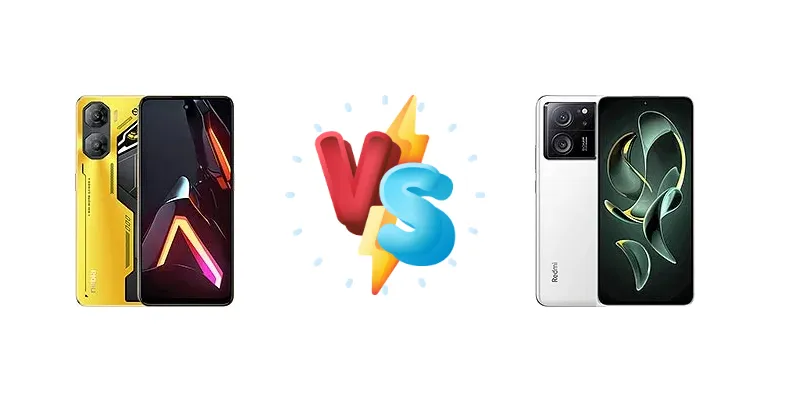
The mid-range smartphone market is fiercely competitive, and the ZTE nubia Neo 3 and Xiaomi Redmi K60 Ultra represent compelling options for budget-conscious buyers. The nubia Neo 3 focuses on maximizing battery life and offering solid performance at a lower price point, while the K60 Ultra prioritizes raw power and incredibly fast charging. This comparison dissects their key differences to help you choose the right device.
🏆 Quick Verdict
For the average user prioritizing speed and convenience, the Xiaomi Redmi K60 Ultra is the clear winner. Its Dimensity 9200+ chipset delivers significantly higher performance, and the 120W charging is a game-changer. However, the nubia Neo 3 offers exceptional battery endurance and represents a strong value proposition for those on a tighter budget.
| Network |
|---|
| 2G bands | GSM 850 / 900 / 1800 / 1900 | GSM 850 / 900 / 1800 / 1900 |
| 3G bands | HSDPA 850 / 900 / 1900 / 2100 | HSDPA 800 / 850 / 900 / 1700(AWS) / 2100 |
| 4G bands | LTE | 1, 3, 4, 5, 8, 18, 19, 26, 34, 38, 39, 40, 41, 42, 66 |
| 5G bands | SA/NSA | 1, 3, 5, 8, 28, 38, 41, 66, 77, 78 SA/NSA |
| Speed | HSPA, LTE, 5G | HSPA, LTE, 5G |
| Technology | GSM / HSPA / LTE / 5G | GSM / CDMA / HSPA / CDMA2000 / LTE / 5G |
| Launch |
|---|
| Announced | 2025, March 03 | 2023, August 15 |
| Status | Available. Released 2025, June | Available. Released 2023, August 15 |
| Body |
|---|
| Dimensions | 168.3 x 76.5 x 8.3 mm (6.63 x 3.01 x 0.33 in) | 162.2 x 75.7 x 8.5 mm (6.39 x 2.98 x 0.33 in) |
| SIM | Nano-SIM + Nano-SIM | Nano-SIM + Nano-SIM |
| Weight | - | 204 g (7.20 oz) |
| Display |
|---|
| Protection | Mohs level 4 | Unspecified |
| Resolution | 1080 x 2392 pixels (~386 ppi density) | 1220 x 2712 pixels, 20:9 ratio (~446 ppi density) |
| Size | 6.8 inches, 111.9 cm2 (~86.9% screen-to-body ratio) | 6.67 inches, 107.4 cm2 (~87.5% screen-to-body ratio) |
| Type | IPS LCD, 120Hz, 1000 nits (HBM) | OLED, 68B colors, 144Hz, Dolby Vision, HDR10+, 2600 nits (peak) |
| Platform |
|---|
| CPU | Octa-core (2x2.2 GHz Cortex-A78 & 6x2.0 GHz Cortex-A55) | Octa-core (1x3.35 GHz Cortex-X3 & 3x3.0 GHz Cortex-A715 & 4x2.0 GHz Cortex-A510) |
| Chipset | Unisoc T8300 (6 nm) | Mediatek Dimensity 9200+ (4 nm) |
| GPU | Mali-G57 MP2 | Immortalis-G715 MC11 |
| OS | Android 15 | Android 13, MIUI 14 |
| Memory |
|---|
| Card slot | No | No |
| Internal | 256GB 8GB RAM | 256GB 12GB RAM, 256GB 16GB RAM, 512GB 16GB RAM, 1TB 16GB RAM, 1TB 24GB RAM |
| Main Camera |
|---|
| Dual | 50 MP, f/1.8, (wide), PDAF
Auxiliary lens | - |
| Features | LED flash, HDR, panorama | Color spectrum sensor, Dual-LED dual-tone flash, HDR, panorama |
| Triple | - | 50 MP, f/1.7, (wide), 1/1.49", 1.0µm, PDAF, OIS
8 MP, 119˚ (ultrawide), 1/4.0", 1.12µm
2 MP (macro) |
| Video | 1080p@30fps | 8K@24fps, 4K@30/60fps, 1080p@30/60/120/240/960fps, gyro-EIS, HDR10+, 10-bit |
| Selfie camera |
|---|
| Features | - | HDR |
| Single | 16 MP, f/2.0, (wide) | 20 MP, (wide), 1/2.0", 0.8µm |
| Video | 1080p@30fps | 1080p@30/120fps |
| Sound |
|---|
| 35mm jack | No | No |
| Loudspeaker | Yes, with stereo speakers | Yes, with stereo speakers |
| Comms |
|---|
| Bluetooth | 5.4, A2DP, LE | 5.4, A2DP, LE |
| Infrared port | - | Yes |
| NFC | Yes (market/region dependent) | Yes |
| Positioning | GPS, GLONASS, GALILEO, BDS | GPS (L1+L5), GLONASS (G1), BDS (B1I+B1C+B2a+B2b), GALILEO (E1+E5a), QZSS (L1+L5), NavIC |
| Radio | Unspecified | Unspecified |
| USB | USB Type-C | USB Type-C, OTG |
| WLAN | Wi-Fi 802.11 a/b/g/n/ac, dual-band | Wi-Fi 802.11 a/b/g/n/ac/6e, dual-band, Wi-Fi Direct |
| Features |
|---|
| Sensors | Fingerprint (side-mounted), accelerometer, gyro, proximity, compass | Fingerprint (under display, optical), accelerometer, gyro, proximity, compass |
| Battery |
|---|
| Charging | 33W wired
Bypass Charging | 120W wired, PD3.0, 100% in 19 min |
| Type | 6000 mAh or 5000 mAh | Li-Po 5000 mAh |
| Misc |
|---|
| Colors | Shadow Black, Cyber Silver, Titanium Gold | Black, White, Green |
| Models | Z2464N | 23078RKD5C |
| Price | About 200 EUR | About 330 EUR |
| EU LABEL |
|---|
| Battery | 60:37h endurance, 800 cycles | - |
| Energy | Class A | - |
| Free fall | Class D (45 falls) | - |
| Repairability | Class B | - |
ZTE nubia Neo 3
- Exceptional battery life (60:37h endurance)
- Excellent value for money
- 800 charge cycles suggest long-term battery health
- Slower charging speed (33W)
- Less powerful processor compared to the K60 Ultra
Xiaomi Redmi K60 Ultra
- Blazing-fast 120W charging (0-100% in 19 minutes)
- Powerful Mediatek Dimensity 9200+ chipset
- Superior performance for gaming and demanding tasks
- Potentially shorter battery life compared to the nubia Neo 3
- Higher price point
Display Comparison
While display specifications are missing for the nubia Neo 3, the Redmi K60 Ultra’s focus is on performance, suggesting a standard, high-refresh-rate panel. The K60 Ultra benefits from the Dimensity 9200+'s image signal processor, potentially offering superior image quality. The nubia Neo 3, likely employing a more cost-effective display solution, will likely prioritize efficiency over visual fidelity.
Camera Comparison
Camera details are limited for both devices. However, given the K60 Ultra’s positioning, it likely features a more sophisticated camera system with a larger sensor and advanced image processing capabilities powered by the Dimensity 9200+. The Unisoc T8300 in the nubia Neo 3, while capable of handling basic photography, will likely struggle in low-light conditions and lack the advanced features found in the K60 Ultra. The absence of details suggests both phones likely prioritize other features over a flagship camera experience.
Performance
The performance gap between these two devices is substantial. The Xiaomi Redmi K60 Ultra’s Mediatek Dimensity 9200+ (4nm) chipset, featuring a Cortex-X3 prime core clocked at 3.35 GHz, significantly outperforms the ZTE nubia Neo 3’s Unisoc T8300 (6nm). The Dimensity 9200+’s more advanced architecture and smaller node size translate to higher clock speeds, improved efficiency, and superior graphics performance. The nubia Neo 3’s Cortex-A78 cores, while capable, are a generation behind and operate at a lower frequency (2.2 GHz). This difference will be most noticeable in demanding tasks like gaming and video editing.
Battery Life
The ZTE nubia Neo 3 boasts a remarkable 60:37h endurance rating, indicating exceptional battery life. While the exact battery capacity is unknown, the Unisoc T8300’s 6nm process contributes to its efficiency. The Redmi K60 Ultra, despite potentially having a smaller battery, compensates with its incredibly fast 120W wired charging, achieving a full charge in just 19 minutes. The nubia Neo 3’s 33W charging is considerably slower, requiring significantly more time to replenish the battery. This trade-off highlights the K60 Ultra’s focus on convenience, while the nubia Neo 3 prioritizes longevity.
Buying Guide
Buy the ZTE nubia Neo 3 if you need a phone that can reliably last through a full day and beyond, and if maximizing value for your money is paramount. It's ideal for users who prioritize battery life over peak performance. Buy the Xiaomi Redmi K60 Ultra if you prefer a snappy, responsive experience, demand the fastest possible charging speeds, and are willing to spend a bit more for a flagship-level processor.
Frequently Asked Questions
❓ Does the Unisoc T8300 in the nubia Neo 3 struggle with graphically intensive games like Genshin Impact?
While the Unisoc T8300 is a capable chip, it won't deliver the same level of performance as the Dimensity 9200+ in the Redmi K60 Ultra. Genshin Impact will likely be playable on medium settings, but expect frame drops and potential stuttering during intense combat scenarios. The K60 Ultra will provide a much smoother and more consistent gaming experience.
❓ How does the 120W charging on the Redmi K60 Ultra affect long-term battery health?
Xiaomi employs intelligent charging algorithms to mitigate the potential impact of fast charging on battery health. The phone dynamically adjusts the charging speed and voltage to minimize stress on the battery cells. While fast charging *can* contribute to faster degradation over time, Xiaomi's implementation aims to minimize this effect. The nubia Neo 3's slower 33W charging will theoretically result in slower degradation, but the difference may be negligible for most users.
❓ Is bypass charging on the nubia Neo 3 useful for gaming?
Yes, bypass charging is a valuable feature for gamers. It allows the phone to be powered directly from the charger while gaming, bypassing the battery and reducing heat buildup. This can help maintain consistent performance and prevent throttling during extended gaming sessions.