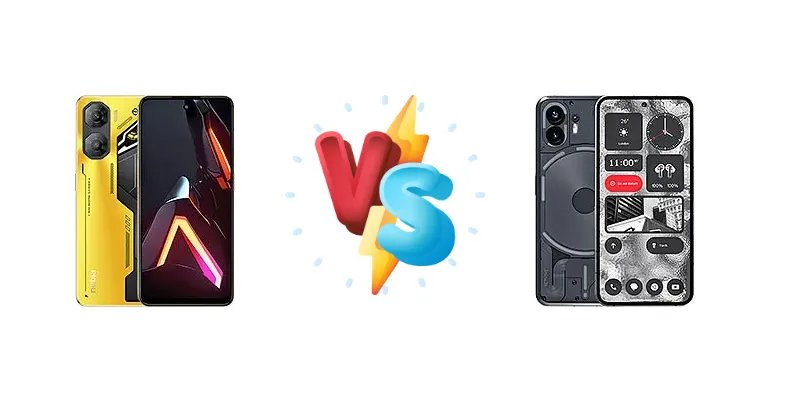
The ZTE nubia Neo 3 and Nothing Phone (2) represent distinct approaches to the mid-range smartphone market. The nubia Neo 3 aggressively targets gamers with a focus on battery life and sustained performance, while the Nothing Phone (2) aims for a more holistic premium experience with a unique design, faster charging, and a brighter display. This comparison dissects their key differences to help you choose the right device.
🏆 Quick Verdict
For the average user prioritizing a balanced experience with a premium feel, the Nothing Phone (2) is the better choice. However, gamers and those needing exceptional battery life will find the nubia Neo 3 a compelling option, offering impressive endurance at a lower price point.
| Network |
|---|
| 2G bands | GSM 850 / 900 / 1800 / 1900 | GSM 850 / 900 / 1800 / 1900 |
| 3G bands | HSDPA 850 / 900 / 1900 / 2100 | HSDPA 800 / 850 / 900 / 1700(AWS) / 1900 / 2100 |
| 4G bands | LTE | 1, 2, 3, 4, 5, 7, 8, 12, 17, 18, 19, 20, 25, 26, 28, 30, 32, 34, 38, 39, 40, 41, 42, 48, 66, 71 |
| 5G bands | SA/NSA | 1, 2, 3, 5, 7, 8, 12, 20, 25, 28, 30, 38, 40, 41, 66, 71, 75, 77, 78 SA/NSA |
| Speed | HSPA, LTE, 5G | HSPA, LTE, 5G |
| Technology | GSM / HSPA / LTE / 5G | GSM / HSPA / LTE / 5G |
| Launch |
|---|
| Announced | 2025, March 03 | 2023, July 11 |
| Status | Available. Released 2025, June | Available. Released 2023, July 17 |
| Body |
|---|
| Build | - | Glass front (Gorilla Glass 5), glass back (Gorilla Glass 5), aluminum frame |
| Dimensions | 168.3 x 76.5 x 8.3 mm (6.63 x 3.01 x 0.33 in) | 162.1 x 76.4 x 8.6 mm (6.38 x 3.01 x 0.34 in) |
| SIM | Nano-SIM + Nano-SIM | Nano-SIM + Nano-SIM |
| Weight | - | 201.2 g (7.09 oz) |
| Display |
|---|
| Protection | Mohs level 4 | Corning Gorilla Glass 5 |
| Resolution | 1080 x 2392 pixels (~386 ppi density) | 1080 x 2412 pixels, 20:9 ratio (~394 ppi density) |
| Size | 6.8 inches, 111.9 cm2 (~86.9% screen-to-body ratio) | 6.7 inches, 108.0 cm2 (~87.2% screen-to-body ratio) |
| Type | IPS LCD, 120Hz, 1000 nits (HBM) | LTPO OLED, 1B colors, 120Hz, 1920Hz PWM, HDR10+, 1600 nits (HBM), 1600 nits (peak) |
| Platform |
|---|
| CPU | Octa-core (2x2.2 GHz Cortex-A78 & 6x2.0 GHz Cortex-A55) | Octa-core (1x3.0 GHz Cortex-X2 & 3x2.5 GHz Cortex-A710 & 4x1.80 GHz Cortex-A510) |
| Chipset | Unisoc T8300 (6 nm) | Qualcomm SM8475 Snapdragon 8+ Gen 1 (4 nm) |
| GPU | Mali-G57 MP2 | Adreno 730 |
| OS | Android 15 | Android 13, upgradable to Android 15, up to 3 major Android upgrades, Nothing OS 3.0 |
| Memory |
|---|
| Card slot | No | No |
| Internal | 256GB 8GB RAM | 128GB 8GB RAM, 256GB 12GB RAM, 512GB 12GB RAM |
| Main Camera |
|---|
| Dual | 50 MP, f/1.8, (wide), PDAF
Auxiliary lens | 50 MP, f/1.9, 24mm (wide), 1/1.56", 1.0µm, PDAF, OIS
50 MP, f/2.2, 114˚ (ultrawide), 1/2.76", 0.64µm, AF |
| Features | LED flash, HDR, panorama | LED flash, panorama, HDR |
| Video | 1080p@30fps | 4K@30/60fps, 1080p@30/60fps, gyro-EIS, live HDR, OIS |
| Selfie camera |
|---|
| Features | - | HDR |
| Single | 16 MP, f/2.0, (wide) | 32 MP, f/2.5, (wide), 1/2.74", 0.8µm |
| Video | 1080p@30fps | 1080p@30fps |
| Sound |
|---|
| 35mm jack | No | No |
| Loudspeaker | Yes, with stereo speakers | Yes, with stereo speakers |
| Comms |
|---|
| Bluetooth | 5.4, A2DP, LE | 5.3, A2DP, LE, aptX HD, aptX Adaptive |
| NFC | Yes (market/region dependent) | Yes |
| Positioning | GPS, GLONASS, GALILEO, BDS | GPS (L1+L5), GLONASS (L1), BDS (B1I+B1c), GALILEO (E1), QZSS (L1), NavIC |
| Radio | Unspecified | No |
| USB | USB Type-C | USB Type-C 2.0, OTG |
| WLAN | Wi-Fi 802.11 a/b/g/n/ac, dual-band | Wi-Fi 802.11 a/b/g/n/ac/6, dual-band, Wi-Fi Direct |
| Features |
|---|
| Sensors | Fingerprint (side-mounted), accelerometer, gyro, proximity, compass | Fingerprint (under display, optical), accelerometer, proximity, gyro, compass |
| Battery |
|---|
| Charging | 33W wired
Bypass Charging | 45W wired, PD3.0, PPS, QC4, 100% in 55 min
15W wireless, 100% in 130 min
5W reverse wireless |
| Type | 6000 mAh or 5000 mAh | Li-Ion 4700 mAh |
| Misc |
|---|
| Colors | Shadow Black, Cyber Silver, Titanium Gold | White, Dark Gray |
| Models | Z2464N | A065 |
| Price | About 200 EUR | $ 379.99 / £ 370.00 |
| EU LABEL |
|---|
| Battery | 60:37h endurance, 800 cycles | - |
| Energy | Class A | - |
| Free fall | Class D (45 falls) | - |
| Repairability | Class B | - |
ZTE nubia Neo 3
- Exceptional battery life (60:37h endurance)
- High battery cycle count (800 cycles)
- Bypass charging reduces heat during use
- More affordable price point
- Less powerful processor (Unisoc T8300)
- Likely dimmer display
- Less sophisticated camera system
Nothing Phone (2)
- Flagship-level performance (Snapdragon 8+ Gen 1)
- Brighter display (998 nits)
- Faster charging (45W wired, 15W wireless)
- More versatile camera system
- Shorter battery life (14:21h active use)
- Higher price
- Potentially more thermal throttling under sustained load
Display Comparison
The Nothing Phone (2) boasts a significantly brighter display, reaching a measured peak of 998 nits, making it far more usable outdoors under direct sunlight. While the nubia Neo 3’s display specs are not provided, it’s likely to be considerably dimmer. The Nothing Phone (2)'s panel likely utilizes LTPO technology, enabling variable refresh rates for improved power efficiency, a feature absent in the nubia Neo 3. This brightness advantage benefits content consumption and overall visibility.
Camera Comparison
The Nothing Phone (2) offers a more comprehensive camera system, though specific details are limited to 'Photo / Video' capabilities. The Snapdragon 8+ Gen 1’s ISP (Image Signal Processor) is far more advanced than the one found in the Unisoc T8300, enabling better image processing, dynamic range, and low-light performance. While the nubia Neo 3 may offer acceptable image quality in good lighting conditions, the Nothing Phone (2) is expected to deliver consistently better results across various scenarios. The absence of details regarding the nubia Neo 3’s sensor size and aperture suggests a less sophisticated camera setup.
Performance
The core difference lies in the chipsets. The Nothing Phone (2) is powered by the Qualcomm Snapdragon 8+ Gen 1 (4nm), a flagship-level processor featuring an octa-core configuration with a Cortex-X2 prime core clocked at 3.0 GHz. This is a substantial leap over the Unisoc T8300 (6nm) in the nubia Neo 3, which utilizes a Cortex-A78 based architecture. The Snapdragon 8+ Gen 1’s superior architecture and smaller node size translate to significantly higher CPU and GPU performance, and better thermal efficiency, reducing throttling during demanding tasks. The nubia Neo 3 will handle everyday tasks well, but the Nothing Phone (2) will excel in graphically intensive games and multitasking.
Battery Life
The nubia Neo 3 shines in battery endurance, achieving a remarkable 60:37h rating and supporting 800 charge cycles, indicating long-term battery health. The Nothing Phone (2), with an older endurance rating of 103h and an active use score of 14:21h, falls short in raw longevity. However, the Nothing Phone (2) compensates with significantly faster charging: 45W wired (100% in 55 minutes), 15W wireless (100% in 130 minutes), and 5W reverse wireless. The nubia Neo 3’s 33W charging is slower, and lacks wireless charging options. The nubia Neo 3’s bypass charging feature is a plus, allowing for direct power from the charger while the battery charges, reducing heat generation.
Buying Guide
Buy the ZTE nubia Neo 3 if you need a phone that can last through extended gaming sessions and multiple days of moderate use, and if maximizing battery life is your top priority. Buy the Nothing Phone (2) if you prefer a more refined design, a brighter and more vibrant display, faster charging speeds (including wireless), and a more versatile camera system, even if it means sacrificing some battery endurance.
Frequently Asked Questions
❓ Does the Unisoc T8300 in the nubia Neo 3 struggle with demanding games like Genshin Impact?
While the Unisoc T8300 is capable of running Genshin Impact, you'll likely need to lower graphics settings to achieve a consistently smooth frame rate. The Snapdragon 8+ Gen 1 in the Nothing Phone (2) will handle Genshin Impact at higher settings with less performance compromise.
❓ How does the Nothing Phone (2)'s 45W charging compare to other phones in its price range?
45W charging is relatively fast for this price segment. It's significantly quicker than the nubia Neo 3's 33W charging and on par with many flagship devices. The addition of 15W wireless charging is a unique advantage the nubia Neo 3 doesn't offer.
❓ Is the Nothing Phone (2)'s Glyph Interface a practical feature, or just a gimmick?
The Glyph Interface is largely a matter of personal preference. It can be customized for notifications and visual cues, but its utility is limited. It's a defining aesthetic feature of the Nothing Phone (2) but doesn't significantly impact core functionality.
❓ How will the nubia Neo 3's 800 charge cycles affect the battery's long-term health?
800 charge cycles is a substantial number, indicating the battery is designed for longevity. It suggests the battery will retain a significant portion of its capacity even after extended use, potentially outlasting the battery in the Nothing Phone (2).