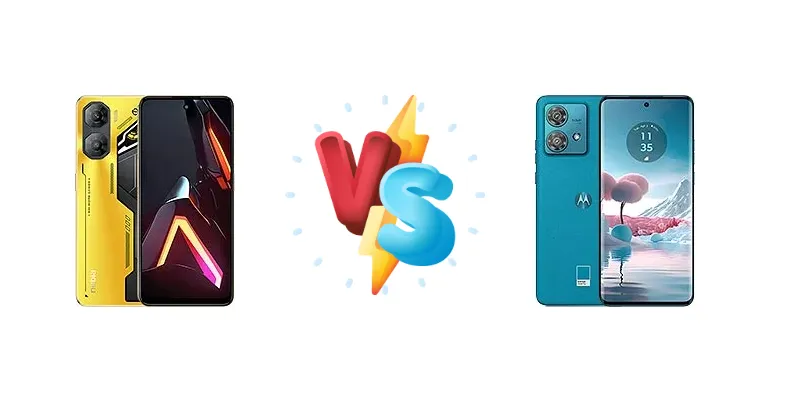
The ZTE nubia Neo 3 and Motorola Edge 40 Neo represent compelling options in the increasingly competitive sub-$300 smartphone market. The nubia Neo 3 aggressively targets gamers with its focus on sustained performance, while the Motorola Edge 40 Neo aims for a more balanced experience with a premium display and faster charging. This comparison dissects their key differences to determine which device best suits your needs.
🏆 Quick Verdict
For the average user prioritizing a vibrant display and rapid charging, the Motorola Edge 40 Neo is the stronger choice. Its 68W charging and 1073 nit peak brightness offer a more refined experience. However, the nubia Neo 3’s exceptional battery endurance and potentially lower price make it ideal for heavy users and gamers who prioritize longevity.
| Network |
|---|
| 2G bands | GSM 850 / 900 / 1800 / 1900 | GSM 850 / 900 / 1800 / 1900 |
| 3G bands | HSDPA 850 / 900 / 1900 / 2100 | HSDPA 800 / 850 / 900 / 1700(AWS) / 1900 / 2100 |
| 4G bands | LTE | 1, 2, 3, 4, 5, 7, 8, 12, 13, 17, 18, 19, 20, 25, 26, 28, 32, 38, 38, 39, 40, 41, 42, 43, 48, 66 |
| 5G bands | SA/NSA | 1, 2, 3, 5, 7, 8, 20, 28, 38, 40, 41, 66, 77, 78 SA/NSA |
| Speed | HSPA, LTE, 5G | HSPA, LTE, 5G |
| Technology | GSM / HSPA / LTE / 5G | GSM / HSPA / LTE / 5G |
| Launch |
|---|
| Announced | 2025, March 03 | 2023, September 14 |
| Status | Available. Released 2025, June | Available. Released 2023, September 14 |
| Body |
|---|
| Build | - | Glass front (Gorilla Glass 3), plastic frame, plastic back |
| Dimensions | 168.3 x 76.5 x 8.3 mm (6.63 x 3.01 x 0.33 in) | 159.6 x 72 x 7.9 mm (6.28 x 2.83 x 0.31 in) |
| SIM | Nano-SIM + Nano-SIM | · Nano-SIM + eSIM· Nano-SIM + Nano-SIM |
| Weight | - | 170 g or 172 g (6.00 oz) |
| Display |
|---|
| Protection | Mohs level 4 | Corning Gorilla Glass 3 |
| Resolution | 1080 x 2392 pixels (~386 ppi density) | 1080 x 2400 pixels, 20:9 ratio (~402 ppi density) |
| Size | 6.8 inches, 111.9 cm2 (~86.9% screen-to-body ratio) | 6.55 inches, 103.6 cm2 (~90.1% screen-to-body ratio) |
| Type | IPS LCD, 120Hz, 1000 nits (HBM) | P-OLED, 1B colors, 144Hz, HDR10+, 1300 nits (peak) |
| Platform |
|---|
| CPU | Octa-core (2x2.2 GHz Cortex-A78 & 6x2.0 GHz Cortex-A55) | Octa-core (2x2.5 GHz Cortex-A78 & 6x2.0 GHz Cortex-A55) |
| Chipset | Unisoc T8300 (6 nm) | MediaTek Dimensity 7030 (6 nm) |
| GPU | Mali-G57 MP2 | Mali-G610 MC3 |
| OS | Android 15 | Android 13, up to 2 major Android upgrades |
| Memory |
|---|
| Card slot | No | No |
| Internal | 256GB 8GB RAM | 128GB 8GB RAM, 256GB 8GB RAM, 256GB 12GB RAM |
| Main Camera |
|---|
| Dual | 50 MP, f/1.8, (wide), PDAF
Auxiliary lens | 50 MP, f/1.8, (wide), 1/1.55", 1.0µm, multi-directional PDAF, OIS
13 MP, f/2.2, 120˚ (ultrawide), 1/3.0", 1.12µm, PDAF |
| Features | LED flash, HDR, panorama | LED flash, HDR, panorama |
| Video | 1080p@30fps | 4K@30fps, 1080p@30/60/120/240fps, gyro-EIS |
| Selfie camera |
|---|
| Features | - | HDR |
| Single | 16 MP, f/2.0, (wide) | 32 MP, f/2.4, (wide), 1/3.0", 0.7µm |
| Video | 1080p@30fps | 4K@30fps, 1080p@30fps |
| Sound |
|---|
| 35mm jack | No | No |
| Loudspeaker | Yes, with stereo speakers | Yes, with stereo speakers |
| Comms |
|---|
| Bluetooth | 5.4, A2DP, LE | 5.4, A2DP, LE |
| NFC | Yes (market/region dependent) | Yes |
| Positioning | GPS, GLONASS, GALILEO, BDS | GPS, GLONASS, GALILEO |
| Radio | Unspecified | No |
| USB | USB Type-C | USB Type-C 2.0, OTG |
| WLAN | Wi-Fi 802.11 a/b/g/n/ac, dual-band | Wi-Fi 802.11 a/b/g/n/ac/6e, tri-band, Wi-Fi Direct |
| Features |
|---|
| Sensors | Fingerprint (side-mounted), accelerometer, gyro, proximity, compass | Fingerprint (under display, optical), accelerometer, gyro, proximity, compass |
| Battery |
|---|
| Charging | 33W wired
Bypass Charging | 68W wired, 50% in 15 min |
| Type | 6000 mAh or 5000 mAh | Li-Po 5000 mAh |
| Misc |
|---|
| Colors | Shadow Black, Cyber Silver, Titanium Gold | Black, Soothing Sea, Caneel Bay, Peach Fuzz |
| Models | Z2464N | XT2307-1 |
| Price | About 200 EUR | $ 299.00 / € 168.73 / ₹ 19,900 |
| EU LABEL |
|---|
| Battery | 60:37h endurance, 800 cycles | - |
| Energy | Class A | - |
| Free fall | Class D (45 falls) | - |
| Repairability | Class B | - |
ZTE nubia Neo 3
- Exceptional battery life (60:37h endurance)
- High charge cycle count (800 cycles)
- Bypass charging for reduced battery degradation
- Slower charging speed (33W)
- Limited display information suggests lower brightness
Motorola Edge 40 Neo
- Fast 68W charging (50% in 15 minutes)
- Bright and color-accurate display (1073 nits)
- More powerful chipset (Dimensity 7030)
- Shorter battery life (10:28h active use)
- Lower charge cycle count (unspecified)
Display Comparison
The Motorola Edge 40 Neo boasts a significant advantage in display quality, achieving a measured peak brightness of 1073 nits. This translates to excellent visibility outdoors, a feature absent from the nubia Neo 3’s specifications. While the nubia Neo 3’s panel details are unavailable, the Edge 40 Neo’s brightness and likely superior color calibration (based on Motorola’s track record) make it the clear winner for media consumption and general usability. The absence of LTPO technology on either device suggests neither offers adaptive refresh rates for power saving.
Camera Comparison
Camera details for the nubia Neo 3 are sparse, making a direct comparison challenging. The Motorola Edge 40 Neo’s camera system, while not flagship-level, likely offers a more versatile experience. Focusing on the main sensors, the Edge 40 Neo’s image processing capabilities, typical of Motorola, prioritize natural-looking images. The absence of detailed camera specs for the nubia Neo 3 suggests it may lean towards a more budget-oriented approach, potentially sacrificing image quality in challenging lighting conditions. We can assume the nubia Neo 3 will have a lower quality sensor and image processing pipeline.
Performance
Both devices utilize octa-core CPUs with a similar core configuration (2x Cortex-A78 & 6x Cortex-A55), but the Motorola Edge 40 Neo’s MediaTek Dimensity 7030, clocked at 2.5 GHz, offers a slight edge over the nubia Neo 3’s Unisoc T8300 (2.2 GHz). Both chipsets are fabricated on a 6nm process, suggesting comparable efficiency. However, the Dimensity 7030 generally demonstrates better GPU performance, benefiting gaming and graphically intensive tasks. The nubia Neo 3’s focus on gaming may rely on optimized software and thermal management to sustain performance, but the Edge 40 Neo has a raw processing advantage.
Battery Life
The ZTE nubia Neo 3 shines in battery endurance, boasting a 60:37h rating and 800 charge cycles, indicating exceptional longevity. This contrasts with the Motorola Edge 40 Neo’s active use score of 10:28h and an older endurance rating of 80h. While the Edge 40 Neo’s 68W charging (50% in 15 minutes) is significantly faster than the nubia Neo 3’s 33W charging, the nubia Neo 3’s larger battery capacity and superior endurance provide a substantial advantage for users who prioritize all-day (or multi-day) battery life. The nubia Neo 3 also features bypass charging, which can help reduce battery degradation during extended use.
Buying Guide
Buy the ZTE nubia Neo 3 if you need maximum battery life and prioritize sustained gaming performance over all else, and are comfortable with a less polished overall experience. Buy the Motorola Edge 40 Neo if you prefer a brighter, more color-accurate display, significantly faster charging, and a more balanced feature set for everyday use and casual gaming.
Frequently Asked Questions
❓ Does the Unisoc T8300 in the nubia Neo 3 struggle with demanding games like Genshin Impact?
While the Unisoc T8300 is a capable chipset, demanding titles like Genshin Impact may require reduced graphics settings to maintain a stable frame rate. The nubia Neo 3’s focus on sustained performance suggests it may handle thermal throttling better than some competitors, but it won't match the raw power of the Dimensity 7030.
❓ How does the 68W charging on the Motorola Edge 40 Neo compare to other phones in this price range?
68W charging is exceptionally fast for this price segment. It allows for a 50% charge in just 15 minutes, significantly reducing downtime compared to the nubia Neo 3’s 33W charging. This makes the Edge 40 Neo ideal for users who need a quick power boost.
❓ Is the Motorola Edge 40 Neo's camera good enough for social media content creation?
Yes, the Motorola Edge 40 Neo’s camera is well-suited for social media. Motorola’s image processing typically produces vibrant and shareable photos. While it may not compete with flagship cameras, it offers a solid experience for everyday photography and videography.
❓ Will the nubia Neo 3's battery degrade quickly with frequent use, despite the 800 charge cycle claim?
The 800 charge cycle claim is a strong indicator of long-term battery health. However, degradation will still occur over time. The inclusion of bypass charging helps mitigate this by reducing heat buildup during extended gaming or charging sessions, potentially extending the battery's lifespan.