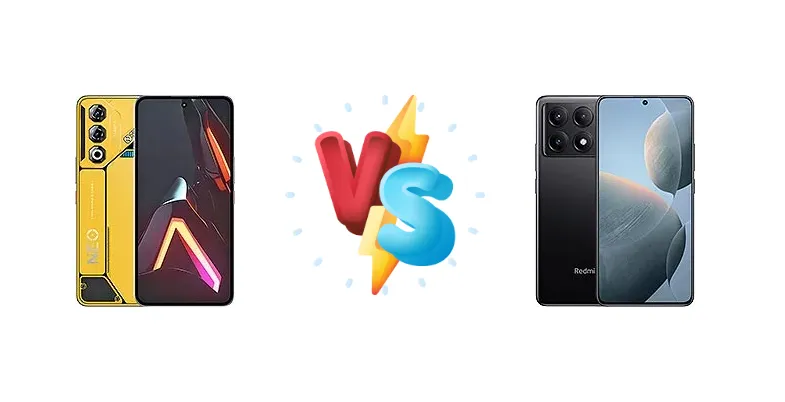
The ZTE nubia Neo 3 GT and Xiaomi Redmi K70E represent compelling options in the increasingly competitive mid-range smartphone market. While both aim to deliver a strong gaming experience, they take distinctly different approaches to achieving it – the nubia focusing on aggressive value with a Unisoc chipset, and the Redmi leveraging MediaTek’s newer Dimensity 8300 Ultra. This comparison dissects their key differences to determine which phone best suits your needs.
🏆 Quick Verdict
For the average user prioritizing overall performance and future-proofing, the Xiaomi Redmi K70E emerges as the stronger choice. Its Dimensity 8300 Ultra, built on a 4nm process, offers a significant performance and efficiency advantage over the nubia Neo 3 GT’s Unisoc T9100, justifying the slight price premium.
| Network |
|---|
| 2G bands | GSM 850 / 900 / 1800 / 1900 | GSM 850 / 900 / 1800 / 1900 |
| 3G bands | HSDPA 850 / 900 / 1900 / 2100 | HSDPA 800 / 850 / 900 / 1700(AWS) / 2100 |
| 4G bands | LTE | 1, 3, 4, 5, 8, 18, 19, 26, 28, 34, 38, 39, 40, 41, 42, 48, 66 |
| 5G bands | SA/NSA | 1, 3, 5, 8, 28, 38, 41, 48, 66, 77, 78 SA/NSA |
| Speed | HSPA, LTE, 5G | HSPA, LTE, 5G |
| Technology | GSM / HSPA / LTE / 5G | GSM / CDMA / HSPA / CDMA2000 / LTE / 5G |
| Launch |
|---|
| Announced | 2025, March 03 | 2023, November 29 |
| Status | Available. Released 2025, June | Available. Released 2023, November 29 |
| Body |
|---|
| Dimensions | 163.3 x 77.2 x 8.2 mm (6.43 x 3.04 x 0.32 in) | 160.5 x 74.3 x 8.1 mm (6.32 x 2.93 x 0.32 in) |
| SIM | Nano-SIM + Nano-SIM | Nano-SIM + Nano-SIM |
| Weight | - | 198 g (6.98 oz) |
| Display |
|---|
| Resolution | 1080 x 2392 pixels (~386 ppi density) | 1220 x 2712 pixels, 20:9 ratio (~446 ppi density) |
| Size | 6.8 inches, 111.9 cm2 (~88.8% screen-to-body ratio) | 6.67 inches, 107.4 cm2 (~90.1% screen-to-body ratio) |
| Type | AMOLED, 120Hz, 1300 nits (peak) | OLED, 68B colors, 120Hz, Dolby Vision, HDR10+, 1800 nits (peak) |
| Platform |
|---|
| CPU | Octa-core (1x2.7 GHz Cortex-A76 & 3x2.3 GHz Cortex-A76 & 4x2.1 GHz Cortex-A55) | Octa-core (1x3.35 GHz Cortex-A715 & 3x3.20 GHz Cortex-A715 & 4x2.20 GHz Cortex-A510) |
| Chipset | Unisoc T9100 (6 nm) | Mediatek Dimensity 8300 Ultra (4 nm) |
| GPU | Mali-G57 | Mali G615-MC6 |
| OS | Android 15 | Android 14, HyperOS |
| Memory |
|---|
| Card slot | No | No |
| Internal | 256GB 12GB RAM | 256GB 8GB RAM, 256GB 12GB RAM, 512GB 12GB RAM, 1TB 16GB RAM |
| Main Camera |
|---|
| Dual | 50 MP, (wide), PDAF
Auxiliary lens | - |
| Features | LED flash, HDR, panorama | LED flash, HDR, panorama |
| Triple | - | 64 MP, (wide), 1/2.0", PDAF, OIS
8 MP, 120˚, (ultrawide)
2 MP (macro) |
| Video | Yes | 4K@24/30fps, 1080p@30/60/120/240/960fps, 720p@1920fps, gyro-EIS |
| Selfie camera |
|---|
| Features | - | HDR, panorama |
| Single | 16 MP | 16 MP, (wide) |
| Video | 1080p@30fps | 1080p@30/60fps, gyro-EIS |
| Sound |
|---|
| 35mm jack | No | No |
| Loudspeaker | Yes, with stereo speakers | Yes, with stereo speakers |
| Comms |
|---|
| Bluetooth | 5.4, A2DP, LE | 5.4, A2DP, LE |
| Infrared port | - | Yes |
| NFC | Yes (market/region dependent) | Yes |
| Positioning | GPS, GLONASS, GALILEO, BDS | GPS, GALILEO, GLONASS, QZSS, BDS (B1I+B1c) |
| Radio | Unspecified | No |
| USB | USB Type-C | USB Type-C, OTG |
| WLAN | Wi-Fi 802.11 a/b/g/n/ac, dual-band | Wi-Fi 802.11 a/b/g/n/ac/6, dual-band, Wi-Fi Direct |
| Features |
|---|
| Sensors | Fingerprint (under display, optical), accelerometer, gyro, compass, proximity | Fingerprint (under display, optical), accelerometer, proximity, gyro, compass |
| Battery |
|---|
| Charging | 80W wired
Bypass Charging | 90W wired, PD3.0, QC2, 100% in 34 min |
| Type | 6000 mAh or 5000 mAh | Li-Po 5500 mAh |
| Misc |
|---|
| Colors | Electro Yellow, Interstellar Gray, White | Black, White, Mint |
| Models | - | 2311DRK48C |
| Price | € 249.00 | About 260 EUR |
ZTE nubia Neo 3 GT
- Aggressive pricing makes it very accessible.
- 80W fast charging is still very quick.
- Unisoc T9100 offers decent performance for the price.
- Unisoc T9100 is less efficient than the Dimensity 8300 Ultra.
- Likely compromises in display and camera quality to meet price point.
Xiaomi Redmi K70E
- Dimensity 8300 Ultra delivers superior performance and efficiency.
- 90W fast charging is faster than the nubia.
- Likely better display and camera quality.
- Higher price point than the nubia Neo 3 GT.
- May not represent the absolute best value for extremely budget-conscious buyers.
Display Comparison
Neither device’s display specifications are provided, so a direct comparison is limited. However, given the Redmi K70E’s positioning, it likely features a higher-quality panel with potentially better color accuracy and peak brightness. The nubia Neo 3 GT, aiming for a lower price point, may utilize a more cost-effective display solution. Expect both to offer high refresh rates suitable for gaming, but the Redmi likely benefits from more advanced display calibration.
Camera Comparison
Without detailed camera specifications, it’s difficult to make a definitive judgment. However, Xiaomi generally invests more heavily in camera technology than ZTE. It’s reasonable to assume the Redmi K70E will offer a more versatile and capable camera system, potentially with a larger main sensor and more sophisticated image processing algorithms. The nubia Neo 3 GT will likely focus on providing a functional camera experience to keep costs down.
Performance
The core difference lies in the chipsets. The Xiaomi Redmi K70E’s MediaTek Dimensity 8300 Ultra (4nm) is a clear step up from the ZTE nubia Neo 3 GT’s Unisoc T9100 (6nm). The 4nm fabrication process of the Dimensity 8300 Ultra translates to superior power efficiency and reduced thermal throttling during sustained workloads like gaming. The Dimensity 8300 Ultra’s CPU configuration – 1x3.35 GHz Cortex-A715 & 3x3.20 GHz Cortex-A715 & 4x2.20 GHz Cortex-A510 – also boasts newer core designs compared to the nubia’s 1x2.7 GHz Cortex-A76 & 3x2.3 GHz Cortex-A76 & 4x2.1 GHz Cortex-A55. This architectural advantage will be noticeable in both single-core and multi-core performance, benefiting everything from app loading times to demanding games.
Battery Life
Both phones offer fast charging, with the Redmi K70E taking a slight lead at 90W versus the nubia Neo 3 GT’s 80W. The Redmi K70E claims a full charge in 34 minutes, while the nubia’s charging time is unspecified. The Dimensity 8300 Ultra’s superior efficiency also means the Redmi K70E will likely exhibit better battery life under similar usage conditions. While battery capacity isn’t specified, the efficiency gains of the 4nm process will be more impactful than a minor difference in mAh.
Buying Guide
Buy the ZTE nubia Neo 3 GT if you need a highly affordable gaming phone and are comfortable with a slightly less refined software experience. Its 80W charging and focus on value make it ideal for budget-conscious gamers. Buy the Xiaomi Redmi K70E if you prefer a more powerful and efficient processor, faster charging speeds (90W), and a generally more polished user experience, even if it means spending a bit more.
Frequently Asked Questions
❓ Will the Unisoc T9100 in the nubia Neo 3 GT struggle with graphically demanding games like Genshin Impact?
The Unisoc T9100 is capable of running Genshin Impact, but you’ll likely need to lower the graphics settings to achieve a consistently smooth frame rate. The Dimensity 8300 Ultra in the Redmi K70E will provide a significantly better experience, allowing for higher settings and more stable performance.
❓ How much faster is the 90W charging on the Redmi K70E compared to the 80W charging on the nubia Neo 3 GT in real-world use?
While both are fast, the Redmi K70E’s 90W charging will shave off approximately 10-15 minutes from a full 0-100% charge, as advertised with its 34-minute claim. This difference is most noticeable when topping up the battery quickly during short breaks.
❓ Does the Dimensity 8300 Ultra in the Redmi K70E offer any advantages for long-term software support?
Generally, MediaTek’s flagship and ultra-class chipsets receive longer software support from manufacturers compared to mid-range Unisoc chips. While specific update policies vary, the Redmi K70E is more likely to receive more Android version updates and security patches over its lifespan.