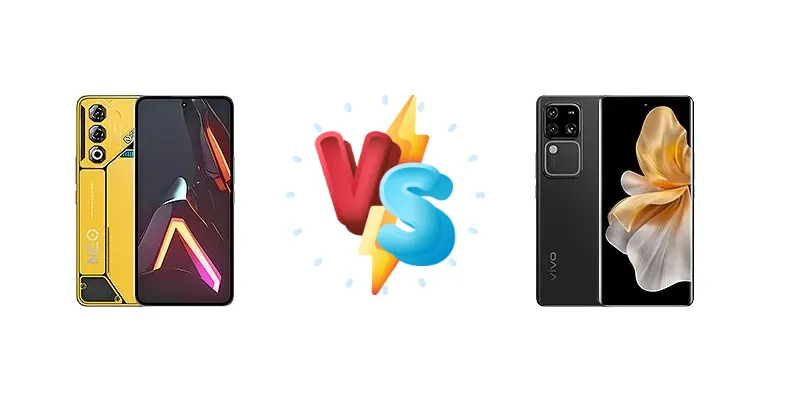
The ZTE nubia Neo 3 GT and vivo S18 Pro represent distinct approaches to the mid-range smartphone market. The nubia Neo 3 GT aggressively targets gamers with a focus on raw processing power and fast charging, while the vivo S18 Pro aims for a more balanced experience with a premium chipset and refined features. This comparison dissects their strengths and weaknesses to help you choose the right device.
🏆 Quick Verdict
For the average user prioritizing a smooth, all-around experience, the vivo S18 Pro is the better choice. Its Mediatek Dimensity 9200+ chipset delivers superior performance and efficiency, while the nubia Neo 3 GT excels specifically for demanding mobile gamers seeking maximum frame rates.
| Network |
|---|
| 2G bands | GSM 850 / 900 / 1800 / 1900 | GSM 850 / 900 / 1800 / 1900 |
| 3G bands | HSDPA 850 / 900 / 1900 / 2100 | HSDPA 850 / 900 / 1700(AWS) / 1900 / 2100 |
| 4G bands | LTE | 1, 3, 4, 5, 7, 8, 18, 19, 26, 28, 34, 38, 39, 40, 41 |
| 5G bands | SA/NSA | 1, 3, 5, 8, 28, 38, 40, 41, 77, 78 SA/NSA |
| Speed | HSPA, LTE, 5G | HSPA, LTE, 5G |
| Technology | GSM / HSPA / LTE / 5G | GSM / CDMA / HSPA / CDMA2000 / LTE / 5G |
| Launch |
|---|
| Announced | 2025, March 03 | 2023, December 14 |
| Status | Available. Released 2025, June | Available. Released 2023, January 13 |
| Body |
|---|
| Build | - | Glass front, plastic frame |
| Dimensions | 163.3 x 77.2 x 8.2 mm (6.43 x 3.04 x 0.32 in) | 164.4 x 75.1 x 7.5 mm (6.47 x 2.96 x 0.30 in) |
| SIM | Nano-SIM + Nano-SIM | Nano-SIM + Nano-SIM |
| Weight | - | 188 g (6.63 oz) |
| Display |
|---|
| Resolution | 1080 x 2392 pixels (~386 ppi density) | 1260 x 2800 pixels, 20:9 ratio (~453 ppi density) |
| Size | 6.8 inches, 111.9 cm2 (~88.8% screen-to-body ratio) | 6.78 inches, 111.0 cm2 (~89.9% screen-to-body ratio) |
| Type | AMOLED, 120Hz, 1300 nits (peak) | AMOLED, 1B colors, 120Hz, 2800 nits (peak) |
| Platform |
|---|
| CPU | Octa-core (1x2.7 GHz Cortex-A76 & 3x2.3 GHz Cortex-A76 & 4x2.1 GHz Cortex-A55) | Octa-core (1x3.35 GHz Cortex-X3 & 3x3.0 GHz Cortex-A715 & 4x2.0 GHz Cortex-A510) |
| Chipset | Unisoc T9100 (6 nm) | Mediatek Dimensity 9200+ (4 nm) |
| GPU | Mali-G57 | Immortalis-G715 MC11 |
| OS | Android 15 | Android 14, OriginOS 4 |
| Memory |
|---|
| Card slot | No | No |
| Internal | 256GB 12GB RAM | 256GB 12GB RAM, 256GB 16GB RAM, 512GB 16GB RAM |
| Main Camera |
|---|
| Dual | 50 MP, (wide), PDAF
Auxiliary lens | - |
| Features | LED flash, HDR, panorama | Ring-LED flash, panorama, HDR |
| Triple | - | 50 MP, f/1.9, (wide), 1/1.49", PDAF, OIS
12 MP, f/2.0, (telephoto), PDAF, 2x optical zoom
50 MP, f/2.0, (ultrawide), 1/2.76" |
| Video | Yes | 4K@30fps, 1080p@30fps |
| Selfie camera |
|---|
| Features | - | Dual-LED flash, HDR |
| Single | 16 MP | 50 MP, f/2.0, 22mm (wide), AF |
| Video | 1080p@30fps | 4K@30fps, 1080p@30fps |
| Sound |
|---|
| 35mm jack | No | No |
| Loudspeaker | Yes, with stereo speakers | Yes |
| Comms |
|---|
| Bluetooth | 5.4, A2DP, LE | 5.3, A2DP, LE, aptX HD |
| NFC | Yes (market/region dependent) | Yes |
| Positioning | GPS, GLONASS, GALILEO, BDS | GPS (L1+L5), GLONASS, BDS (B1I+B1c+B2a), GALILEO (E1+E5a), QZSS (L1+L5), NavIC (L5) |
| Radio | Unspecified | No |
| USB | USB Type-C | USB Type-C 2.0, OTG |
| WLAN | Wi-Fi 802.11 a/b/g/n/ac, dual-band | Wi-Fi 802.11 a/b/g/n/ac/6/7, dual-band, Wi-Fi Direct |
| Features |
|---|
| Sensors | Fingerprint (under display, optical), accelerometer, gyro, compass, proximity | Fingerprint (under display, optical), accelerometer, gyro, proximity, compass |
| Battery |
|---|
| Charging | 80W wired
Bypass Charging | 80W wired, PD
Reverse wired |
| Type | 6000 mAh or 5000 mAh | 5000 mAh |
| Misc |
|---|
| Colors | Electro Yellow, Interstellar Gray, White | Black, Blue, Silver |
| Models | - | V2344A |
| Price | € 249.00 | About 410 EUR |
ZTE nubia Neo 3 GT
- Aggressive gaming performance
- 80W Bypass Charging for gaming
- Potentially lower price point
- Less efficient Unisoc T9100 chipset
- Likely compromises in camera quality
- Less refined software experience
vivo S18 Pro
- Superior performance with Dimensity 9200+
- More efficient 4nm process
- Likely better camera system
- Potentially higher price
- May not match nubia's gaming-specific features
Display Comparison
While both devices likely feature LCD panels given their price points, specific details like resolution and refresh rate are missing. However, the core difference lies in the processing power driving them. The vivo S18 Pro’s Dimensity 9200+ benefits from a more advanced display pipeline, potentially enabling smoother animations and more efficient rendering of graphics. The nubia Neo 3 GT, while capable, will rely on the Unisoc T9100 to handle display tasks, which may result in slightly less responsiveness.
Camera Comparison
Without detailed camera specs, a direct comparison is limited. However, vivo typically prioritizes camera technology, and the S18 Pro likely features a more sophisticated image processing pipeline and potentially larger sensor sizes. The nubia Neo 3 GT, geared towards gaming, likely compromises on camera quality to reduce costs. Expect the S18 Pro to deliver better image quality in various lighting conditions, with improved dynamic range and detail. The presence of OIS on the S18 Pro (likely) would further enhance image stability.
Performance
The performance gap is significant. The vivo S18 Pro’s Mediatek Dimensity 9200+ (4nm) boasts a Cortex-X3 prime core clocked at 3.35 GHz, a substantial upgrade over the nubia Neo 3 GT’s Unisoc T9100 (6nm) and its Cortex-A76 based cores peaking at 2.7 GHz. The 4nm process node of the Dimensity 9200+ translates to better thermal efficiency, meaning sustained performance during extended gaming sessions is more likely. The Dimensity 9200+ also benefits from a more modern GPU architecture, offering superior graphics processing capabilities. The nubia Neo 3 GT will provide adequate performance for most tasks, but will struggle to match the S18 Pro in graphically intensive applications.
Battery Life
Both devices support 80W wired charging, promising rapid replenishment. The nubia Neo 3 GT includes 'Bypass Charging', which allows charging while gaming, minimizing heat buildup and maintaining performance. The vivo S18 Pro adds 'PD' (Power Delivery) support, offering wider compatibility with chargers and potentially more efficient charging. While battery capacity is unknown for both, the Dimensity 9200+'s superior efficiency in the S18 Pro could translate to longer real-world battery life despite potentially having a similar or smaller battery capacity.
Buying Guide
Buy the ZTE nubia Neo 3 GT if you are a dedicated mobile gamer who prioritizes peak performance and fast charging above all else, and are willing to accept potential trade-offs in camera quality and software refinement. Buy the vivo S18 Pro if you prefer a more polished, versatile smartphone experience with a strong emphasis on camera capabilities, efficient performance for everyday tasks, and a more refined user interface.
Frequently Asked Questions
❓ Does the Unisoc T9100 in the nubia Neo 3 GT throttle under sustained gaming loads?
The Unisoc T9100, being a 6nm chip, is more prone to thermal throttling compared to the 4nm Dimensity 9200+ in the vivo S18 Pro. While the nubia Neo 3 GT's bypass charging helps mitigate heat, prolonged gaming sessions at maximum settings may still result in performance drops.
❓ Is the 80W charging on the vivo S18 Pro compatible with all USB-PD chargers?
Yes, the vivo S18 Pro's support for USB Power Delivery (PD) ensures compatibility with a wide range of chargers. However, to achieve the full 80W charging speed, you'll need a charger that specifically supports the PD 3.0 standard and delivers sufficient wattage.
❓ How does the Dimensity 9200+ handle demanding games like Genshin Impact?
The Dimensity 9200+ in the vivo S18 Pro is exceptionally capable of running Genshin Impact at high settings with stable frame rates. Its powerful GPU and efficient thermal management allow for sustained performance without significant throttling, providing a smooth and enjoyable gaming experience.