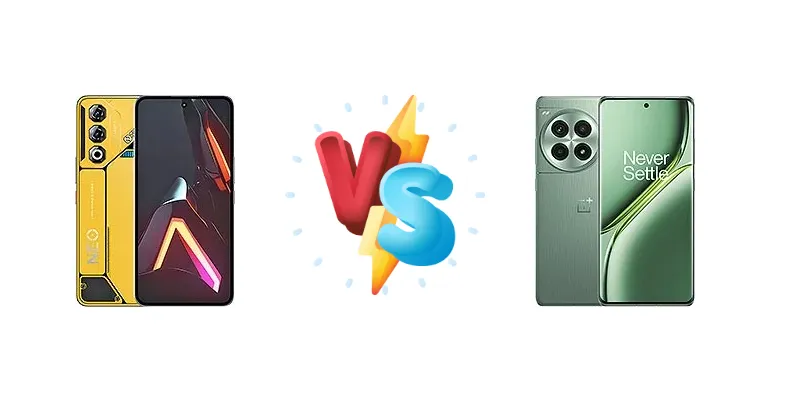
The ZTE nubia Neo 3 GT and OnePlus Ace 3 Pro represent distinct approaches to delivering high performance. The nubia focuses on aggressive value with a Unisoc chipset, while the Ace 3 Pro leverages Qualcomm’s flagship Snapdragon 8 Gen 3. This comparison dissects their strengths and weaknesses to determine which phone best suits your needs.
🏆 Quick Verdict
For most users, the OnePlus Ace 3 Pro is the superior choice. Its Snapdragon 8 Gen 3 chipset delivers significantly higher performance and efficiency, justifying the price premium. However, the nubia Neo 3 GT offers compelling value for budget-conscious gamers who prioritize raw power over refinement.
| Network |
|---|
| 2G bands | GSM 850 / 900 / 1800 / 1900 | GSM 850 / 900 / 1800 / 1900 |
| 3G bands | HSDPA 850 / 900 / 1900 / 2100 | HSDPA 850 / 900 / 1700(AWS) / 2100 |
| 4G bands | LTE | 1, 3, 4, 5, 8, 18, 19, 26, 28, 34, 38, 39, 40, 41, 66 |
| 5G bands | SA/NSA | 1, 3, 5, 8, 28, 38, 40, 41, 77, 78 SA/NSA |
| Speed | HSPA, LTE, 5G | HSPA, LTE, 5G |
| Technology | GSM / HSPA / LTE / 5G | GSM / CDMA / HSPA / LTE / 5G |
| Launch |
|---|
| Announced | 2025, March 03 | 2024, June 27 |
| Status | Available. Released 2025, June | Available. Released 2024, July 03 |
| Body |
|---|
| Dimensions | 163.3 x 77.2 x 8.2 mm (6.43 x 3.04 x 0.32 in) | 163.3 x 75.3 x 8.7 / 8.9 / 9.0 mm |
| SIM | Nano-SIM + Nano-SIM | Nano-SIM + Nano-SIM |
| Weight | - | 207 g, 212 g, 225 g (7.30 oz) |
| Display |
|---|
| Protection | - | Corning Gorilla Glass Victus 2 |
| Resolution | 1080 x 2392 pixels (~386 ppi density) | 1264 x 2780 pixels (~450 ppi density) |
| Size | 6.8 inches, 111.9 cm2 (~88.8% screen-to-body ratio) | 6.78 inches, 111.7 cm2 (~90.9% screen-to-body ratio) |
| Type | AMOLED, 120Hz, 1300 nits (peak) | LTPO AMOLED, 1B colors, 120Hz, HDR10+, Dolby Vision, 800 nits (typ), 1600 nits (HBM), 4500 nits (peak) |
| Platform |
|---|
| CPU | Octa-core (1x2.7 GHz Cortex-A76 & 3x2.3 GHz Cortex-A76 & 4x2.1 GHz Cortex-A55) | Octa-core (1x3.3 GHz Cortex-X4 & 3x3.2 GHz Cortex-A720 & 2x3.0 GHz Cortex-A720 & 2x2.3 GHz Cortex-A520) |
| Chipset | Unisoc T9100 (6 nm) | Qualcomm SM8650-AB Snapdragon 8 Gen 3 (4 nm) |
| GPU | Mali-G57 | Adreno 750 |
| OS | Android 15 | Android 14, ColorOS 14 |
| Memory |
|---|
| Card slot | No | No |
| Internal | 256GB 12GB RAM | 256GB 12GB RAM, 256GB 16GB RAM, 512GB 16GB RAM, 1TB 24GB RAM |
| Main Camera |
|---|
| Dual | 50 MP, (wide), PDAF
Auxiliary lens | - |
| Features | LED flash, HDR, panorama | Dual-LED flash, HDR, panorama |
| Triple | - | 50 MP, f/1.8, 24mm (wide), 1/1.56", 1.0µm, PDAF, OIS
8 MP, f/2.2, 16mm, 112˚ (ultrawide), 1/4.0", 1.12µm
2 MP (macro) |
| Video | Yes | 4K@30/60fps, 1080p@30/60/120/240fps, gyro-EIS, OIS |
| Selfie camera |
|---|
| Features | - | HDR, panorama |
| Single | 16 MP | 16 MP, f/2.4, 26mm (wide), 1/3", 1.0µm |
| Video | 1080p@30fps | 1080p@30fps |
| Sound |
|---|
| 35mm jack | No | No |
| Loudspeaker | Yes, with stereo speakers | Yes, with stereo speakers |
| Comms |
|---|
| Bluetooth | 5.4, A2DP, LE | 5.3, A2DP, LE, aptX HD, LHDC |
| Infrared port | - | Yes |
| NFC | Yes (market/region dependent) | Yes |
| Positioning | GPS, GLONASS, GALILEO, BDS | GPS (L1+L5), GLONASS (G1), BDS (B1I+B1c+B2a), GALILEO (E1+E5a), QZSS (L1+L5) |
| Radio | Unspecified | No |
| USB | USB Type-C | USB Type-C 2.0 |
| WLAN | Wi-Fi 802.11 a/b/g/n/ac, dual-band | Wi-Fi 802.11 a/b/g/n/ac/6/7, dual-band |
| Features |
|---|
| Sensors | Fingerprint (under display, optical), accelerometer, gyro, compass, proximity | Fingerprint (under display, optical), accelerometer, gyro, proximity, compass |
| Battery |
|---|
| Charging | 80W wired
Bypass Charging | 100W wired, PD2.0, QC2, 52% in 15 min, 100% in 36 min |
| Type | 6000 mAh or 5000 mAh | 6100 mAh |
| Misc |
|---|
| Colors | Electro Yellow, Interstellar Gray, White | Gray, White, Green |
| Models | - | PJX110 |
| Price | € 249.00 | About 410 EUR |
ZTE nubia Neo 3 GT
- Aggressive pricing offers excellent value.
- 80W fast charging is still very quick.
- Unisoc T9100 provides respectable performance for the price.
- Unisoc T9100 is significantly less powerful than Snapdragon 8 Gen 3.
- Potential software optimization issues with Unisoc chipset.
- Likely compromises in camera quality.
OnePlus Ace 3 Pro
- Snapdragon 8 Gen 3 delivers flagship-level performance.
- 100W charging is incredibly fast.
- Polished software experience and reliable updates.
- Higher price point.
- May not offer significant camera improvements over previous OnePlus models.
- Potential for software bloat (typical of OnePlus).
Display Comparison
While display specifications aren't provided, both phones likely feature high refresh rate panels geared towards gaming. However, the Ace 3 Pro, typical of OnePlus flagships, likely benefits from a higher peak brightness and potentially LTPO technology for adaptive refresh rates, improving battery life. The nubia Neo 3 GT, aiming for a lower price point, may utilize a less advanced panel, potentially impacting color accuracy and outdoor visibility. Bezels are expected to be minimal on both, but the Ace 3 Pro's build quality will likely be superior.
Camera Comparison
Without detailed camera specs, it’s difficult to make a definitive judgment. However, OnePlus generally prioritizes camera quality in its Pro models. The Ace 3 Pro likely features a larger main sensor with OIS, enabling better low-light performance and image stabilization. The nubia Neo 3 GT may focus on a more cost-effective camera setup, potentially sacrificing image quality in challenging conditions. We can expect both phones to offer a range of shooting modes, but the Ace 3 Pro’s image processing algorithms will likely be more refined.
Performance
The core difference lies in the chipsets. The OnePlus Ace 3 Pro’s Snapdragon 8 Gen 3 (4nm) is a generational leap ahead of the nubia Neo 3 GT’s Unisoc T9100 (6nm). The Snapdragon 8 Gen 3’s Cortex-X4 prime core, clocked at 3.3 GHz, and advanced Cortex-A720 performance cores provide substantially greater CPU and GPU performance. The 4nm process node also translates to significantly improved thermal efficiency, reducing throttling during sustained gaming sessions. The Unisoc T9100, while capable, relies on older Cortex-A76 cores and a less efficient 6nm process, resulting in lower peak performance and potentially more heat generation. The Ace 3 Pro’s LPDDR5x RAM further enhances its performance advantage.
Battery Life
The OnePlus Ace 3 Pro’s 100W wired charging is a significant advantage, achieving a 52% charge in 15 minutes and a full charge in 36 minutes. The nubia Neo 3 GT’s 80W charging is still fast, but noticeably slower. While battery capacity isn’t specified, the Ace 3 Pro’s more efficient Snapdragon 8 Gen 3 chipset will likely deliver comparable or better battery life despite potentially having a similar or smaller battery capacity. The Ace 3 Pro also supports PD2.0 and QC2, offering wider compatibility with chargers.
Buying Guide
Buy the ZTE nubia Neo 3 GT if you need a gaming-focused phone on a tight budget and are willing to accept potential software quirks and less refined features. Buy the OnePlus Ace 3 Pro if you prefer a polished, flagship experience with top-tier performance, faster charging, and a more reliable software ecosystem, even at a higher cost.
Frequently Asked Questions
❓ Will the Unisoc T9100 in the nubia Neo 3 GT struggle with demanding games like Genshin Impact?
The Unisoc T9100 can run Genshin Impact, but you'll likely need to lower graphics settings to maintain a stable frame rate. The Snapdragon 8 Gen 3 in the Ace 3 Pro will handle Genshin Impact at maximum settings with ease, offering a smoother and more consistent gaming experience.
❓ How much faster is the 100W charging on the OnePlus Ace 3 Pro compared to the 80W charging on the nubia Neo 3 GT in real-world use?
The Ace 3 Pro's 100W charging will add approximately 10-15 minutes of usable battery life in the same amount of charging time as the nubia Neo 3 GT. The difference is most noticeable when topping up the battery quickly between gaming sessions.
❓ Is the software experience on the nubia Neo 3 GT as refined as on the OnePlus Ace 3 Pro?
Generally, OnePlus' OxygenOS is known for being cleaner and more polished than ZTE's MyOS. The nubia Neo 3 GT may have more pre-installed apps and potentially less frequent software updates.
❓ Does the OnePlus Ace 3 Pro get noticeably hot during extended gaming sessions?
The Snapdragon 8 Gen 3 is very efficient, but it can still generate heat under heavy load. The Ace 3 Pro likely incorporates a robust cooling system to mitigate throttling, but some warmth is expected during prolonged gaming. It will still be cooler than the nubia Neo 3 GT due to the more efficient chipset.