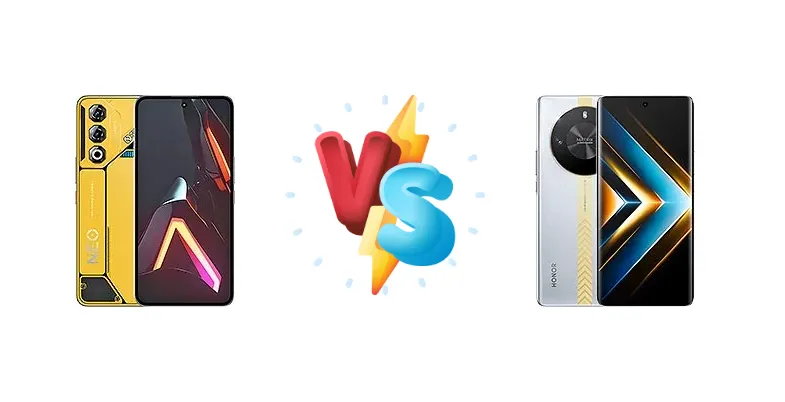
The mid-range gaming phone segment is heating up, and the ZTE nubia Neo 3 GT and Honor X50 GT represent compelling options. The nubia Neo 3 GT focuses on aggressive charging and a value-oriented Unisoc chipset, while the Honor X50 GT leverages the proven performance of the Snapdragon 8+ Gen 1. This comparison dissects their strengths and weaknesses to determine which phone delivers the best experience.
🏆 Quick Verdict
For most users, the Honor X50 GT emerges as the stronger choice. The Snapdragon 8+ Gen 1 offers a significant performance advantage over the Unisoc T9100, translating to smoother gaming and faster app loading. While the nubia Neo 3 GT boasts faster 80W charging, the Honor X50 GT’s overall refinement and processing power justify the trade-off.
| Network |
|---|
| 2G bands | GSM 850 / 900 / 1800 / 1900 | GSM 850 / 900 / 1800 / 1900 |
| 3G bands | HSDPA 850 / 900 / 1900 / 2100 | HSDPA 850 / 900 / 1700(AWS) / 1900 / 2100 |
| 4G bands | LTE | LTE |
| 5G bands | SA/NSA | SA/NSA |
| Speed | HSPA, LTE, 5G | HSPA, LTE, 5G |
| Technology | GSM / HSPA / LTE / 5G | GSM / CDMA / HSPA / CDMA2000 / LTE / 5G |
| Launch |
|---|
| Announced | 2025, March 03 | 2024, January 04 |
| Status | Available. Released 2025, June | Available. Released 2024, January 09 |
| Body |
|---|
| Dimensions | 163.3 x 77.2 x 8.2 mm (6.43 x 3.04 x 0.32 in) | 163.6 x 75.5 x 8 mm (6.44 x 2.97 x 0.31 in) |
| SIM | Nano-SIM + Nano-SIM | Nano-SIM + Nano-SIM |
| Weight | - | 192 g (6.77 oz) |
| Display |
|---|
| Resolution | 1080 x 2392 pixels (~386 ppi density) | 1220 x 2652 pixels, 19.5:9 ratio (~431 ppi density) |
| Size | 6.8 inches, 111.9 cm2 (~88.8% screen-to-body ratio) | 6.78 inches, 112.6 cm2 (~91.2% screen-to-body ratio) |
| Type | AMOLED, 120Hz, 1300 nits (peak) | AMOLED, 1B colors, 120Hz |
| Platform |
|---|
| CPU | Octa-core (1x2.7 GHz Cortex-A76 & 3x2.3 GHz Cortex-A76 & 4x2.1 GHz Cortex-A55) | Octa-core (1x3.0 GHz Cortex-X2 & 3x2.5 GHz Cortex-A710 & 4x1.80 GHz Cortex-A510) |
| Chipset | Unisoc T9100 (6 nm) | Qualcomm SM8475 Snapdragon 8+ Gen 1 (4 nm) |
| GPU | Mali-G57 | Adreno 730 |
| OS | Android 15 | Android 13, MagicOS 7.2 |
| Memory |
|---|
| Card slot | No | No |
| Internal | 256GB 12GB RAM | 256GB 12GB RAM, 256GB 16GB RAM, 512GB 16GB RAM, 1TB 16GB RAM |
| Main Camera |
|---|
| Dual | 50 MP, (wide), PDAF
Auxiliary lens | 108 MP, f/1.8, (wide), 1/1.67", PDAF
Auxiliary lens |
| Features | LED flash, HDR, panorama | LED flash, panorama, HDR |
| Video | Yes | 4K@30fps, 1080p@30fps |
| Selfie camera |
|---|
| Single | 16 MP | 8 MP, f/2.0, (wide) |
| Video | 1080p@30fps | 1080p@30fps |
| Sound |
|---|
| 35mm jack | No | No |
| Loudspeaker | Yes, with stereo speakers | Yes |
| Comms |
|---|
| Bluetooth | 5.4, A2DP, LE | 5.2, A2DP, LE, aptX HD |
| NFC | Yes (market/region dependent) | Yes |
| Positioning | GPS, GLONASS, GALILEO, BDS | GPS, GLONASS, GALILEO, BDS |
| Radio | Unspecified | No |
| USB | USB Type-C | USB Type-C 2.0, OTG |
| WLAN | Wi-Fi 802.11 a/b/g/n/ac, dual-band | Wi-Fi 802.11 a/b/g/n/ac/6, dual-band, Wi-Fi Direct |
| Features |
|---|
| Sensors | Fingerprint (under display, optical), accelerometer, gyro, compass, proximity | Fingerprint (under display, optical), accelerometer, gyro, ultrasound proximity, compass |
| Battery |
|---|
| Charging | 80W wired
Bypass Charging | 35W wired
7.5W reverse wired |
| Type | 6000 mAh or 5000 mAh | Li-Po 5800 mAh |
| Misc |
|---|
| Colors | Electro Yellow, Interstellar Gray, White | Black, Silver |
| Models | - | ALP-AN00 |
| Price | € 249.00 | About 260 EUR |
ZTE nubia Neo 3 GT
- Significantly faster 80W charging
- Potentially lower price point
- Unisoc T9100 offers decent performance for casual gaming
- Unisoc T9100 is outperformed by the Snapdragon 8+ Gen 1
- Less efficient chipset may lead to more throttling
- Camera performance likely inferior to the Honor X50 GT
Honor X50 GT
- Superior performance with Snapdragon 8+ Gen 1
- More efficient chipset for better thermal management
- Advanced ISP for improved camera quality
- 7.5W reverse wired charging
- Slower 35W charging compared to nubia Neo 3 GT
- Potentially higher price point
Display Comparison
Neither device’s display specifications are provided, so a direct comparison is limited. However, given the price points, we can assume both utilize LCD or AMOLED panels with high refresh rates. The absence of LTPO technology on either device suggests a less adaptive refresh rate, potentially impacting battery life during static content viewing. Bezels are likely similar, focusing on maximizing screen real estate within their respective form factors. Color accuracy will likely be tuned for vibrant gaming visuals, but professional color work may require calibration.
Camera Comparison
Without detailed camera specs, analysis is limited. However, the chipset difference indirectly impacts camera performance. The Snapdragon 8+ Gen 1’s ISP (Image Signal Processor) is significantly more advanced, enabling faster image processing, better noise reduction, and improved dynamic range. While both phones likely feature multi-camera setups, the Honor X50 GT will likely deliver superior image quality, particularly in challenging lighting conditions. We anticipate the Honor X50 GT will have better video recording capabilities as well.
Performance
The core difference lies in the chipsets. The Honor X50 GT’s Snapdragon 8+ Gen 1 (4nm) is a flagship-level processor, featuring a Cortex-X2 prime core clocked at 3.0 GHz, alongside three Cortex-A710 performance cores and four Cortex-A510 efficiency cores. This architecture provides a substantial performance uplift compared to the Unisoc T9100 (6nm) in the nubia Neo 3 GT. The T9100, while capable, relies on older Cortex-A76 cores and a less efficient manufacturing process. This translates to lower sustained performance and potentially more thermal throttling under heavy load. The Snapdragon 8+ Gen 1’s 4nm process offers superior thermal efficiency, allowing for longer gaming sessions without significant performance drops. The Honor X50 GT will excel in demanding games and multitasking scenarios.
Battery Life
The nubia Neo 3 GT’s 80W wired charging is a clear advantage, allowing for significantly faster top-ups compared to the Honor X50 GT’s 35W charging. While battery capacity isn’t specified, the faster charging speed mitigates the impact of a potentially smaller battery on the nubia Neo 3 GT. The Honor X50 GT also offers 7.5W reverse wired charging, a convenient feature for topping up accessories. However, the Snapdragon 8+ Gen 1’s superior power efficiency may result in comparable real-world battery life despite the charging disparity, especially for moderate users.
Buying Guide
Buy the ZTE nubia Neo 3 GT if you prioritize extremely fast charging and are on a tight budget, and are willing to accept some performance compromises. It’s ideal for users who frequently top up their phones and play less demanding mobile games. Buy the Honor X50 GT if you demand consistent, high-end performance for gaming and multitasking, and value a more established chipset with better optimization. This is the better choice for power users and those seeking a longer-lasting device.
Frequently Asked Questions
❓ Will the Unisoc T9100 in the nubia Neo 3 GT struggle with graphically demanding games like Genshin Impact?
The Unisoc T9100 will likely be able to run Genshin Impact, but you’ll likely need to lower the graphics settings to medium or low to maintain a stable frame rate. The Snapdragon 8+ Gen 1 in the Honor X50 GT will provide a much smoother experience at higher settings.
❓ How much faster is the 80W charging on the nubia Neo 3 GT compared to the 35W charging on the Honor X50 GT in real-world use?
The nubia Neo 3 GT can potentially charge from 0-100% in around 30-40 minutes, while the Honor X50 GT will likely take closer to 60-75 minutes. This difference is most noticeable for quick top-ups, but the Honor X50 GT’s efficiency may minimize the overall impact on daily usage.
❓ Does the Snapdragon 8+ Gen 1 in the Honor X50 GT get hot during extended gaming sessions?
The Snapdragon 8+ Gen 1 is known for its thermal efficiency, but it can still generate heat during prolonged gaming. However, the 4nm process and likely effective cooling solutions in the Honor X50 GT should prevent significant throttling and maintain consistent performance for extended periods.