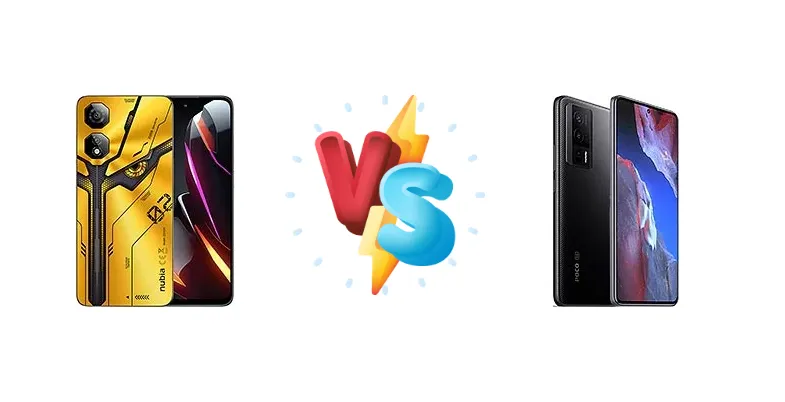
The Xiaomi Poco F5 Pro and ZTE nubia Neo 2 represent distinct approaches to the mid-range smartphone market. The Poco F5 Pro aims for near-flagship performance with its Snapdragon 8+ Gen 1, while the nubia Neo 2 prioritizes efficient gaming and affordability with the Unisoc T820. This comparison dissects their key differences to help you choose the right device.
🏆 Quick Verdict
For users prioritizing raw performance and faster charging, the Xiaomi Poco F5 Pro is the clear winner. Its Snapdragon 8+ Gen 1 offers a significant leap in processing power. However, the nubia Neo 2 provides a compelling value proposition for budget-conscious gamers who don't need top-tier specs.
| Network |
|---|
| 2G bands | GSM 850 / 900 / 1800 / 1900 | GSM 850 / 900 / 1800 / 1900 |
| 3G bands | HSDPA 850 / 900 / 1900 / 2100 | HSDPA 800 / 850 / 900 / 1700(AWS) / 1900 / 2100 |
| 4G bands | 1, 2, 3, 4, 5, 7, 8, 20, 28, 38, 40, 41 | 1, 2, 3, 4, 5, 7, 8, 18, 19, 20, 28, 38, 40, 41, 66 |
| 5G bands | 1, 3, 7, 8, 20, 28, 38, 40, 41, 71, 77 SA/NSA | 1, 3, 5, 7, 8, 20, 28, 38, 40, 41, 77, 78 SA/NSA/Sub6 |
| Speed | HSPA, LTE, 5G | HSPA, LTE, 5G |
| Technology | GSM / HSPA / LTE / 5G | GSM / HSPA / LTE / 5G |
| Launch |
|---|
| Announced | 2024, February 28 | 2023, May 09 |
| Status | Available. Released 2024, Q2 | Available. Released 2023, May |
| Body |
|---|
| Build | - | Glass front (Gorilla Glass 5), glass back, plastic frame |
| Dimensions | 166 x 76.1 x 8.5 mm (6.54 x 3.00 x 0.33 in) | 162.8 x 75.4 x 8.6 mm (6.41 x 2.97 x 0.34 in) |
| SIM | Nano-SIM + Nano-SIM | Nano-SIM + Nano-SIM |
| Weight | 208 g (7.34 oz) | 204 g (7.20 oz) |
| | - | IP53, dust and splash resistant |
| Display |
|---|
| Protection | - | Corning Gorilla Glass 5 |
| Resolution | 1080 x 2400 pixels, 20:9 ratio (~392 ppi density) | 1440 x 3200 pixels, 20:9 ratio (~526 ppi density) |
| Size | 6.72 inches, 109.0 cm2 (~86.3% screen-to-body ratio) | 6.67 inches, 107.4 cm2 (~87.5% screen-to-body ratio) |
| Type | IPS LCD, 120Hz | AMOLED, 68B colors, 120Hz, Dolby Vision, HDR10+, 500 nits (typ), 1000 nits (HBM), 1400 nits (peak) |
| Platform |
|---|
| CPU | Octa-core (1x2.7 GHz Cortex-A76 & 3x2.3 GHz Cortex-A76 & 4x2.1 GHz Cortex-A55) | Octa-core (1x3.0 GHz Cortex-X2 & 3x2.5 GHz Cortex-A710 & 4x1.80 GHz Cortex-A510) |
| Chipset | Unisoc T820 (6 nm) | Qualcomm SM8475 Snapdragon 8+ Gen 1 (4 nm) |
| GPU | Mali-G57 | Adreno 730 |
| OS | Android 13, upgradable to Android 14 | Android 13, upgradable to Android 15 |
| Memory |
|---|
| Card slot | No | No |
| Internal | 256GB 8GB RAM | 256GB 8GB RAM, 256GB 12GB RAM, 512GB 12GB RAM |
| | - | UFS 3.1 |
| Main Camera |
|---|
| Dual | 50 MP, f/1.8, (wide), PDAF
Auxiliary lens | - |
| Features | LED flash, HDR, panorama | Dual-LED dual-tone flash, HDR, panorama |
| Triple | - | 64 MP, f/1.8, (wide), 1/2.0", 0.7µm, PDAF, OIS
8 MP, f/2.2, 120˚ (ultrawide), 1/4.0", 1.12µm
2 MP (macro) |
| Video | 1080p@30fps | 8K@24fps, 4K@30/60fps, 1080p@30/60/120/240fps, gyro-EIS |
| Selfie camera |
|---|
| Features | - | HDR |
| Single | 16 MP, f/2.0, (wide) | 16 MP, f/2.5, (wide), 1/3.06", 1.0µm |
| Video | 1080p@30fps | 1080p@30/60fps |
| Sound |
|---|
| 3.5mm jack | - | No |
| 35mm jack | No | No |
| Loudspeaker | Yes, with stereo speakers | Yes, with stereo speakers |
| | - | 24-bit/192kHz audio |
| Comms |
|---|
| Bluetooth | 5.2, A2DP, LE | 5.3, A2DP, LE |
| Infrared port | - | Yes |
| NFC | Yes (market/region dependent) | Yes (market/region dependent) |
| Positioning | GPS, GLONASS, GALILEO, BDS | GPS (L1), GLONASS (G1), BDS (B1I), GALILEO (E1), QZSS (L1) |
| Radio | FM radio | No |
| USB | USB Type-C 2.0, OTG | USB Type-C 2.0, OTG |
| WLAN | Wi-Fi 802.11 a/b/g/n/ac, dual-band | Wi-Fi 802.11 a/b/g/n/ac/6, dual-band |
| Features |
|---|
| Sensors | Fingerprint (side-mounted), accelerometer, gyro, proximity, compass | Fingerprint (under display, optical), accelerometer, gyro, proximity, compass |
| Battery |
|---|
| Charging | 33W wired | 67W wired, PD3.0, QC3+, 50% in 15 min
30W wireless, 50% in 32 min |
| Type | 6000 mAh or 5200 mAh | Li-Po 5160 mAh |
| Misc |
|---|
| Colors | Sunfire Yellow, Frost Silver, Storm Gray | Black, White |
| Models | Z2352N | 23013PC75G |
| Price | € 179.00 | $ 449.99 / € 241.85 |
| SAR | - | 1.09 W/kg (head) 1.08 W/kg (body) |
| SAR EU | - | 1.00 W/kg (head) 1.00 W/kg (body) |
| Tests |
|---|
| Battery life | - | Endurance rating 99h |
| Camera | - |
Photo / Video |
| Display | - |
Contrast ratio: Infinite (nominal) |
| Loudspeaker | - |
-26.2 LUFS (Good) |
| Performance | - |
AnTuTu: 1057977 (v9)
GeekBench: 4001 (v5.1), 4009 (v6)
GFXBench: 50fps (ES 3.1 onscreen) |
ZTE nubia Neo 2
- Excellent performance with the Unisoc T820 for the price.
- Focus on gaming experience.
- Potentially longer battery life due to efficient chipset.
- Less powerful chipset compared to the Snapdragon 8+ Gen 1.
- Slower charging speed at 33W.
- Limited display information suggests a lower quality panel.
Xiaomi Poco F5 Pro
- Flagship-level performance with the Snapdragon 8+ Gen 1.
- Extremely fast 67W wired and 30W wireless charging.
- Bright and high-contrast display (1059 nits).
- Higher price point.
- May run hotter under sustained load compared to the more efficient T820.
- Camera details are limited, but likely not a class-leading system.
Display Comparison
The Poco F5 Pro boasts a significantly brighter display, reaching a measured 1059 nits, making it far more usable outdoors. While the nubia Neo 2’s display specs are not provided, the F5 Pro’s infinite (nominal) contrast ratio suggests a superior viewing experience with deeper blacks. The F5 Pro’s brightness advantage is crucial for users who frequently consume content in bright environments. The lack of detailed display information for the nubia Neo 2 suggests a more basic panel focused on cost savings.
Camera Comparison
Both devices offer photo and video capabilities, but detailed camera specs are limited. The Poco F5 Pro likely benefits from Qualcomm’s superior image signal processor (ISP) within the Snapdragon 8+ Gen 1, enabling better image processing and low-light performance. Without specific sensor details for the nubia Neo 2, it’s reasonable to assume a more basic camera system focused on everyday snapshots. The absence of information regarding OIS on either device suggests a reliance on software stabilization.
Performance
The core difference lies in the chipsets. The Poco F5 Pro’s Qualcomm Snapdragon 8+ Gen 1 (4nm) is a flagship-level processor, featuring a Cortex-X2 prime core clocked at 3.0 GHz, and built on a more efficient 4nm process. This translates to substantially higher CPU and GPU performance compared to the nubia Neo 2’s Unisoc T820 (6nm). The T820, while capable, utilizes older Cortex-A76 cores and a less refined 6nm process, resulting in lower peak performance and potentially more thermal throttling under sustained load. The F5 Pro’s LPDDR5X RAM further enhances its performance advantage.
Battery Life
Both phones achieve an endurance rating of 99 hours, indicating similar overall battery life despite differing battery capacities (not specified for the nubia Neo 2). However, the Poco F5 Pro’s charging capabilities are vastly superior, offering 67W wired charging (50% in 15 minutes), 30W wireless charging (50% in 32 minutes), and support for PD3.0 and QC3+. The nubia Neo 2 is limited to 33W wired charging, meaning significantly longer recharge times. This makes the Poco F5 Pro ideal for users who need to quickly top up their battery.
Buying Guide
Buy the ZTE nubia Neo 2 if you need a dedicated gaming phone on a tight budget, prioritizing long play sessions over absolute graphical fidelity. Buy the Xiaomi Poco F5 Pro if you prefer a more versatile device capable of handling demanding tasks like video editing, and require the fastest possible charging speeds and a brighter display.
Frequently Asked Questions
❓ Is the Unisoc T820 in the nubia Neo 2 powerful enough for demanding games like Genshin Impact?
The Unisoc T820 can run Genshin Impact, but you'll likely need to lower the graphics settings to achieve a smooth frame rate. It's optimized for efficiency, prioritizing sustained performance over peak power, making it suitable for longer gaming sessions at medium settings.
❓ Does the Poco F5 Pro get excessively hot during prolonged gaming?
The Snapdragon 8+ Gen 1 is known to generate heat under heavy load. While the Poco F5 Pro likely has thermal management features, expect some degree of throttling during extended gaming sessions. However, the 4nm process is more efficient than older nodes, mitigating the issue compared to previous Snapdragon generations.
❓ How does the 67W charging on the Poco F5 Pro compare to the 33W charging on the nubia Neo 2 in real-world use?
The 67W charging on the Poco F5 Pro is significantly faster. It can charge from 0-50% in just 15 minutes, while the nubia Neo 2 will take considerably longer to reach the same level. This is a major convenience factor for users who frequently need to quickly top up their battery.
❓ What kind of gaming features does the nubia Neo 2 offer beyond the chipset?
While specific details are limited, nubia phones often include gaming-centric features like dedicated gaming modes, shoulder buttons (not confirmed for this model), and optimized software for improved performance and reduced latency. These features enhance the overall gaming experience.