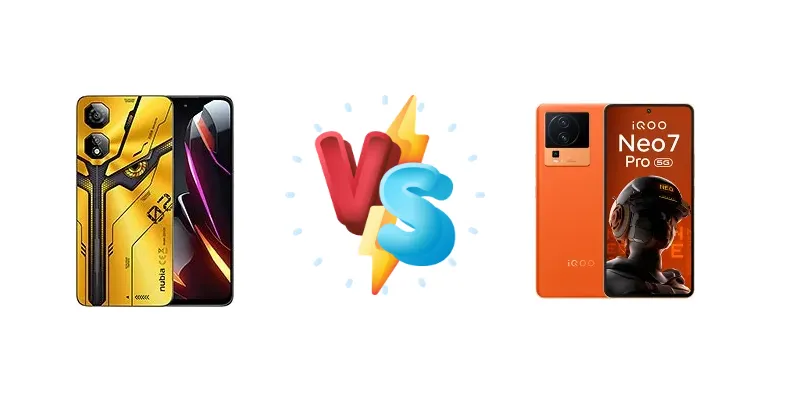
The ZTE nubia Neo 2 and vivo iQOO Neo 7 Pro represent distinct approaches to the mid-range smartphone market. The nubia Neo 2 aims for affordability with a focus on essential features, while the iQOO Neo 7 Pro prioritizes performance with flagship-level processing and incredibly fast charging. This comparison dissects their key differences to determine which device best suits your needs.
🏆 Quick Verdict
For users prioritizing raw performance and rapid charging, the vivo iQOO Neo 7 Pro is the clear winner. Its Snapdragon 8+ Gen 1 chipset delivers a significantly smoother experience, especially in demanding games. However, the ZTE nubia Neo 2 provides a compelling value proposition for budget-conscious users who don't require top-tier processing power.
| Network |
|---|
| 2G bands | GSM 850 / 900 / 1800 / 1900 | GSM 850 / 900 / 1800 / 1900 |
| 3G bands | HSDPA 850 / 900 / 1900 / 2100 | HSDPA 800 / 850 / 900 / 1700(AWS) / 1900 / 2100 |
| 4G bands | 1, 2, 3, 4, 5, 7, 8, 20, 28, 38, 40, 41 | 1, 2, 3, 4, 5, 8, 28, 34, 38, 39, 40, 41 |
| 5G bands | 1, 3, 7, 8, 20, 28, 38, 40, 41, 71, 77 SA/NSA | 1, 3, 5, 8, 28, 40, 77, 78 SA/NSA |
| Speed | HSPA, LTE, 5G | HSPA, LTE, 5G |
| Technology | GSM / HSPA / LTE / 5G | GSM / HSPA / LTE / 5G |
| Launch |
|---|
| Announced | 2024, February 28 | 2023, July 04 |
| Status | Available. Released 2024, Q2 | Available. Released 2023, July 15 |
| Body |
|---|
| Build | - | Glass front, plastic frame, glass or leather back |
| Dimensions | 166 x 76.1 x 8.5 mm (6.54 x 3.00 x 0.33 in) | 164.8 x 76.9 x 8.5 mm or 8.9 mm |
| SIM | Nano-SIM + Nano-SIM | Nano-SIM + Nano-SIM |
| Weight | 208 g (7.34 oz) | 197 g or 202 g (6.95 oz) |
| Display |
|---|
| Resolution | 1080 x 2400 pixels, 20:9 ratio (~392 ppi density) | 1080 x 2400 pixels, 20:9 ratio (~388 ppi density) |
| Size | 6.72 inches, 109.0 cm2 (~86.3% screen-to-body ratio) | 6.78 inches, 111.0 cm2 (~87.6% screen-to-body ratio) |
| Type | IPS LCD, 120Hz | AMOLED, 1B colors, 120Hz, HDR10+, 1300 nits (peak) |
| Platform |
|---|
| CPU | Octa-core (1x2.7 GHz Cortex-A76 & 3x2.3 GHz Cortex-A76 & 4x2.1 GHz Cortex-A55) | Octa-core (1x3.19 GHz Cortex-X2 & 3x2.75 GHz Cortex-A710 & 4x2.0 GHz Cortex-A510) |
| Chipset | Unisoc T820 (6 nm) | Qualcomm SM8475 Snapdragon 8+ Gen 1 (4 nm) |
| GPU | Mali-G57 | Adreno 730 |
| OS | Android 13, upgradable to Android 14 | Android 13, Funtouch 13 |
| Memory |
|---|
| Card slot | No | No |
| Internal | 256GB 8GB RAM | 128GB 8GB RAM, 256GB 12GB RAM |
| Main Camera |
|---|
| Dual | 50 MP, f/1.8, (wide), PDAF
Auxiliary lens | - |
| Features | LED flash, HDR, panorama | LED flash, HDR, panorama |
| Triple | - | 50 MP, f/1.9, 24mm (wide), 1/1.57", 1.0µm, PDAF, OIS
8 MP, f/2.2, 16mm (ultrawide), 1/4.0", 1.12µm
2 MP (macro) |
| Video | 1080p@30fps | 4K@30fps, 1080p@30fps |
| Selfie camera |
|---|
| Features | - | HDR |
| Single | 16 MP, f/2.0, (wide) | 16 MP, f/2.5, (wide), 1/3.1", 1.0µm |
| Video | 1080p@30fps | 1080p@30fps |
| Sound |
|---|
| 35mm jack | No | No |
| Loudspeaker | Yes, with stereo speakers | Yes, with stereo speakers |
| Comms |
|---|
| Bluetooth | 5.2, A2DP, LE | 5.3, A2DP, LE, aptX HD, aptX Adaptive |
| Infrared port | - | Yes |
| NFC | Yes (market/region dependent) | No |
| Positioning | GPS, GLONASS, GALILEO, BDS | GPS, GLONASS, GALILEO, BDS, QZSS, NavIC |
| Radio | FM radio | No |
| USB | USB Type-C 2.0, OTG | USB Type-C 2.0, OTG |
| WLAN | Wi-Fi 802.11 a/b/g/n/ac, dual-band | Wi-Fi 802.11 a/b/g/n/ac/6, dual-band, Wi-Fi Direct |
| Features |
|---|
| Sensors | Fingerprint (side-mounted), accelerometer, gyro, proximity, compass | Fingerprint (under display, optical), accelerometer, gyro, proximity, compass |
| Battery |
|---|
| Charging | 33W wired | 120W wired, 50% in 8 min |
| Type | 6000 mAh or 5200 mAh | 5000 mAh |
| Misc |
|---|
| Colors | Sunfire Yellow, Frost Silver, Storm Gray | Fearless Flame, Dark Storm |
| Models | Z2352N | I2217 |
| Price | € 179.00 | About 380 EUR |
ZTE nubia Neo 2
- Significantly more affordable
- Decent performance for everyday tasks
- Reliable for basic smartphone use
- Underpowered for demanding games
- Slow charging speed (33W)
- Likely inferior camera performance
vivo iQOO Neo 7 Pro
- Flagship-level Snapdragon 8+ Gen 1 performance
- Ultra-fast 120W charging
- Superior gaming experience
- Higher price point
- Potentially more heat generation under load
- May be overkill for basic users
Display Comparison
While display specifications aren't provided, both phones likely feature LCD panels given their price points. The iQOO Neo 7 Pro, being a more premium offering, may have a slightly higher peak brightness and potentially a higher refresh rate. However, the nubia Neo 2's display will likely suffice for everyday use. Bezels are expected to be similar, with the iQOO potentially offering a slightly more refined design. Color accuracy will depend on software calibration, but neither is expected to rival flagship OLED displays.
Camera Comparison
Camera details are limited, but we can infer some differences. The iQOO Neo 7 Pro, positioned as a performance-focused device, likely incorporates a more sophisticated camera system with a larger sensor and potentially Optical Image Stabilization (OIS). The nubia Neo 2 will likely feature a more basic camera setup, prioritizing affordability over image quality. Lens apertures will likely be wider on the iQOO, allowing for better low-light performance. Image processing algorithms will also differ, with the iQOO likely offering more advanced features and potentially more accurate color reproduction.
Performance
The performance disparity is the most significant difference. The iQOO Neo 7 Pro’s Qualcomm Snapdragon 8+ Gen 1 (4nm) is a substantial leap ahead of the nubia Neo 2’s Unisoc T820 (6nm). The Snapdragon 8+ Gen 1’s Cortex-X2 prime core, clocked at 3.19 GHz, provides a noticeable advantage in single-core tasks and responsiveness. The iQOO also benefits from a more advanced GPU, delivering superior graphics performance. The 4nm process node of the Snapdragon 8+ Gen 1 also translates to better thermal efficiency, reducing the likelihood of throttling during extended gaming sessions. The nubia Neo 2’s Unisoc T820 is capable for everyday tasks, but will struggle with graphically intensive games and multitasking.
Battery Life
The nubia Neo 2 features 33W wired charging, while the iQOO Neo 7 Pro boasts an impressive 120W wired charging capability. This translates to a massive difference in charging speed – the iQOO can reach 50% charge in just 8 minutes, while the nubia Neo 2 will take considerably longer. While battery capacity isn't specified, the iQOO's faster charging mitigates the impact of a potentially smaller battery. Users who frequently find themselves needing to top up their phone quickly will greatly benefit from the iQOO Neo 7 Pro’s 120W charging.
Buying Guide
Buy the ZTE nubia Neo 2 if you need a reliable daily driver for basic tasks, social media, and light gaming, and are looking to maximize value for your money. Buy the vivo iQOO Neo 7 Pro if you prioritize a fluid gaming experience, require fast charging to minimize downtime, and are willing to invest in a more powerful processor.
Frequently Asked Questions
❓ Will the Unisoc T820 in the nubia Neo 2 struggle with popular games like Genshin Impact or Call of Duty Mobile?
Yes, the Unisoc T820 is likely to struggle with graphically demanding games like Genshin Impact or Call of Duty Mobile, especially at higher settings. You'll likely need to lower the graphics settings and resolution to achieve playable frame rates. The iQOO Neo 7 Pro's Snapdragon 8+ Gen 1 is far better equipped to handle these titles smoothly.
❓ How much faster is the 120W charging on the iQOO Neo 7 Pro compared to the 33W charging on the nubia Neo 2 in a real-world scenario?
The 120W charging on the iQOO Neo 7 Pro is dramatically faster. While the nubia Neo 2 will take well over an hour to fully charge, the iQOO Neo 7 Pro can reach 50% charge in just 8 minutes and a full charge in around 30-40 minutes. This is a significant advantage for users who need to quickly top up their battery.
❓ Is the iQOO Neo 7 Pro prone to overheating during extended gaming sessions?
While the Snapdragon 8+ Gen 1 is a powerful chip, it can generate heat under sustained load. However, the iQOO Neo 7 Pro likely incorporates effective thermal management solutions, such as vapor chamber cooling, to mitigate overheating. While some throttling may occur during very long gaming sessions, it shouldn't be a major issue for most users.