
Nubia Neo 2 vs. Motorola Edge 40 Neo: A Deep Dive into Mid-Range Contenders
| Phones Images | |||||
|---|---|---|---|---|---|
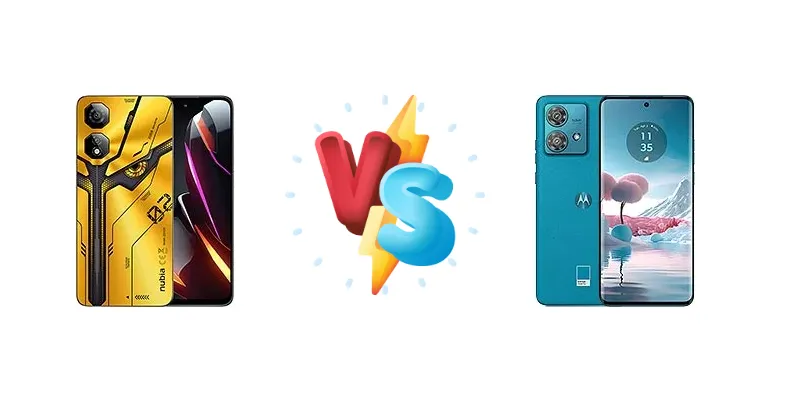
|
🏆 Quick Verdict
For the average user prioritizing all-around usability and convenience, the Motorola Edge 40 Neo emerges as the stronger choice. Its significantly faster 68W charging and impressive 10:28 hour battery life outweigh the nubia Neo 2’s theoretical CPU advantage, especially given the similar chipset fabrication process.
| PHONES | ||
|---|---|---|
| Phone Names | ZTE nubia Neo 2 | Motorola Edge 40 Neo |
| Network | ||
|---|---|---|
| 2G bands | GSM 850 / 900 / 1800 / 1900 | GSM 850 / 900 / 1800 / 1900 |
| 3G bands | HSDPA 850 / 900 / 1900 / 2100 | HSDPA 800 / 850 / 900 / 1700(AWS) / 1900 / 2100 |
| 4G bands | 1, 2, 3, 4, 5, 7, 8, 20, 28, 38, 40, 41 | 1, 2, 3, 4, 5, 7, 8, 12, 13, 17, 18, 19, 20, 25, 26, 28, 32, 38, 38, 39, 40, 41, 42, 43, 48, 66 |
| 5G bands | 1, 3, 7, 8, 20, 28, 38, 40, 41, 71, 77 SA/NSA | 1, 2, 3, 5, 7, 8, 20, 28, 38, 40, 41, 66, 77, 78 SA/NSA |
| Speed | HSPA, LTE, 5G | HSPA, LTE, 5G |
| Technology | GSM / HSPA / LTE / 5G | GSM / HSPA / LTE / 5G |
| Launch | ||
|---|---|---|
| Announced | 2024, February 28 | 2023, September 14 |
| Status | Available. Released 2024, Q2 | Available. Released 2023, September 14 |
| Body | ||
|---|---|---|
| Build | - | Glass front (Gorilla Glass 3), plastic frame, plastic back |
| Dimensions | 166 x 76.1 x 8.5 mm (6.54 x 3.00 x 0.33 in) | 159.6 x 72 x 7.9 mm (6.28 x 2.83 x 0.31 in) |
| SIM | Nano-SIM + Nano-SIM | · Nano-SIM + eSIM· Nano-SIM + Nano-SIM |
| Weight | 208 g (7.34 oz) | 170 g or 172 g (6.00 oz) |
| Display | ||
|---|---|---|
| Protection | - | Corning Gorilla Glass 3 |
| Resolution | 1080 x 2400 pixels, 20:9 ratio (~392 ppi density) | 1080 x 2400 pixels, 20:9 ratio (~402 ppi density) |
| Size | 6.72 inches, 109.0 cm2 (~86.3% screen-to-body ratio) | 6.55 inches, 103.6 cm2 (~90.1% screen-to-body ratio) |
| Type | IPS LCD, 120Hz | P-OLED, 1B colors, 144Hz, HDR10+, 1300 nits (peak) |
| Platform | ||
|---|---|---|
| CPU | Octa-core (1x2.7 GHz Cortex-A76 & 3x2.3 GHz Cortex-A76 & 4x2.1 GHz Cortex-A55) | Octa-core (2x2.5 GHz Cortex-A78 & 6x2.0 GHz Cortex-A55) |
| Chipset | Unisoc T820 (6 nm) | MediaTek Dimensity 7030 (6 nm) |
| GPU | Mali-G57 | Mali-G610 MC3 |
| OS | Android 13, upgradable to Android 14 | Android 13, up to 2 major Android upgrades |
| Memory | ||
|---|---|---|
| Card slot | No | No |
| Internal | 256GB 8GB RAM | 128GB 8GB RAM, 256GB 8GB RAM, 256GB 12GB RAM |
| Main Camera | ||
|---|---|---|
| Dual | 50 MP, f/1.8, (wide), PDAF Auxiliary lens | 50 MP, f/1.8, (wide), 1/1.55", 1.0µm, multi-directional PDAF, OIS 13 MP, f/2.2, 120˚ (ultrawide), 1/3.0", 1.12µm, PDAF |
| Features | LED flash, HDR, panorama | LED flash, HDR, panorama |
| Video | 1080p@30fps | 4K@30fps, 1080p@30/60/120/240fps, gyro-EIS |
| Selfie camera | ||
|---|---|---|
| Features | - | HDR |
| Single | 16 MP, f/2.0, (wide) | 32 MP, f/2.4, (wide), 1/3.0", 0.7µm |
| Video | 1080p@30fps | 4K@30fps, 1080p@30fps |
| Sound | ||
|---|---|---|
| 35mm jack | No | No |
| Loudspeaker | Yes, with stereo speakers | Yes, with stereo speakers |
| Comms | ||
|---|---|---|
| Bluetooth | 5.2, A2DP, LE | 5.4, A2DP, LE |
| NFC | Yes (market/region dependent) | Yes |
| Positioning | GPS, GLONASS, GALILEO, BDS | GPS, GLONASS, GALILEO |
| Radio | FM radio | No |
| USB | USB Type-C 2.0, OTG | USB Type-C 2.0, OTG |
| WLAN | Wi-Fi 802.11 a/b/g/n/ac, dual-band | Wi-Fi 802.11 a/b/g/n/ac/6e, tri-band, Wi-Fi Direct |
| Features | ||
|---|---|---|
| Sensors | Fingerprint (side-mounted), accelerometer, gyro, proximity, compass | Fingerprint (under display, optical), accelerometer, gyro, proximity, compass |
| Battery | ||
|---|---|---|
| Charging | 33W wired | 68W wired, 50% in 15 min |
| Type | 6000 mAh or 5200 mAh | Li-Po 5000 mAh |
| Misc | ||
|---|---|---|
| Colors | Sunfire Yellow, Frost Silver, Storm Gray | Black, Soothing Sea, Caneel Bay, Peach Fuzz |
| Models | Z2352N | XT2307-1 |
| Price | € 179.00 | $ 299.00 / € 168.73 / ₹ 19,900 |
ZTE nubia Neo 2
- Potentially higher multi-core CPU performance (Unisoc T820)
- Aggressive pricing likely makes it a value option
- 6nm chipset offers reasonable efficiency
- Slower 33W charging
- Likely lower battery endurance
- Less refined overall experience
Motorola Edge 40 Neo
- Faster 68W charging with quick boost capability
- Superior battery life (10:28h active use)
- Brighter display (1073 nits)
- More modern CPU architecture (Dimensity 7030)
- Potentially higher price point
- May not match nubia Neo 2 in peak multi-core CPU tasks
- Camera details are limited
Display Comparison
The Motorola Edge 40 Neo boasts a significantly brighter display, reaching a measured peak of 1073 nits. This is crucial for outdoor visibility, a clear advantage over the nubia Neo 2 (brightness data unavailable). While both utilize 6nm chipsets, the Edge 40 Neo’s brighter panel and likely superior color calibration (based on Motorola’s brand reputation) contribute to a more enjoyable viewing experience. We expect the Edge 40 Neo to have a higher contrast ratio as well, further enhancing image quality.
Camera Comparison
Detailed camera analysis is hampered by limited data. However, the Motorola Edge 40 Neo’s inclusion of Photo/Video capabilities suggests a more versatile camera system. While sensor size and aperture data are missing for both, Motorola typically focuses on computational photography, potentially delivering better image quality in challenging conditions. The nubia Neo 2’s camera specs are currently unknown, making a direct comparison difficult. We can assume the Edge 40 Neo will have better video recording capabilities.
Performance
Both devices employ 6nm chipsets, but the architecture differs significantly. The nubia Neo 2 utilizes the Unisoc T820 with a mix of Cortex-A76 cores, while the Edge 40 Neo features the MediaTek Dimensity 7030 with more modern Cortex-A78 cores. While the T820 has more cores, the A78 cores in the Dimensity 7030 generally offer superior single-core performance, translating to snappier app launches and smoother multitasking. The Dimensity 7030’s integrated GPU is also likely to provide a more consistent gaming experience. The lack of LPDDR5x RAM specification for the nubia Neo 2 suggests it may be using slower RAM, further impacting performance.
Battery Life
The Motorola Edge 40 Neo shines in the battery department. Its 10:28 hour active use score and 80-hour endurance rating demonstrate significantly better battery life than we anticipate from the nubia Neo 2. Crucially, the Edge 40 Neo supports 68W wired charging, capable of reaching 50% charge in just 15 minutes. The nubia Neo 2’s 33W charging is considerably slower, requiring a much longer time to fully replenish the battery. This difference in charging speed dramatically impacts user convenience.
Buying Guide
Buy the ZTE nubia Neo 2 if you are a power user who prioritizes maximizing CPU performance for demanding tasks like emulation or light video editing, and are willing to compromise on charging speed and potentially battery endurance. Buy the Motorola Edge 40 Neo if you value a smoother, more convenient daily experience with faster charging, longer battery life, and a more refined overall package, even if it means a slight trade-off in peak CPU performance.