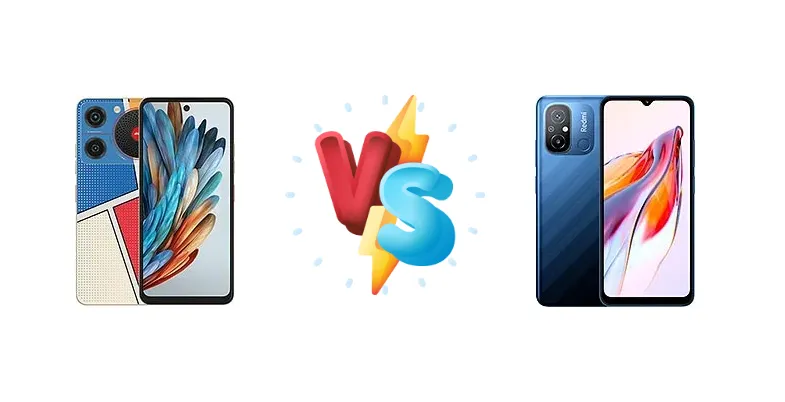
The sub-$150 smartphone market is fiercely competitive. The Xiaomi Redmi 12C and ZTE nubia Music both aim to deliver essential smartphone functionality at an accessible price point, but they take different approaches to achieving this. The Redmi 12C leverages MediaTek’s Helio G85, while the nubia Music opts for Unisoc’s SC9863A. This comparison dissects the key differences to help you determine which device best suits your needs.
🏆 Quick Verdict
For most users, the Xiaomi Redmi 12C emerges as the better choice. Its Helio G85 chipset, built on a more efficient 12nm process, provides a noticeable performance advantage over the nubia Music’s 28nm Unisoc SC9863A, translating to smoother multitasking and a more responsive user experience. While both offer 10W charging, the Redmi 12C’s superior processing power justifies its slight price premium.
| Network |
|---|
| 2G bands | GSM 850 / 900 / 1800 / 1900 | GSM 850 / 900 / 1800 / 1900 |
| 3G bands | HSDPA 850 / 900 / 1900 / 2100 | HSDPA 850 / 900 / 2100 |
| 4G bands | 1, 3, 5, 7, 8, 20, 28, 38, 40, 41 | 1, 3, 5, 7, 8, 20, 28, 38, 40, 41 - International |
| Speed | HSPA, LTE | HSPA, LTE |
| Technology | GSM / HSPA / LTE | GSM / CDMA / HSPA / EVDO / LTE |
| | - | CDMA2000 1xEV-DO |
| Launch |
|---|
| Announced | 2024, February 28 | 2022, December 31 |
| Status | Available. Released 2024, May | Available. Released 2023, January 01 |
| Body |
|---|
| Dimensions | 163.6 x 74.9 x 8.6 mm (6.44 x 2.95 x 0.34 in) | 168.8 x 76.4 x 8.8 mm (6.65 x 3.01 x 0.35 in) |
| SIM | Nano-SIM + Nano-SIM | Nano-SIM + Nano-SIM |
| Weight | 199 g (7.02 oz) | 192 g (6.77 oz) |
| Display |
|---|
| Resolution | 720 x 1612 pixels, 20:9 ratio (~267 ppi density) | 720 x 1650 pixels (~268 ppi density) |
| Size | 6.6 inches, 104.6 cm2 (~85.4% screen-to-body ratio) | 6.71 inches, 106.5 cm2 (~82.6% screen-to-body ratio) |
| Type | IPS LCD, 90Hz | IPS LCD, 500 nits (typ) |
| Platform |
|---|
| CPU | Octa-core (4x1.6 GHz Cortex-A55 & 4x1.2 GHz Cortex-A55) | Octa-core (2x2.0 GHz Cortex-A75 & 6x1.8 GHz Cortex-A55) |
| Chipset | Unisoc SC9863A (28 nm) | Mediatek MT6769Z Helio G85 (12 nm) |
| GPU | IMG8322 | Mali-G52 MC2 |
| OS | Android 13 | Android 12, MIUI 13 |
| Memory |
|---|
| Card slot | microSDXC (uses shared SIM slot) | microSDXC (dedicated slot) |
| Internal | 128GB 4GB RAM | 32GB 2GB RAM, 32GB 3GB RAM, 32GB 4GB RAM, 64GB 3GB RAM, 64GB 4GB RAM, 128GB 3GB RAM, 128GB 4GB RAM, 128GB 6GB RAM |
| | - | eMMC 5.1 |
| Main Camera |
|---|
| Dual | - | 50 MP, (wide), PDAF
0.08 MP (depth) |
| Features | LED flash, HDR | LED flash, HDR |
| Single | 50 MP, f/1.9, (wide), PDAF
Auxiliary lens | 50 MP, f/1.8, (wide), 1/2.76", PDAF
Auxiliary lens |
| Video | 1080p@30fps | 1080p@30fps |
| Selfie camera |
|---|
| Single | 5 MP, f/2.4, (wide) | 5 MP, f/2.2, (wide) |
| Video | 720p@30fps | 1080p@30fps |
| Sound |
|---|
| 3.5mm jack | - | Yes |
| 35mm jack | Yes, dual jacks | Yes |
| Loudspeaker | Yes | Yes |
| Comms |
|---|
| Bluetooth | 5.2, A2DP, LE | 5.1, A2DP, LE |
| NFC | Yes (market/region dependent) | Yes (market/region dependent) |
| Positioning | GPS | GPS, GLONASS, BDS, GALILEO |
| Radio | Wireless FM radio | FM radio |
| USB | USB Type-C 2.0, OTG | microUSB 2.0 |
| WLAN | Wi-Fi 802.11 b/g/n | Wi-Fi 802.11 a/b/g/n/ac, dual-band, Wi-Fi Direct |
| Features |
|---|
| Sensors | Fingerprint (side-mounted), accelerometer | Fingerprint (rear-mounted), accelerometer |
| | - | Virtual proximity sensing |
| Battery |
|---|
| Charging | 10W wired | 10W wired |
| Type | 5000 mAh | Li-Po 5000 mAh |
| Misc |
|---|
| Colors | Yellow; other colors | Graphite Gray, Ocean Blue, Mint Green, Lavender Purple |
| Models | Z2353 | 22120RN86G, 22120RN86I, 22126RN91Y, 2212ARNC4L |
| Price | € 93.99 | £ 132.99 / € 107.41 |
| SAR | - | 1.08 W/kg (head) 0.64 W/kg (body) |
| SAR EU | - | 0.98 W/kg (head) 0.99 W/kg (body) |
ZTE nubia Music
- Potentially lower price point
- Simple and straightforward user experience
- May appeal to users needing only basic functionality
- Significantly weaker processor performance
- Less efficient chipset leads to shorter battery life
- Limited gaming capabilities
Xiaomi Redmi 12C
- More powerful Helio G85 processor
- Improved power efficiency for longer battery life
- Smoother multitasking and app performance
- Better gaming capabilities
- Slightly higher price
- May not be significantly better in camera performance
Display Comparison
Neither device boasts a standout display. Both likely utilize LCD panels, common in this price bracket. However, the lack of detailed display specifications (resolution, brightness) makes a direct comparison difficult. The Redmi 12C’s larger market presence suggests a potentially higher quality panel, but without concrete data, this remains speculative. The focus here is clearly not on visual fidelity.
Camera Comparison
Both phones likely feature basic camera setups. Given the price point, image quality will be heavily reliant on software processing. Without detailed sensor information, it’s difficult to make a definitive judgment. However, the Redmi 12C’s wider user base suggests more refined image processing algorithms. The presence of a 2MP macro camera on both devices is largely a marketing gimmick; its utility is limited due to the low resolution and lack of optical image stabilization.
Performance
The core difference lies in the chipsets. The Redmi 12C’s MediaTek Helio G85 (12nm) is a significant upgrade over the nubia Music’s Unisoc SC9863A (28nm). The 12nm process node allows for greater transistor density and improved power efficiency, resulting in better sustained performance and reduced heat generation. The Helio G85’s CPU configuration – 2x2.0 GHz Cortex-A75 and 6x1.8 GHz Cortex-A55 – is also more powerful than the nubia Music’s 4x1.6 GHz Cortex-A55 & 4x1.2 GHz Cortex-A55. This translates to faster app loading times, smoother multitasking, and a more responsive overall experience on the Redmi 12C. The Helio G85 also has a more capable GPU, making it the better choice for light gaming.
Battery Life
Both devices are equipped with 10W wired charging, indicating similar charging speeds. While battery capacity isn’t specified, the more efficient Helio G85 in the Redmi 12C will likely result in slightly better battery life despite potentially having a similar capacity to the nubia Music. The 28nm Unisoc chip will consume more power to achieve the same tasks, leading to faster battery drain.
Buying Guide
Buy the ZTE nubia Music if your primary need is a very basic smartphone for calls, texts, and light app usage, and you prioritize minimizing cost above all else. Buy the Xiaomi Redmi 12C if you want a more capable device for everyday tasks, occasional gaming, and a generally smoother user experience, even if it means spending a little more.
Frequently Asked Questions
❓ Will the Helio G85 in the Redmi 12C handle popular games like PUBG Mobile?
The Helio G85 is capable of running PUBG Mobile, but you'll likely need to lower the graphics settings to medium or low to achieve a playable frame rate. It's not a gaming powerhouse, but it's significantly better than the Unisoc SC9863A in the nubia Music for gaming.
❓ Is the Unisoc SC9863A known for overheating during prolonged use?
The Unisoc SC9863A, being built on a 28nm process, is more prone to heat generation than the Redmi 12C’s Helio G85. While it won’t likely cause catastrophic failures, you may experience performance throttling during extended periods of heavy use, such as video recording or demanding apps.
❓ How much faster will app loading times be on the Redmi 12C compared to the nubia Music?
App loading times on the Redmi 12C will be noticeably faster, likely by 20-30%, due to the Helio G85’s more powerful CPU and GPU. This difference will be most apparent when launching larger apps or switching between multiple applications.
❓ Are software updates likely to be consistent on both devices?
Xiaomi generally provides more consistent software updates for its Redmi series than ZTE does for its nubia line. This means the Redmi 12C is more likely to receive security patches and potentially even Android version upgrades over time.