
ZTE nubia Music vs Motorola Moto G Play (2023): A Deep Dive into Budget Smartphone Choices
| Phones Images | |||||
|---|---|---|---|---|---|
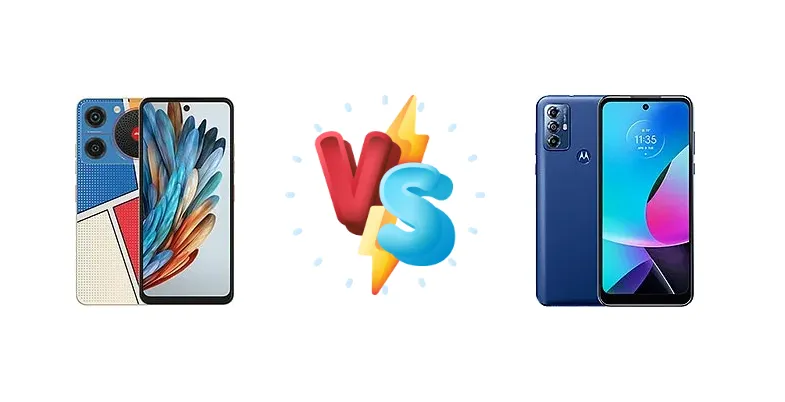
|
🏆 Quick Verdict
For most users, the Motorola Moto G Play (2023) is the better choice. Its Mediatek Helio G37 chipset, fabricated on a 12nm process, provides a noticeable performance advantage over the ZTE nubia Music’s older 28nm Unisoc SC9863A, translating to smoother app loading and a more responsive user experience. While both offer basic functionality, the Moto G Play delivers a more future-proof platform.
| PHONES | ||
|---|---|---|
| Phone Names | ZTE nubia Music | Motorola Moto G Play (2023) |
| Network | ||
|---|---|---|
| 2G bands | GSM 850 / 900 / 1800 / 1900 | GSM 850 / 900 / 1800 / 1900 |
| 3G bands | HSDPA 850 / 900 / 1900 / 2100 | HSDPA 850 / 900 / 1700(AWS) / 1900 / 2100 |
| 4G bands | 1, 3, 5, 7, 8, 20, 28, 38, 40, 41 | 1, 2, 3, 4, 5, 7, 8, 12, 13, 14, 17, 18, 19, 20, 25, 26, 29, 30, 38, 39, 40, 41, 66, 71 |
| Speed | HSPA, LTE | HSPA, LTE |
| Technology | GSM / HSPA / LTE | GSM / CDMA / HSPA / LTE |
| - | CDMA 800 / 1900 | |
| Launch | ||
|---|---|---|
| Announced | 2024, February 28 | 2022, December 08 |
| Status | Available. Released 2024, May | Available. Released 2022, December 12 |
| Body | ||
|---|---|---|
| Build | - | Plastic frame, plastic back |
| Dimensions | 163.6 x 74.9 x 8.6 mm (6.44 x 2.95 x 0.34 in) | 167.2 x 76.5 x 9.4 mm (6.58 x 3.01 x 0.37 in) |
| SIM | Nano-SIM + Nano-SIM | Nano-SIM |
| Weight | 199 g (7.02 oz) | 203 g (7.20 oz) |
| - | Water-repellent coating | |
| Display | ||
|---|---|---|
| Resolution | 720 x 1612 pixels, 20:9 ratio (~267 ppi density) | 720 x 1600 pixels, 20:9 ratio (~270 ppi density) |
| Size | 6.6 inches, 104.6 cm2 (~85.4% screen-to-body ratio) | 6.5 inches, 102.0 cm2 (~79.7% screen-to-body ratio) |
| Type | IPS LCD, 90Hz | IPS LCD, 90Hz |
| Platform | ||
|---|---|---|
| CPU | Octa-core (4x1.6 GHz Cortex-A55 & 4x1.2 GHz Cortex-A55) | Octa-core (4x2.3 GHz Cortex-A53 & 4x1.8 GHz Cortex-A53) |
| Chipset | Unisoc SC9863A (28 nm) | Mediatek MT6765 Helio G37 (12 nm) |
| GPU | IMG8322 | PowerVR GE8320 |
| OS | Android 13 | Android 12 |
| Memory | ||
|---|---|---|
| Card slot | microSDXC (uses shared SIM slot) | microSDXC (dedicated slot) |
| Internal | 128GB 4GB RAM | 32GB 3GB RAM |
| - | eMMC 5.1 | |
| Main Camera | ||
|---|---|---|
| Features | LED flash, HDR | LED flash, HDR, panorama |
| Single | 50 MP, f/1.9, (wide), PDAF Auxiliary lens | - |
| Triple | - | 16 MP, f/2.2, (wide), 1.12µm, PDAF 2 MP (macro) Auxiliary lens |
| Video | 1080p@30fps | 1080p@30/60fps |
| Selfie camera | ||
|---|---|---|
| Features | - | HDR |
| Single | 5 MP, f/2.4, (wide) | 5 MP, f/2.4, (wide), 1.12µm |
| Video | 720p@30fps | 1080p@30fps |
| Sound | ||
|---|---|---|
| 3.5mm jack | - | Yes |
| 35mm jack | Yes, dual jacks | Yes |
| Loudspeaker | Yes | Yes |
| Comms | ||
|---|---|---|
| Bluetooth | 5.2, A2DP, LE | 5.0, A2DP, LE |
| NFC | Yes (market/region dependent) | No |
| Positioning | GPS | GPS, GLONASS |
| Radio | Wireless FM radio | No |
| USB | USB Type-C 2.0, OTG | USB Type-C 2.0 |
| WLAN | Wi-Fi 802.11 b/g/n | Wi-Fi 802.11 a/b/g/n/ac, dual-band |
| Features | ||
|---|---|---|
| Sensors | Fingerprint (side-mounted), accelerometer | Fingerprint (rear-mounted), accelerometer, proximity, barometer |
| Battery | ||
|---|---|---|
| Charging | 10W wired | 10W wired |
| Type | 5000 mAh | Li-Po 5000 mAh |
| Misc | ||
|---|---|---|
| Colors | Yellow; other colors | Deep Indigo |
| Models | Z2353 | XT2271-1, XT2271-3, XT2271-5, XT2271-4 |
| Price | € 93.99 | $ 54.00 / C$ 129.00 |
ZTE nubia Music
- Potential focus on audio quality (implied by name)
- Lower price point (likely)
- Simple and straightforward user experience
- Older, less efficient Unisoc SC9863A chipset
- 28nm process leads to higher power consumption
- Likely slower performance compared to Moto G Play
Motorola Moto G Play (2023)
- More modern and efficient Mediatek Helio G37 chipset
- 12nm process improves performance and battery life
- Faster CPU clock speeds for smoother operation
- Basic camera system
- 10W charging is relatively slow
- May not have a significant audio advantage
Display Comparison
Neither device boasts a standout display. Details regarding panel type, resolution, or refresh rate are absent, suggesting both utilize basic LCD panels. However, the lack of information on PWM dimming rates makes it difficult to assess potential eye strain. The display is likely a cost-saving measure on both devices, focusing on functionality over visual fidelity.
Camera Comparison
Camera performance is likely to be similar, leaning towards basic functionality on both devices. The absence of details regarding sensor size or image stabilization suggests both rely on simple camera modules. Any 2MP macro or depth sensors present on either device are unlikely to deliver significant image quality improvements. Image processing will likely be the differentiating factor, but without sample images, it’s difficult to assess which device performs better in real-world scenarios.
Performance
The core difference lies in the chipsets. The Motorola Moto G Play (2023) utilizes the Mediatek Helio G37, built on a more efficient 12nm process. This contrasts sharply with the ZTE nubia Music’s Unisoc SC9863A, fabricated on an older 28nm node. The 12nm process allows for higher transistor density and improved power efficiency, resulting in better sustained performance and reduced thermal throttling. While both are octa-core CPUs, the Helio G37’s Cortex-A53 cores clocked at 2.3 GHz offer a significant speed advantage over the nubia Music’s 1.6 GHz and 1.2 GHz Cortex-A55 cores. This translates to faster app launches, smoother multitasking, and a more responsive user interface on the Moto G Play.
Battery Life
Both devices feature 10W wired charging, indicating similar charging speeds. While battery capacity isn’t specified, the more efficient Mediatek Helio G37 in the Moto G Play (2023) will likely result in better battery life despite potentially having a similar capacity to the nubia Music. The 12nm process reduces power consumption, allowing the Moto G Play to operate longer on a single charge, especially during demanding tasks.
Buying Guide
Buy the ZTE nubia Music if you absolutely prioritize audio quality and have a limited budget, and are willing to compromise on overall performance. Its name suggests a focus on sound, though details are limited in the provided specs. Buy the Motorola Moto G Play (2023) if you prefer a more responsive and capable smartphone experience for everyday tasks, social media, and light gaming, even if it means sacrificing potential audio enhancements.