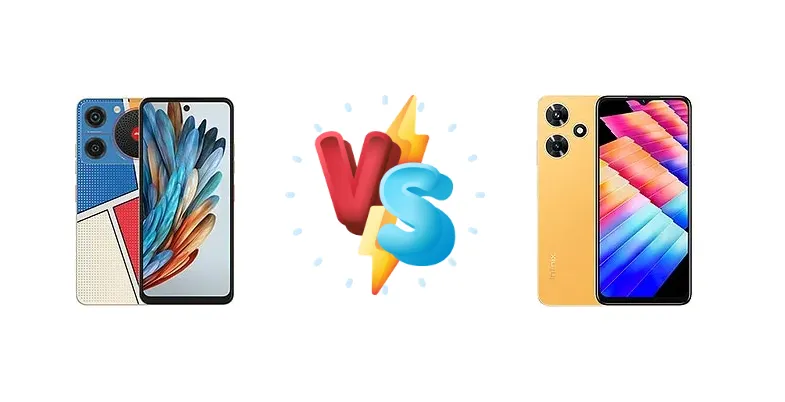
The ZTE nubia Music and Infinix Hot 30i represent a growing segment of ultra-affordable smartphones. Both rely on Unisoc chipsets to deliver a functional Android experience, but significant differences in their silicon and charging capabilities dictate which phone is the better choice for different users. This comparison dissects those differences, focusing on real-world performance implications.
🏆 Quick Verdict
For most users, the Infinix Hot 30i emerges as the superior choice. Its newer 12nm Unisoc T606 chipset, featuring Cortex-A75 performance cores, provides a noticeable performance uplift over the nubia Music’s older SC9863A. The 18W charging also significantly reduces downtime, making the Hot 30i a more practical daily driver.
| Network |
|---|
| 2G bands | GSM 850 / 900 / 1800 / 1900 | GSM 850 / 900 / 1800 / 1900 |
| 3G bands | HSDPA 850 / 900 / 1900 / 2100 | HSDPA 850 / 900 / 1700(AWS) / 1900 / 2100 |
| 4G bands | 1, 3, 5, 7, 8, 20, 28, 38, 40, 41 | 1, 2, 3, 4, 5, 7, 8, 20, 28, 38, 40, 41 |
| Speed | HSPA, LTE | HSPA, LTE |
| Technology | GSM / HSPA / LTE | GSM / HSPA / LTE |
| Launch |
|---|
| Announced | 2024, February 28 | 2023, March 31 |
| Status | Available. Released 2024, May | Available. Released 2023, March 31 |
| Body |
|---|
| Build | - | Glass front, plastic frame, plastic back |
| Dimensions | 163.6 x 74.9 x 8.6 mm (6.44 x 2.95 x 0.34 in) | 164 x 75.8 x 8.4 mm (6.46 x 2.98 x 0.33 in) |
| SIM | Nano-SIM + Nano-SIM | Nano-SIM + Nano-SIM |
| Weight | 199 g (7.02 oz) | 191 g (6.74 oz) |
| Display |
|---|
| Resolution | 720 x 1612 pixels, 20:9 ratio (~267 ppi density) | 720 x 1612 pixels, 20:9 ratio (~269 ppi density) |
| Size | 6.6 inches, 104.6 cm2 (~85.4% screen-to-body ratio) | 6.56 inches, 103.4 cm2 (~83.2% screen-to-body ratio) |
| Type | IPS LCD, 90Hz | IPS LCD, 90Hz, 500 nits (peak) |
| Platform |
|---|
| CPU | Octa-core (4x1.6 GHz Cortex-A55 & 4x1.2 GHz Cortex-A55) | Octa-core (2x1.6 GHz Cortex-A75 & 6x1.6 GHz Cortex-A55) |
| Chipset | Unisoc SC9863A (28 nm) | Unisoc T606 (12 nm) |
| GPU | IMG8322 | Mali-G57 MP1 |
| OS | Android 13 | Android 12, XOS 10.6 |
| Memory |
|---|
| Card slot | microSDXC (uses shared SIM slot) | microSDXC (dedicated slot) |
| Internal | 128GB 4GB RAM | 64GB 4GB RAM, 128GB 4GB RAM, 128GB 8GB RAM |
| | - | UFS 2.2 |
| Main Camera |
|---|
| Dual | - | 13 MP, f/1.9, (wide), AF
0.08 MP, (depth) |
| Features | LED flash, HDR | Dual-LED flash, HDR, panorama |
| Single | 50 MP, f/1.9, (wide), PDAF
Auxiliary lens | 13 MP, f/1.9, (wide), 1/3.07", AF
Auxiliary lens |
| Video | 1080p@30fps | 1080p@30fps |
| Selfie camera |
|---|
| Features | - | Dual-LED flash |
| Single | 5 MP, f/2.4, (wide) | 8 MP, f/2.0, (wide), 1/3.94" |
| Video | 720p@30fps | 1080p@30fps |
| Sound |
|---|
| 3.5mm jack | - | Yes |
| 35mm jack | Yes, dual jacks | Yes |
| Loudspeaker | Yes | Yes |
| Comms |
|---|
| Bluetooth | 5.2, A2DP, LE | Yes |
| NFC | Yes (market/region dependent) | Yes (Hot 30i NFC only) |
| Positioning | GPS | GPS |
| Radio | Wireless FM radio | FM radio |
| USB | USB Type-C 2.0, OTG | USB Type-C 2.0, OTG |
| WLAN | Wi-Fi 802.11 b/g/n | Wi-Fi 802.11 a/b/g/n/ac, dual-band |
| Features |
|---|
| Sensors | Fingerprint (side-mounted), accelerometer | Fingerprint (side-mounted), accelerometer, proximity, compass |
| Battery |
|---|
| Charging | 10W wired | 18W wired |
| Type | 5000 mAh | 5000 mAh |
| Misc |
|---|
| Colors | Yellow; other colors | Mirror Black, Glacier Blue, Diamond White, Marigold |
| Models | Z2353 | X669, X669D |
| Price | € 93.99 | - |
ZTE nubia Music
- Potentially lower price point.
- Simple and straightforward user experience.
- May be more readily available in certain markets.
- Significantly slower processor.
- Slower 10W charging.
- Less responsive user interface.
Infinix Hot 30i
- Faster and more efficient Unisoc T606 chipset.
- Faster 18W wired charging.
- Improved responsiveness and multitasking.
- Better suited for casual gaming.
- May be slightly more expensive.
- Potentially larger physical size.
Display Comparison
Neither device boasts a standout display. Given the context data focuses on processing, we can infer both likely utilize LCD panels common in this price bracket. The absence of information regarding resolution or refresh rate suggests both are targeting the baseline for affordability. Bezels are likely substantial on both, prioritizing cost reduction over premium aesthetics. Color accuracy is expected to be standard for the segment, leaning towards warmer tones to appear more vibrant.
Camera Comparison
Without detailed camera specifications, a direct comparison is difficult. However, given the price points, both phones likely feature basic camera setups. We can assume both will include a primary sensor, potentially accompanied by a depth or macro lens of limited utility. The image processing capabilities of the Unisoc chipsets are unlikely to be sophisticated, resulting in images that are acceptable in good lighting conditions but struggle in low light. The aperture of the main lens will be the most critical factor, but without that data, it’s impossible to determine which phone captures better images.
Performance
The core difference lies in the chipsets. The Infinix Hot 30i’s Unisoc T606 (12nm) is a clear upgrade over the ZTE nubia Music’s Unisoc SC9863A (28nm). The T606’s inclusion of 2x 1.6 GHz Cortex-A75 cores alongside 6x Cortex-A55 cores provides a significant boost in single-core performance, crucial for app launch speeds and general responsiveness. The SC9863A relies solely on 4x 1.6 GHz Cortex-A55 and 4x 1.2 GHz Cortex-A55, resulting in a slower, more sluggish experience. The 12nm process node of the T606 also contributes to better power efficiency, potentially extending battery life under load. While both likely pair with similar amounts of RAM, the T606’s superior CPU architecture will minimize bottlenecks.
Battery Life
While battery capacity isn’t specified, the charging wattage difference is significant. The Infinix Hot 30i’s 18W wired charging is considerably faster than the ZTE nubia Music’s 10W charging. This translates to a much quicker 0-100% charge time, reducing downtime and improving usability. Even with a similar battery capacity, the Hot 30i’s more efficient chipset could result in slightly longer battery life during typical usage. The faster charging is a key advantage for users who rely heavily on their phones throughout the day.
Buying Guide
Buy the ZTE nubia Music if your priority is a simple, no-frills experience and you primarily need a phone for basic communication and light tasks. Its lower price point may be attractive for first-time smartphone users or as a secondary device. Buy the Infinix Hot 30i if you value responsiveness, faster charging, and a more capable processor for social media, streaming, and casual gaming. The Hot 30i offers a better overall user experience for a minimal price increase.
Frequently Asked Questions
❓ Will the Infinix Hot 30i handle popular games like PUBG Mobile or Call of Duty?
The Unisoc T606 in the Hot 30i can run PUBG Mobile and Call of Duty, but expect to play at lower graphics settings (Medium or Low) and frame rates to maintain a stable experience. The SC9863A in the nubia Music will struggle with these titles, offering a significantly less enjoyable gaming experience.
❓ How long will it take to fully charge each phone from 0%?
With its 18W charging, the Infinix Hot 30i should fully charge in approximately 2-3 hours, depending on battery capacity. The ZTE nubia Music’s 10W charging will take considerably longer, likely exceeding 4-5 hours for a full charge. This difference is substantial for users who need to quickly top up their battery.
❓ Is the difference in processor speed noticeable in everyday tasks like browsing and social media?
Yes, the difference is quite noticeable. The Cortex-A75 cores in the Infinix Hot 30i’s T606 chipset provide a snappier and more responsive experience when opening apps, scrolling through social media feeds, and browsing the web. The nubia Music’s SC9863A will feel sluggish in comparison.