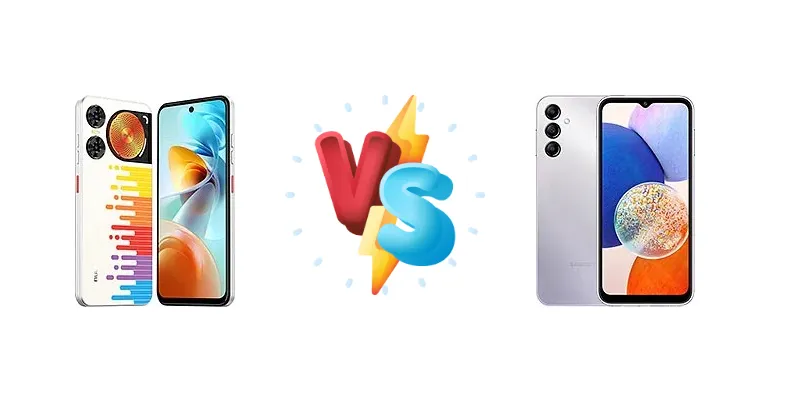
The ZTE nubia Music 2 and Samsung Galaxy A14 5G represent opposite ends of the budget smartphone spectrum. The nubia prioritizes extreme battery endurance, while the A14 5G focuses on bringing 5G connectivity and a more contemporary feature set to a wider audience. This comparison dissects their strengths and weaknesses to determine which device delivers the best value.
🏆 Quick Verdict
For users prioritizing all-day (and multi-day) battery life above all else, the ZTE nubia Music 2 is the clear winner, offering nearly 50 hours of endurance. However, the Samsung Galaxy A14 5G provides a more balanced experience with 5G support, a brighter display, and a more modern chipset, making it the better choice for most users.
| Network |
|---|
| 2G bands | GSM 850 / 900 / 1800 / 1900 | GSM 850 / 900 / 1800 / 1900 |
| 3G bands | HSDPA 850 / 900 / 1900 / 2100 | HSDPA 850 / 900 / 1700(AWS) / 1900 / 2100 |
| 4G bands | 1, 3, 5, 7, 8, 20, 28, 38, 40, 41 | 1, 2, 3, 4, 5, 7, 8, 12, 17, 20, 26, 28, 38, 40, 41, 66 - International |
| 5G bands | - | 2, 5, 66, 77 Sub6/mmWave - USA |
| Speed | HSPA, LTE | HSPA, LTE, 5G |
| Technology | GSM / HSPA / LTE | GSM / HSPA / LTE / 5G |
| | - | 1, 3, 5, 7, 8, 20, 28, 40, 41, 78 SA/NSA/Sub6 - India |
| Launch |
|---|
| Announced | 2025, January 07 | 2023, January 04 |
| Status | Available. Released 2025, January 07 | Available. Released 2023, January 12 |
| Body |
|---|
| Build | - | Glass front, plastic back, plastic frame |
| Dimensions | 163.6 x 74.9 x 8.6 mm (6.44 x 2.95 x 0.34 in) | 167.7 x 78 x 9.1 mm (6.60 x 3.07 x 0.36 in) |
| SIM | Nano-SIM + Nano-SIM | · Nano-SIM· Nano-SIM + Nano-SIM |
| Weight | 202 g (7.13 oz) | 202 g (7.13 oz) |
| Display |
|---|
| Protection | Mohs level 4 | - |
| Resolution | 720 x 1612 pixels, 20:9 ratio (~264 ppi density) | 1080 x 2408 pixels, 20:9 ratio (~400 ppi density) |
| Size | 6.7 inches, 107.8 cm2 (~88.0% screen-to-body ratio) | 6.6 inches, 104.9 cm2 (~80.2% screen-to-body ratio) |
| Type | IPS LCD, 120Hz | PLS LCD, 90Hz |
| Platform |
|---|
| CPU | Octa-core (2x1.6 GHz Cortex-A75 & 6x1.6 GHz Cortex-A55) | Octa-core (2x2.4 GHz Cortex-A78 & 6x2.0 GHz Cortex-A55) - SM-A146BOcta-core (2x2.2 GHz Cortex-A76 & 6x2.0 GHz Cortex-A55) - SM-A146P |
| Chipset | Unisoc T7200 (12 nm) | Exynos 1330 (5 nm) - SM-A146BMediatek Dimensity 700 (7 nm) - SM-A146P |
| GPU | Mali-G57 MP1 | Mali-G68 MP2 - SM-A146BMali-G57 MC2 - SM-A146P |
| OS | Android 14 | Android 13, upgradable to Android 15, One UI Core 7 |
| Memory |
|---|
| Card slot | microSDXC (uses shared SIM slot) | microSDXC (uses shared SIM slot) - USA onlymicroSDXC (dedicated slot) - International |
| Internal | 128GB 4GB RAM | 64GB 4GB RAM, 128GB 4GB RAM, 128GB 6GB RAM, 128GB 8GB RAM |
| Main Camera |
|---|
| Features | LED flash, HDR | LED flash, panorama, HDR |
| Single | 50 MP, f/1.8, (wide), PDAF
Auxiliary lens | 13 MP, f/2.0, (wide) |
| Triple | - | 50 MP, f/1.8, 26mm (wide), 1/2.76", 0.64µm, PDAF
2 MP (macro)
Auxiliary lens |
| Video | 1080p@30fps | 1080p@30fps |
| Selfie camera |
|---|
| Single | 5 MP, f/2.4, (wide) | 13 MP, f/2.0, 26mm (wide), 1.12µm |
| Video | 720p@30fps | 1080p@30fps |
| Sound |
|---|
| 3.5mm jack | - | Yes |
| 35mm jack | Yes | Yes |
| Loudspeaker | Yes, with stereo speakers (3 speakers) | Yes |
| Comms |
|---|
| Bluetooth | 5.2, A2DP, LE | 5.2, A2DP, LE |
| NFC | Yes (market/region dependent) | Yes |
| Positioning | GPS | GPS, GLONASS, GALILEO |
| Radio | Unspecified | FM radio (Exynos 1330 chipset only), recording |
| USB | USB Type-C 2.0, OTG | USB Type-C 2.0 |
| WLAN | Wi-Fi 802.11 b/g/n/ac, dual-band | Wi-Fi 802.11 a/b/g/n/ac, dual-band, Wi-Fi Direct |
| Features |
|---|
| Sensors | Fingerprint (side-mounted); unspecified sensors | Fingerprint (side-mounted), accelerometer, gyro, proximity, compass, barometer (USA only) |
| Battery |
|---|
| Charging | 10W wired | 15W wired |
| Type | 5000 mAh | Li-Po 5000 mAh |
| Misc |
|---|
| Colors | Yellow/Blue/Red, White | Black, Light Green, Dark Red, Silver |
| Models | Z2460 | SM-A146B, SM-A146B/DS, SM-A146P, SM-A146P/DS, SM-A146U, SM-A146U1, SM-A146U1/DS, SM-A146W, SM-A146P/N, SM-A146P/DSN, SM-S146VL, SM-A146M |
| Price | € 87.51 / £ 78.27 | $ 77.63 / C$ 151.00 / £ 97.00 / € 159.79 / ₹ 14,990 |
| SAR | - | 1.00 W/kg (head) 1.00 W/kg (body) |
| SAR EU | - | 0.56 W/kg (head) 1.28 W/kg (body) |
| Tests |
|---|
| Battery life | - |
Endurance rating 130h
|
| Camera | - |
Photo / Video |
| Display | - |
Contrast ratio: 1334:1 (nominal) |
| Loudspeaker | - |
-26.8 LUFS (Good)
|
| Performance | - |
AnTuTu: 307886 (v9)
GeekBench: 1727 (v5.1)
GFXBench: 12fps (ES 3.1 onscreen) |
| EU LABEL |
|---|
| Battery | 49:27h endurance, 800 cycles | - |
| Energy | Class B | - |
| Free fall | Class D (45 falls) | - |
| Repairability | Class B | - |
ZTE nubia Music 2
- Exceptional battery life (49:27h endurance)
- 800 battery charge cycles suggest long-term durability
- Potentially lower cost due to older chipset
- Slow 10W charging
- Less powerful Unisoc T7200 chipset
- Lacks 5G connectivity
Samsung Galaxy A14 5G
- 5G connectivity for faster data speeds
- More powerful Exynos 1330 or Dimensity 700 chipset
- Brighter display (519 nits)
- Significantly shorter battery life (130h endurance)
- 15W charging is relatively slow
- Potential chipset variation (Exynos vs. Dimensity)
Display Comparison
The Samsung Galaxy A14 5G boasts a significantly brighter display, reaching 519 nits compared to an unlisted value for the nubia Music 2. Both share a 1334:1 contrast ratio, suggesting similar panel quality in terms of black levels. The A14 5G’s higher brightness will be particularly beneficial for outdoor visibility. While the nubia Music 2’s display specs are unknown, its focus on battery life suggests a potentially less power-hungry panel, but likely at the cost of brightness and color accuracy.
Camera Comparison
Both phones feature 'Photo / Video' capabilities, but detailed camera specs are limited. The lack of specific sensor information makes a direct comparison difficult. However, given the A14 5G’s positioning, it likely benefits from Samsung’s image processing algorithms, potentially delivering more refined photos. The nubia Music 2’s camera is likely a more basic implementation, prioritizing cost savings over image quality. The presence of a 2MP macro camera on the A14 5G is unlikely to significantly impact overall camera performance.
Performance
The Samsung Galaxy A14 5G presents a more complex chipset situation, with the SM-A146B model utilizing the Exynos 1330 (5nm) and the SM-A146P using the MediaTek Dimensity 700 (7nm). Both represent a performance leap over the ZTE nubia Music 2’s Unisoc T7200 (12nm). The 5nm process of the Exynos 1330 offers superior power efficiency and thermal performance, translating to less throttling during sustained tasks. The A14 5G’s CPU, featuring Cortex-A78 cores, also outperforms the A75 cores in the nubia Music 2. This means faster app loading, smoother multitasking, and a more responsive user experience on the Samsung device.
Battery Life
The ZTE nubia Music 2 dominates in battery endurance, achieving an astonishing 49 hours and 27 minutes of usage. This is drastically superior to the Samsung Galaxy A14 5G’s 130 hours. However, the A14 5G offers 15W wired charging, slightly faster than the nubia Music 2’s 10W charging. While the nubia’s battery capacity is unlisted, its endurance suggests a large battery, but the slower charging speed means a longer time to fully replenish. The A14 5G’s 5G connectivity will also impact battery life, potentially reducing its overall endurance compared to the nubia Music 2.
Buying Guide
Buy the ZTE nubia Music 2 if you absolutely need a phone that can last for days on a single charge, and are willing to compromise on processing power and 5G connectivity. Buy the Samsung Galaxy A14 5G if you want a more well-rounded smartphone experience with 5G, a brighter screen, and a more responsive processor, even if it means charging more frequently.
Frequently Asked Questions
❓ Does the Exynos 1330 in the Samsung Galaxy A14 5G tend to overheat during prolonged gaming sessions?
The Exynos 1330, built on a 5nm process, is generally efficient and shouldn't exhibit significant overheating during typical gaming. However, demanding titles at maximum settings may cause some thermal throttling, reducing performance slightly over extended periods. The A14 5G’s plastic build doesn’t aid in heat dissipation, but it’s unlikely to reach uncomfortable temperatures.
❓ Is the 2MP macro camera on the Samsung Galaxy A14 5G actually useful for taking detailed close-up photos?
Generally, 2MP macro cameras on budget phones offer limited detail and image quality. The small sensor size and fixed focus often result in soft, noisy images. While it can be fun to experiment with, don’t expect professional-level macro photography from the A14 5G.
❓ How long does it realistically take to fully charge the ZTE nubia Music 2 with its 10W charging?
With a 10W charger, fully charging the ZTE nubia Music 2 will likely take over 4 hours, potentially closer to 5 or 6 hours depending on the battery capacity. This is a significant drawback compared to the A14 5G’s 15W charging, but is a trade-off for the exceptional battery endurance.
❓ Which phone is better for streaming videos and browsing the web on the go?
The Samsung Galaxy A14 5G is better suited for streaming and browsing due to its brighter display and more powerful processor. The brighter screen ensures better visibility in various lighting conditions, and the Exynos 1330 or Dimensity 700 will provide a smoother, more responsive experience when loading web pages and streaming video content.