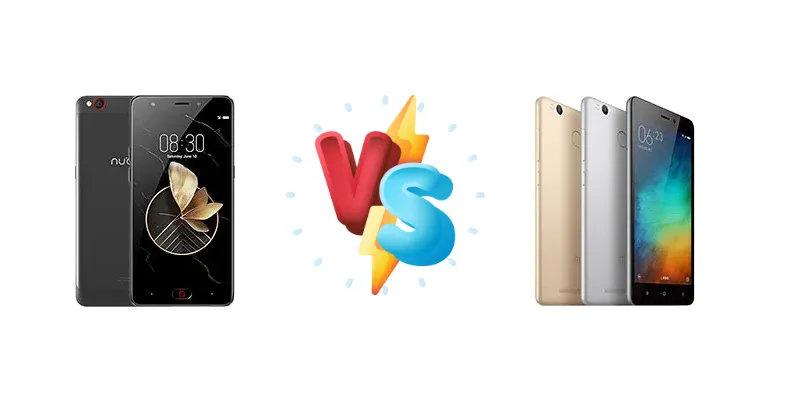
The budget smartphone market is fiercely competitive, offering incredible value for money. Today, we're pitting two contenders against each other: the ZTE nubia M2 Play and the Xiaomi Redmi 3s Prime. Both promise affordability, but which one delivers the better overall experience?
🏆 Quick Verdict
The Xiaomi Redmi 3s Prime edges out the nubia M2 Play thanks to its exceptional battery life and slightly better overall performance. While both are budget options, the Redmi 3s Prime's endurance and established reputation give it a slight advantage, making it a more reliable choice for daily use.
| Network |
|---|
| 2G bands | GSM 850 / 900 / 1800 / 1900 - SIM 1 & SIM 2 | GSM 900 / 1800 - SIM 1 & SIM 2 |
| 3G bands | HSDPA 850 / 900 / 1900 / 2100 | HSDPA 900 / 2100 - India |
| 4G bands | 1, 3, 5, 7, 38, 39, 40, 41 | 3, 5, 40 - India |
| Speed | HSPA, LTE | HSPA, LTE |
| Technology | GSM / CDMA / HSPA / LTE | GSM / HSPA / LTE |
| | CDMA 800 & TD-SCDMA | 1, 3, 7, 8, 20, 40 - Global |
| Launch |
|---|
| Announced | 2017, June. Released 2017, July | 2016, August. Released 2016, August |
| Status | Discontinued | Discontinued |
| Body |
|---|
| Build | - | Glass front, aluminum back, aluminum frame |
| Dimensions | 154.5 x 68.5 x 7.9 mm (6.08 x 2.70 x 0.31 in) | 139.3 x 69.6 x 8.5 mm (5.48 x 2.74 x 0.33 in) |
| SIM | Nano-SIM + Nano-SIM | Nano-SIM + Micro-SIM |
| Weight | - | 144 g (5.08 oz) |
| Display |
|---|
| Resolution | 720 x 1280 pixels, 16:9 ratio (~267 ppi density) | 720 x 1280 pixels, 16:9 ratio (~294 ppi density) |
| Size | 5.5 inches, 83.4 cm2 (~78.8% screen-to-body ratio) | 5.0 inches, 68.9 cm2 (~71.1% screen-to-body ratio) |
| Type | TFT | IPS LCD |
| Platform |
|---|
| CPU | Octa-core 1.4 GHz Cortex-A53 | Octa-core 1.4 GHz Cortex-A53 |
| Chipset | Qualcomm MSM8940 Snapdragon 435 (28 nm) | Qualcomm MSM8937 Snapdragon 430 (28 nm) |
| GPU | Adreno 505 | Adreno 505 |
| OS | Android 7.1 (Nougat), nubia UI 5 | Android 6.0.1 (Marshmallow), MIUI 9.2 |
| Memory |
|---|
| Card slot | microSDXC (uses shared SIM slot) | microSDXC (uses shared SIM slot) |
| Internal | 32GB 3GB RAM | 32GB 3GB RAM |
| | eMMC 5.1 | eMMC 5.1 |
| Main Camera |
|---|
| Features | LED flash, HDR, panorama | LED flash, HDR, panorama |
| Single | 13 MP, f/2.2, PDAF | 13 MP, f/2.0, PDAF |
| Video | 1080p@30fps | 1080p@30fps |
| Selfie camera |
|---|
| Single | 5 MP, f/2.4 | 5 MP, f/2.2 |
| Video | - | 1080p@30fps |
| Sound |
|---|
| 3.5mm jack | Yes | Yes |
| 35mm jack | Yes | Yes |
| Loudspeaker | Yes | Yes |
| Comms |
|---|
| Bluetooth | 4.x, A2DP, LE | 4.1, A2DP, LE |
| Infrared port | - | Yes |
| NFC | No | No |
| Positioning | GPS, GLONASS | GPS, GLONASS, BDS |
| Radio | No | FM radio |
| USB | microUSB 2.0 | microUSB 2.0 |
| WLAN | Wi-Fi 802.11 a/b/g/n/ac, dual-band, Wi-Fi Direct | Wi-Fi 802.11 b/g/n, Wi-Fi Direct |
| Features |
|---|
| Sensors | Fingerprint (front-mounted), accelerometer, proximity | Fingerprint (rear-mounted), accelerometer, gyro, proximity, compass |
| Battery |
|---|
| Charging | - | 10W wired |
| Type | Li-Po 3000 mAh, non-removable | Li-Ion 4100 mAh, non-removable |
| Misc |
|---|
| Colors | Black, Gold | Gold, Dark Gray, Silver |
| Models | NX907J | - |
| Price | About 230 EUR | About 150 EUR |
| SAR EU | - | 0.62 W/kg (head) 0.43 W/kg (body) |
| Tests |
|---|
| Battery life | - |
Endurance rating 85h
|
| Camera | - |
Photo / Video |
| Performance | - |
GFXBench: 4.9fps (ES 3.1 onscreen) |
ZTE nubia M2 Play
- Potentially more modern design
- Slightly newer chipset (Snapdragon 435)
- Compact size
- Lower battery life
- Potentially less optimized software
- Performance slightly behind Redmi 3s Prime
Xiaomi Redmi 3s Prime
- Exceptional battery life (85h endurance)
- Slightly better performance (Snapdragon 430)
- Proven reliability
- Good value for money
- Older design
- May lack latest software updates
- Camera performance average
Display Comparison
Both phones feature a 5.0-inch display, likely with a resolution around 720p (HD). The nubia M2 Play might have a slightly more modern panel, but the difference in real-world viewing experience will be minimal. Expect adequate brightness and color reproduction for everyday use.
Camera Comparison
Camera performance is likely comparable. Both phones feature standard camera setups for their time. Image quality will depend heavily on lighting conditions. The Redmi 3s Prime might have slightly better image processing due to its slightly newer chipset.
Performance
Both devices are powered by octa-core Cortex-A53 processors, but the Redmi 3s Prime utilizes the Snapdragon 430, which generally offers a slight performance advantage over the Snapdragon 435 in the M2 Play. Expect smooth multitasking and app usage for basic tasks on both, but demanding games might struggle.
Battery Life
This is where the Redmi 3s Prime truly shines. Its endurance rating of 85h is significantly higher than what the nubia M2 Play likely offers. Expect the Redmi 3s Prime to easily last a full day, even with moderate usage, while the M2 Play might require a midday top-up.
Buying Guide
The ZTE nubia M2 Play is ideal for users prioritizing a slightly more modern design and a potentially smoother UI experience (depending on software updates). The Xiaomi Redmi 3s Prime is perfect for those who need a phone that can last all day and are looking for a proven, reliable device with excellent battery life.
Frequently Asked Questions
❓ Which phone is better for gaming?
The Xiaomi Redmi 3s Prime has a slight edge due to its slightly more powerful Snapdragon 430 chipset, but neither phone is a gaming powerhouse. Expect to play less demanding games smoothly.
❓ Which phone has better software support?
Software support is a challenge for both devices as they are older models. Xiaomi generally has a slightly better track record for updates, but don't expect major Android version upgrades.