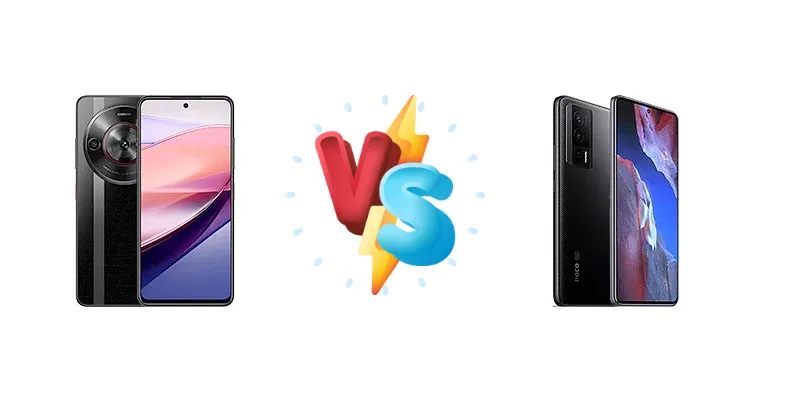
The smartphone landscape is increasingly segmented, with the Poco F5 Pro aiming to deliver near-flagship experiences at a competitive price. The ZTE nubia Focus, meanwhile, represents a more budget-conscious approach, prioritizing efficiency and value. This comparison dissects the key differences between these two devices, helping you determine which best suits your needs.
🏆 Quick Verdict
For users prioritizing raw performance and fast charging, the Xiaomi Poco F5 Pro is the clear winner. Its Snapdragon 8+ Gen 1 chipset offers a significant leap in processing power. However, the ZTE nubia Focus provides a compelling alternative for those seeking a balanced device with decent performance at a lower price point.
| Network |
|---|
| 2G bands | GSM 850 / 900 / 1800 / 1900 | GSM 850 / 900 / 1800 / 1900 |
| 3G bands | HSDPA 850 / 900 / 1900 / 2100 | HSDPA 800 / 850 / 900 / 1700(AWS) / 1900 / 2100 |
| 4G bands | LTE | 1, 2, 3, 4, 5, 7, 8, 18, 19, 20, 28, 38, 40, 41, 66 |
| 5G bands | SA/NSA | 1, 3, 5, 7, 8, 20, 28, 38, 40, 41, 77, 78 SA/NSA/Sub6 |
| Speed | HSPA, LTE, 5G | HSPA, LTE, 5G |
| Technology | GSM / HSPA / LTE / 5G | GSM / HSPA / LTE / 5G |
| Launch |
|---|
| Announced | 2024, February 28 | 2023, May 09 |
| Status | Available. Released 2024, Q2 | Available. Released 2023, May |
| Body |
|---|
| Build | Glass front, glass back | Glass front (Gorilla Glass 5), glass back, plastic frame |
| Dimensions | 163.6 x 74.9 x 8.6 mm (6.44 x 2.95 x 0.34 in) | 162.8 x 75.4 x 8.6 mm (6.41 x 2.97 x 0.34 in) |
| SIM | Nano-SIM + Nano-SIM | Nano-SIM + Nano-SIM |
| Weight | 205.5 g (7.27 oz) | 204 g (7.20 oz) |
| | - | IP53, dust and splash resistant |
| Display |
|---|
| Protection | - | Corning Gorilla Glass 5 |
| Resolution | 720 x 1612 pixels, 20:9 ratio (~269 ppi density) | 1440 x 3200 pixels, 20:9 ratio (~526 ppi density) |
| Size | 6.56 inches, 103.4 cm2 (~84.4% screen-to-body ratio) | 6.67 inches, 107.4 cm2 (~87.5% screen-to-body ratio) |
| Type | IPS LCD, 120Hz (90Hz - LATAM) | AMOLED, 68B colors, 120Hz, Dolby Vision, HDR10+, 500 nits (typ), 1000 nits (HBM), 1400 nits (peak) |
| Platform |
|---|
| CPU | Octa-core (1x2.2 GHz Cortex-A76 & 3x Cortex-A76 & 4x Cortex-A55) | Octa-core (1x3.0 GHz Cortex-X2 & 3x2.5 GHz Cortex-A710 & 4x1.80 GHz Cortex-A510) |
| Chipset | Unisoc T760 (6 nm) | Qualcomm SM8475 Snapdragon 8+ Gen 1 (4 nm) |
| GPU | Mali-G57 | Adreno 730 |
| OS | Android 14 | Android 13, upgradable to Android 15 |
| Memory |
|---|
| Card slot | No | No |
| Internal | 256GB 4GB RAM, 256GB 6GB RAM, 256GB 8GB RAM, 256GB 12GB RAM | 256GB 8GB RAM, 256GB 12GB RAM, 512GB 12GB RAM |
| | - | UFS 3.1 |
| Main Camera |
|---|
| Dual | 108 MP, f/1.8, 24mm (wide), 1/1.67", PDAF
Auxiliary lens | - |
| Features | LED flash, HDR | Dual-LED dual-tone flash, HDR, panorama |
| Triple | - | 64 MP, f/1.8, (wide), 1/2.0", 0.7µm, PDAF, OIS
8 MP, f/2.2, 120˚ (ultrawide), 1/4.0", 1.12µm
2 MP (macro) |
| Video | 4K@30fps, 1080p@30fps | 8K@24fps, 4K@30/60fps, 1080p@30/60/120/240fps, gyro-EIS |
| Selfie camera |
|---|
| Features | - | HDR |
| Single | 5 MP, f/2.2, (wide)
or
8 MP, (wide) | 16 MP, f/2.5, (wide), 1/3.06", 1.0µm |
| Video | Yes | 1080p@30/60fps |
| Sound |
|---|
| 3.5mm jack | - | No |
| 35mm jack | Yes | No |
| Loudspeaker | Yes | Yes, with stereo speakers |
| | - | 24-bit/192kHz audio |
| Comms |
|---|
| Bluetooth | 5.2, A2DP, LE | 5.3, A2DP, LE |
| Infrared port | - | Yes |
| NFC | Yes (market/region dependent) | Yes (market/region dependent) |
| Positioning | GPS | GPS (L1), GLONASS (G1), BDS (B1I), GALILEO (E1), QZSS (L1) |
| Radio | Unspecified | No |
| USB | USB Type-C 2.0 | USB Type-C 2.0, OTG |
| WLAN | Wi-Fi 802.11 a/b/g/n/ac, dual-band | Wi-Fi 802.11 a/b/g/n/ac/6, dual-band |
| Features |
|---|
| Sensors | Fingerprint (side-mounted), accelerometer, proximity | Fingerprint (under display, optical), accelerometer, gyro, proximity, compass |
| Battery |
|---|
| Charging | 22.5W or 33W wired | 67W wired, PD3.0, QC3+, 50% in 15 min
30W wireless, 50% in 32 min |
| Type | 5000 mAh | Li-Po 5160 mAh |
| Misc |
|---|
| Colors | Black, Gold, Coral | Black, White |
| Models | Z2455 | 23013PC75G |
| Price | About 200 EUR | $ 449.99 / € 241.85 |
| SAR | - | 1.09 W/kg (head) 1.08 W/kg (body) |
| SAR EU | - | 1.00 W/kg (head) 1.00 W/kg (body) |
| Tests |
|---|
| Battery life | - | Endurance rating 99h |
| Camera | - |
Photo / Video |
| Display | - |
Contrast ratio: Infinite (nominal) |
| Loudspeaker | - |
-26.2 LUFS (Good) |
| Performance | - |
AnTuTu: 1057977 (v9)
GeekBench: 4001 (v5.1), 4009 (v6)
GFXBench: 50fps (ES 3.1 onscreen) |
ZTE nubia Focus
- More Affordable Price
- Decent Performance for Daily Tasks
- Potentially Better Battery Life (based on endurance rating)
- Significantly Weaker Processor
- Slower Charging Speed
- Limited Camera Information
Xiaomi Poco F5 Pro
- Flagship-Level Snapdragon 8+ Gen 1 Performance
- Fast 67W Wired and 30W Wireless Charging
- Brighter, Higher Contrast Display
- Higher Price Point
- Potentially More Heat Generation
- May Not Offer Significantly Longer Battery Life Despite Faster Charging
Display Comparison
The Xiaomi Poco F5 Pro boasts a significantly brighter display, reaching a measured 1059 nits. This translates to superior visibility in direct sunlight compared to the nubia Focus, whose peak brightness is not specified. While both are likely to utilize IPS LCD or AMOLED panels (spec not provided for nubia Focus), the Poco F5 Pro’s infinite contrast ratio suggests an AMOLED panel, offering deeper blacks and more vibrant colors. The lack of detailed display specs for the nubia Focus makes a direct comparison difficult, but the Poco F5 Pro clearly holds an advantage in visual experience.
Camera Comparison
Both devices are listed as having Photo/Video capabilities, but detailed camera specifications are absent. Without sensor size, aperture, or OIS information, a meaningful comparison is impossible. However, given the Poco F5 Pro’s positioning as a higher-end device, it’s reasonable to assume it features a more sophisticated camera system with a larger sensor and potentially optical image stabilization. The nubia Focus likely relies on software processing to compensate for potentially inferior hardware. The absence of details makes it difficult to assess the real-world image quality differences.
Performance
The core difference lies in the chipsets. The Poco F5 Pro’s Qualcomm Snapdragon 8+ Gen 1 (4nm) is a flagship-level processor, featuring a Cortex-X2 prime core clocked at 3.0 GHz, alongside Cortex-A710 and A510 cores. This architecture delivers substantially higher CPU and GPU performance than the Unisoc T760 (6nm) found in the nubia Focus. The T760, while efficient, utilizes older Cortex-A76 cores and a less powerful GPU. This means the Poco F5 Pro will handle demanding games and applications with ease, while the nubia Focus may struggle with graphically intensive tasks. The 4nm process node of the Snapdragon also contributes to better thermal efficiency, reducing throttling during sustained workloads.
Battery Life
Both phones achieve an endurance rating of 99 hours, suggesting similar overall battery life despite differing battery capacities (not specified for nubia Focus). However, the charging capabilities are vastly different. The Poco F5 Pro supports 67W wired charging, achieving 50% charge in just 15 minutes, and even 30W wireless charging. The nubia Focus offers a slower 22.5W or 33W wired charging solution. This means the Poco F5 Pro can be rapidly topped up, minimizing downtime, a significant advantage for power users.
Buying Guide
Buy the ZTE nubia Focus if you need a reliable daily driver with acceptable performance for everyday tasks and moderate gaming, and value affordability above all else. Buy the Xiaomi Poco F5 Pro if you prioritize demanding mobile gaming, content creation, and rapid charging, and are willing to spend more for a significantly more powerful processor.
Frequently Asked Questions
❓ Does the Unisoc T760 in the nubia Focus struggle with demanding games like Genshin Impact?
Yes, the Unisoc T760 is a mid-range processor and will likely require significant graphics settings reductions to achieve playable frame rates in demanding titles like Genshin Impact. Expect noticeable frame drops and potentially long loading times compared to the Snapdragon 8+ Gen 1.
❓ How much faster is the 67W charging on the Poco F5 Pro compared to the nubia Focus's charging?
The Poco F5 Pro's 67W charging can reach 50% battery in just 15 minutes, while the nubia Focus (with 22.5W or 33W) will take considerably longer – likely over 45 minutes to reach the same level. This difference is significant for users who frequently need to quickly top up their battery.
❓ Is the lack of detailed camera specs for the nubia Focus a major concern?
Yes, it is. Without knowing the sensor size, aperture, or presence of OIS, it's difficult to assess the camera's capabilities. It's safe to assume the Poco F5 Pro will offer a more versatile and higher-quality camera experience.
❓ Will the Snapdragon 8+ Gen 1 in the Poco F5 Pro overheat during extended gaming sessions?
While the Snapdragon 8+ Gen 1 is a powerful chip, it's also known to generate heat. The Poco F5 Pro likely incorporates thermal management solutions to mitigate this, but some throttling may occur during prolonged, intensive gaming. The 4nm process helps, but it's not a complete solution.