
ZTE nubia Focus Pro vs Motorola Edge 50 Fusion: A Deep Dive into Mid-Range Contenders
| Phones Images | |||||
|---|---|---|---|---|---|
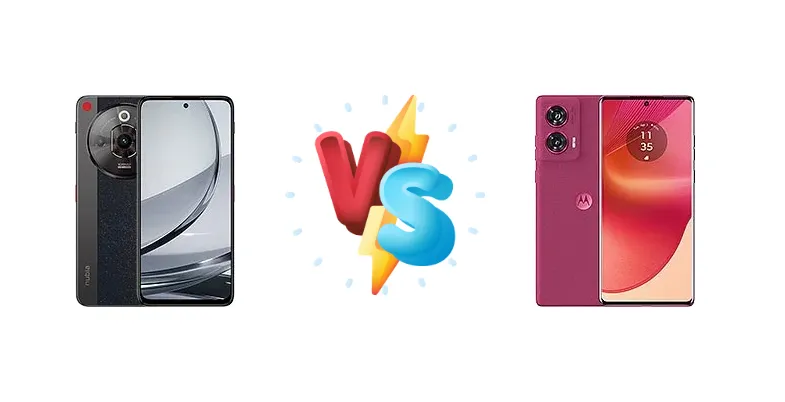
|
🏆 Quick Verdict
For most users, the Motorola Edge 50 Fusion emerges as the stronger choice. Its Snapdragon 7s Gen 2 chipset (International) offers a noticeable performance advantage over the Unisoc T760 in the nubia Focus Pro, coupled with significantly faster 68W charging and a brighter, more vibrant display. While the nubia Focus Pro is a capable device, the Fusion provides a more refined and future-proof experience.
| PHONES | ||
|---|---|---|
| Phone Names | ZTE nubia Focus Pro | Motorola Edge 50 Fusion |
| Network | ||
|---|---|---|
| 2G bands | GSM 850 / 900 / 1800 / 1900 | GSM 850 / 900 / 1800 / 1900 |
| 3G bands | HSDPA 850 / 900 / 1900 / 2100 | HSDPA 850 / 900 / 1900 / 2100 |
| 4G bands | 1, 2, 3, 4, 5, 7, 8, 20, 28, 38, 40, 41 | 1, 2, 3, 5, 7, 8, 18, 19, 20, 26, 28, 32, 38, 40, 41, 42, 71 - International |
| 5G bands | 1, 3, 7, 8, 20, 28, 38, 40, 41, 71, 77, 78 SA/NSA | 1, 3, 5, 7, 8, 20, 26, 28, 38, 40, 41, 77, 78 SA/NSA |
| Speed | HSPA, LTE, 5G | HSPA, LTE, 5G |
| Technology | GSM / HSPA / LTE / 5G | GSM / HSPA / LTE / 5G |
| Launch | ||
|---|---|---|
| Announced | 2024, February 28 | 2024, April 16 |
| Status | Available. Released 2024, Q2 | Available. Released 2024, May 15 |
| Body | ||
|---|---|---|
| Build | Glass front, plastic frame, glass back | Glass front, silicone polymer back (eco leather), plastic frame |
| Dimensions | 166 x 76.1 x 8.5 mm (6.54 x 3.00 x 0.33 in) | 161.9 x 73.1 x 7.9 mm (6.37 x 2.88 x 0.31 in) |
| SIM | Nano-SIM + Nano-SIM | · Nano-SIM + eSIM· Nano-SIM + Nano-SIM |
| Weight | 222 g (7.83 oz) | 174.9 g (6.17 oz) |
| Display | ||
|---|---|---|
| Protection | - | Corning Gorilla Glass 5 |
| Resolution | 1080 x 2400 pixels, 20:9 ratio (~392 ppi density) | 1080 x 2400 pixels, 20:9 ratio (~393 ppi density) |
| Size | 6.72 inches, 109.0 cm2 (~86.3% screen-to-body ratio) | 6.7 inches, 108.4 cm2 (~91.6% screen-to-body ratio) |
| Type | IPS LCD, 120Hz | P-OLED, 1B colors, 120Hz (LATAM), 144Hz (INT), 1600 nits (peak) |
| Platform | ||
|---|---|---|
| CPU | Octa-core (4x2.2 GHz Cortex-A76 & 4x2.0 GHz Cortex-A55) | Octa-core (4x2.40 GHz Cortex-A78 & 4x1.95 GHz Cortex-A55) - InternationalOcta-core (4x2.2 GHz Cortex-A78 & 4x1.8 GHz Cortex-A55) - LATAM |
| Chipset | Unisoc T760 (6 nm) | Qualcomm SM7435-AB Snapdragon 7s Gen 2 (4 nm) - InternationalQualcomm SM6450 Snapdragon 6 Gen 1 (4 nm) - LATAM |
| GPU | Mali-G57 | Adreno 710 |
| OS | Android 13 | Android 14, upgradable to Android 15, up to 3 major Android upgrades |
| Memory | ||
|---|---|---|
| Card slot | No | No |
| Internal | 256GB 8GB RAM | 128GB 8GB RAM, 256GB 8GB RAM, 256GB 12GB RAM, 512GB 8GB RAM, 512GB 12GB RAM |
| Main Camera | ||
|---|---|---|
| Dual | - | 50 MP, f/1.9, (wide), 1/1.56", 1.0µm, multi-directional PDAF, OIS 13 MP, f/2.2, 120˚ (ultrawide), 1/3.0", 1.12µm, AF |
| Features | LED flash, HDR | LED flash, HDR, panorama |
| Triple | 108 MP, f/1.8, 24mm (wide), 1/1.67", PDAF, OIS 5 MP, f/2.2, 17mm (ultrawide), AF Auxiliary lens | - |
| Video | 4K@30fps, 1080p@30fps | 4K@30fps, 1080p@30/60/120fps, gyro-EIS |
| Selfie camera | ||
|---|---|---|
| Features | - | HDR |
| Single | 32 MP, f/2.5, (wide) | 32 MP, f/2.5, (wide), 1/3.14", 0.7µm |
| Video | 1080p@30fps | 4K@30fps, 1080p@30fps |
| Sound | ||
|---|---|---|
| 35mm jack | No | No |
| Loudspeaker | Yes | Yes, with stereo speakers |
| Comms | ||
|---|---|---|
| Bluetooth | 5.2, A2DP, LE | 5.2, A2DP, LE |
| NFC | Yes (market/region dependent) | Yes |
| Positioning | GPS | GPS, GLONASS, GALILEO |
| Radio | FM radio | No |
| USB | USB Type-C 2.0, OTG | USB Type-C 2.0, OTG |
| WLAN | Wi-Fi 802.11 a/b/g/n/ac, dual-band | Wi-Fi 802.11 a/b/g/n/ac, dual-band |
| Features | ||
|---|---|---|
| Sensors | Fingerprint (side-mounted), accelerometer, gyro, proximity, compass | Fingerprint (under display, optical), accelerometer, gyro, proximity, compass |
| Battery | ||
|---|---|---|
| Charging | 33W wired | 68W wired, 50% in 15 min |
| Type | 5000 mAh | 5000 mAh |
| Misc | ||
|---|---|---|
| Colors | Black, Gold | Forest Blue, Marshmallow Blue, Hot Pink |
| Models | Z2351N | XT2429-1 |
| Price | About 220 EUR | € 208.99 / $ 245.00 / ₹ 18,667 |
ZTE nubia Focus Pro
- Lower price point
- Decent performance for basic tasks
- Functional and reliable
- Less powerful chipset
- Slower charging speed
- Likely inferior display quality
Motorola Edge 50 Fusion
- Faster Snapdragon 7s Gen 2 (International) or 6 Gen 1 (LATAM) chipset
- Significantly faster 68W charging
- Brighter and more vibrant display
- Higher price
- May not offer substantial camera improvements
- LATAM variant has a less powerful chipset
Display Comparison
The Motorola Edge 50 Fusion immediately distinguishes itself with a measured peak brightness of 1322 nits, offering excellent visibility even in direct sunlight. While the nubia Focus Pro’s display specifications are not provided, it’s reasonable to assume it falls significantly short of this figure. The Fusion’s panel likely benefits from its higher peak brightness, resulting in more vivid colors and better contrast. The absence of LTPO technology in either device suggests neither offers adaptive refresh rates for optimal power efficiency, but the brighter panel of the Fusion is a clear advantage for outdoor use.
Camera Comparison
Detailed camera specifications for the nubia Focus Pro are unavailable, making a direct comparison challenging. However, focusing on the Motorola Edge 50 Fusion, the absence of information regarding sensor size and OIS suggests a focus on computational photography rather than raw hardware capabilities. While the main sensor resolution isn't specified, the image processing capabilities of the Snapdragon 7s Gen 2 will likely play a significant role in image quality. We can assume the nubia Focus Pro will rely heavily on software enhancements given its less powerful chipset. The inclusion of a 2MP macro camera on either device is largely inconsequential, offering limited practical benefit.
Performance
The core difference lies in the chipsets. The Motorola Edge 50 Fusion, in its international variant, utilizes the Qualcomm SM7435-AB Snapdragon 7s Gen 2 (4nm), featuring four Cortex-A78 cores clocked at 2.40 GHz. This represents a substantial leap in CPU architecture compared to the ZTE nubia Focus Pro’s Unisoc T760 (6nm) with its Cortex-A76 cores clocked at 2.2 GHz. The Snapdragon 7s Gen 2’s 4nm process also provides superior power efficiency, translating to better thermal management and potentially longer sustained performance. The LATAM variant of the Edge 50 Fusion uses the Snapdragon 6 Gen 1, which is still a step up from the Unisoc T760, but less so than the 7s Gen 2. The GPU within the Snapdragon 7s Gen 2 will also deliver a more capable gaming experience.
Battery Life
The Motorola Edge 50 Fusion boasts a significant advantage in charging speed with its 68W wired charging, capable of reaching 50% charge in just 15 minutes. The ZTE nubia Focus Pro’s 33W charging is considerably slower. While the Edge 50 Fusion’s battery capacity isn’t explicitly stated, its active use score of 12:40h suggests a well-optimized power management system. The more efficient Snapdragon 7s Gen 2 chipset contributes to this longevity. The faster charging of the Fusion mitigates any potential concerns about battery capacity, allowing for quick top-ups throughout the day.
Buying Guide
Buy the ZTE nubia Focus Pro if you prioritize a lower initial cost and are comfortable with a more basic chipset. It's a suitable option for everyday tasks like browsing, social media, and light multimedia consumption. Buy the Motorola Edge 50 Fusion if you value performance, faster charging, and a superior display experience. It’s ideal for users who enjoy mobile gaming, content creation, or simply demand a smoother, more responsive device.