
ZTE nubia Focus Pro vs Google Pixel 8a: A Detailed Comparison
| Phones Images | |||||
|---|---|---|---|---|---|
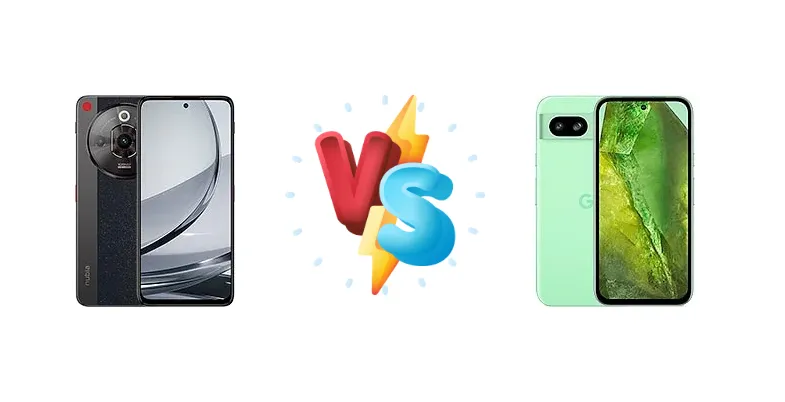
|
🏆 Quick Verdict
For the average user prioritizing camera quality, software experience, and long-term support, the Google Pixel 8a is the clear winner. However, the ZTE nubia Focus Pro offers a compelling value proposition for those on a tighter budget who prioritize basic functionality and don't need advanced features.
| PHONES | ||
|---|---|---|
| Phone Names | ZTE nubia Focus Pro | Google Pixel 8a |
| Network | ||
|---|---|---|
| 2G bands | GSM 850 / 900 / 1800 / 1900 | GSM 850 / 900 / 1800 / 1900 |
| 3G bands | HSDPA 850 / 900 / 1900 / 2100 | HSDPA 800 / 850 / 900 / 1700(AWS) / 1900 / 2100 |
| 4G bands | 1, 2, 3, 4, 5, 7, 8, 20, 28, 38, 40, 41 | 1, 2, 3, 4, 5, 7, 8, 12, 17, 18, 19, 20, 26, 28, 32, 38, 40, 41, 42, 66 - G6GPR (International) |
| 5G bands | 1, 3, 7, 8, 20, 28, 38, 40, 41, 71, 77, 78 SA/NSA | 1, 2, 3, 5, 7, 8, 12, 20, 26, 28, 38, 40, 41, 66, 75, 76, 77, 78 SA/NSA/Sub6 - G6GPR (International) |
| Speed | HSPA, LTE, 5G | HSPA, LTE, 5G |
| Technology | GSM / HSPA / LTE / 5G | GSM / HSPA / LTE / 5G |
| Launch | ||
|---|---|---|
| Announced | 2024, February 28 | 2024, May 07 |
| Status | Available. Released 2024, Q2 | Available. Released 2024, May 14 |
| Body | ||
|---|---|---|
| Build | Glass front, plastic frame, glass back | Glass front (Gorilla Glass 3), aluminum frame, plastic back |
| Dimensions | 166 x 76.1 x 8.5 mm (6.54 x 3.00 x 0.33 in) | 152.1 x 72.7 x 8.9 mm (5.99 x 2.86 x 0.35 in) |
| SIM | Nano-SIM + Nano-SIM | Nano-SIM + eSIM |
| Weight | 222 g (7.83 oz) | 188 g (6.63 oz) |
| Display | ||
|---|---|---|
| Protection | - | Corning Gorilla Glass 3, Mohs level 5 |
| Resolution | 1080 x 2400 pixels, 20:9 ratio (~392 ppi density) | 1080 x 2400 pixels, 20:9 ratio (~430 ppi density) |
| Size | 6.72 inches, 109.0 cm2 (~86.3% screen-to-body ratio) | 6.1 inches, 90.3 cm2 (~81.6% screen-to-body ratio) |
| Type | IPS LCD, 120Hz | OLED, HDR, 120Hz, 2000 nits (peak) |
| Platform | ||
|---|---|---|
| CPU | Octa-core (4x2.2 GHz Cortex-A76 & 4x2.0 GHz Cortex-A55) | Nona-core (1x3.0 GHz Cortex-X3 & 4x2.45 GHz Cortex-A715 & 4x2.15 GHz Cortex-A510) |
| Chipset | Unisoc T760 (6 nm) | Google Tensor G3 (4 nm) |
| GPU | Mali-G57 | Immortalis-G715s MC10 |
| OS | Android 13 | Android 14, upgradable to Android 16, up to 7 major Android upgrades |
| Memory | ||
|---|---|---|
| Card slot | No | No |
| Internal | 256GB 8GB RAM | 128GB 8GB RAM, 256GB 8GB RAM |
| Main Camera | ||
|---|---|---|
| Dual | - | 64 MP (16 MP eff.), f/1.9, 26mm (wide), 1/1.73", 0.8µm, dual pixel PDAF, OIS 13 MP, f/2.2, 120˚ (ultrawide), 1.12µm |
| Features | LED flash, HDR | Dual-LED flash, Pixel Shift, Ultra HDR, panorama, Best Take |
| Triple | 108 MP, f/1.8, 24mm (wide), 1/1.67", PDAF, OIS 5 MP, f/2.2, 17mm (ultrawide), AF Auxiliary lens | - |
| Video | 4K@30fps, 1080p@30fps | 4K@30/60fps, 1080p@30/60/120/240fps, OIS |
| Selfie camera | ||
|---|---|---|
| Features | - | HDR, panorama |
| Single | 32 MP, f/2.5, (wide) | 13 MP, f/2.2, 20mm (ultrawide), 1.12µm |
| Video | 1080p@30fps | 4K@30fps, 1080p@30/60fps |
| Sound | ||
|---|---|---|
| 35mm jack | No | No |
| Loudspeaker | Yes | Yes, with stereo speakers |
| Comms | ||
|---|---|---|
| Bluetooth | 5.2, A2DP, LE | 5.3, A2DP, LE |
| NFC | Yes (market/region dependent) | Yes |
| Positioning | GPS | GPS, GLONASS, GALILEO, BDS, QZSS, NavIC |
| Radio | FM radio | No |
| USB | USB Type-C 2.0, OTG | USB Type-C 3.2 |
| WLAN | Wi-Fi 802.11 a/b/g/n/ac, dual-band | Wi-Fi 802.11 a/b/g/n/ac/6e, dual/tri-band (market/region dependent) |
| Features | ||
|---|---|---|
| Sensors | Fingerprint (side-mounted), accelerometer, gyro, proximity, compass | Fingerprint (under display, optical), accelerometer, gyro, proximity, compass, barometer |
| Battery | ||
|---|---|---|
| Charging | 33W wired | 18W wired, PD3.0 7.5W wireless Bypass charging |
| Type | 5000 mAh | Li-Po 4492 mAh |
| Misc | ||
|---|---|---|
| Colors | Black, Gold | Obsidian, Porcelain, Bay, Aloe |
| Models | Z2351N | GKV4X, G6GPR, G8HHN, G576D |
| Price | About 220 EUR | $ 229.98 / C$ 417.99 / £ 279.00 / € 299.99 / ₹ 33,300 |
| EU LABEL | ||
|---|---|---|
| Battery | - | 40:06h endurance, 1000 cycles |
| Energy | - | Class B |
| Free fall | - | Class A (270 falls) |
| Repairability | - | Class B |
ZTE nubia Focus Pro
- Faster 33W wired charging
- Potentially lower price point
- Functional and reliable for basic tasks
- Less powerful processor
- Inferior camera system
- Likely less refined software experience
Google Pixel 8a
- Superior performance with Google Tensor G3
- Exceptional camera quality and AI features
- Long-term software support and updates
- Slower 18W wired charging
- Higher price point
- May require more frequent charging
Display Comparison
The Google Pixel 8a boasts a significantly brighter display, reaching a measured peak of 1508 nits, ensuring excellent visibility even in direct sunlight. While the nubia Focus Pro’s display specifications are not provided, it’s likely to be considerably dimmer. The Pixel 8a’s display technology, though not explicitly stated as LTPO, benefits from Google’s color calibration expertise, delivering accurate and vibrant colors. The Pixel 8a’s smaller bezels also contribute to a more immersive viewing experience.
Camera Comparison
The Pixel 8a’s camera system is a major differentiator. While specific sensor details aren’t provided, Google’s computational photography prowess, powered by the Tensor G3’s image signal processor, delivers exceptional image quality, particularly in challenging lighting conditions. The Pixel 8a’s image processing excels in dynamic range and detail preservation. The nubia Focus Pro’s camera capabilities are less defined; without sensor size or aperture information, it’s difficult to assess its performance, but it likely won’t match the Pixel 8a’s sophistication. We can assume the Pixel 8a will have superior video recording capabilities as well.
Performance
The core difference lies in the chipsets: the ZTE nubia Focus Pro utilizes the Unisoc T760 (6nm), while the Pixel 8a is powered by the Google Tensor G3 (4nm). The Tensor G3’s 4nm process offers superior power efficiency and thermal performance compared to the T760’s 6nm node, translating to less throttling during sustained workloads. The Tensor G3’s nona-core architecture, featuring a Cortex-X3 prime core, provides a substantial performance advantage over the T760’s octa-core configuration, particularly in demanding tasks like video editing and gaming. The Pixel 8a’s likely use of faster LPDDR5x RAM further enhances its responsiveness.
Battery Life
The Google Pixel 8a demonstrates impressive battery endurance, achieving 40:06 hours of total usage and 11:25 hours of active use. The 83-hour endurance rating (older data) suggests consistent performance. While the nubia Focus Pro’s battery capacity is unknown, its 33W wired charging is faster than the Pixel 8a’s 18W charging. However, the Pixel 8a’s Power Delivery 3.0 (PD3.0) support and bypass charging feature offer convenience and potentially extend battery lifespan. The Pixel 8a’s 1000-cycle battery longevity is a significant advantage, indicating long-term reliability.
Buying Guide
Buy the ZTE nubia Focus Pro if you need a functional smartphone for essential tasks, prioritize affordability above all else, and are comfortable with a less refined software experience. Buy the Google Pixel 8a if you prefer a superior camera system, benefit from Google’s AI features, value a smooth and regularly updated software experience, and are willing to pay a premium for these advantages.