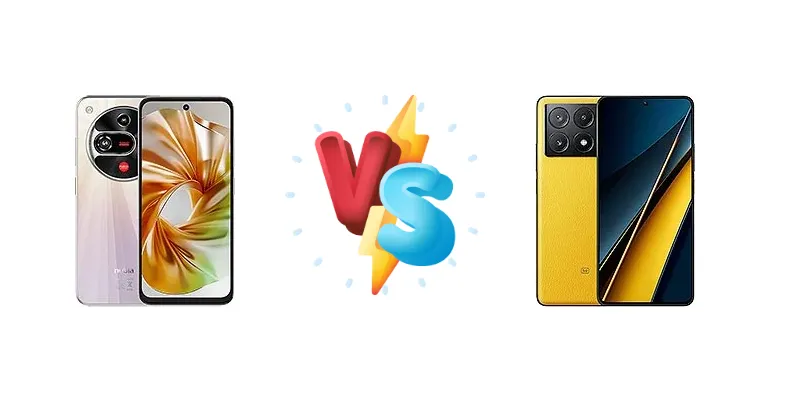
The ZTE nubia Focus 2 and Xiaomi Poco X6 Pro represent distinct approaches to the mid-range smartphone market. The nubia Focus 2 prioritizes exceptional battery endurance, while the Poco X6 Pro aims for flagship-level performance at a competitive price. This comparison dissects their key differences to determine which device best suits your needs.
🏆 Quick Verdict
For the average user prioritizing longevity, the ZTE nubia Focus 2 is the clear winner, boasting an incredible 44:20h endurance. However, if raw performance and faster charging are paramount, the Xiaomi Poco X6 Pro, powered by the Dimensity 8300 Ultra, delivers a significantly more responsive experience.
| Network |
|---|
| 2G bands | GSM 850 / 900 / 1800 / 1900 | GSM 850 / 900 / 1800 / 1900 |
| 3G bands | HSDPA 850 / 900 / 1900 / 2100 | HSDPA 850 / 900 / 1700(AWS) / 1900 / 2100 |
| 4G bands | LTE | 1, 2, 3, 4, 5, 7, 8, 18, 19, 20, 28, 38, 40, 41, 48, 66 |
| 5G bands | SA/NSA | 1, 2, 3, 5, 7, 8, 20, 28, 38, 40, 41, 48, 77, 78 SA/NSA/Sub6 |
| Speed | HSPA, LTE, 5G | HSPA, LTE, 5G |
| Technology | GSM / HSPA / LTE / 5G | GSM / HSPA / LTE / 5G |
| Launch |
|---|
| Announced | 2025, March 03 | 2024, January 11 |
| Status | Available. Released 2025, June | Available. Released 2024, January 12 |
| Body |
|---|
| Build | - | Glass front (Gorilla Glass 5), plastic frame, plastic back or silicone polymer back (eco leather) |
| Dimensions | 163.6 x 74.9 x 8 mm (6.44 x 2.95 x 0.31 in) | 160.5 x 74.3 x 8.3 mm (6.32 x 2.93 x 0.33 in) |
| SIM | Nano-SIM + Nano-SIM | Nano-SIM + Nano-SIM |
| Weight | - | 186 g or 190 g (6.56 oz) |
| Display |
|---|
| Protection | Mohs level 4 | Corning Gorilla Glass 5 |
| Resolution | 720 x 1600 pixels, 20:9 ratio (~262 ppi density) | 1220 x 2712 pixels, 20:9 ratio (~446 ppi density) |
| Size | 6.7 inches, 108.4 cm2 (~88.4% screen-to-body ratio) | 6.67 inches, 107.4 cm2 (~90.1% screen-to-body ratio) |
| Type | IPS LCD, 120Hz, 1000 nits (HBM) | AMOLED, 68B colors, 120Hz, 1920Hz PWM, HDR10+, Dolby Vision, 500 nits (typ), 1200 nits (HBM), 1800 nits (peak) |
| Platform |
|---|
| CPU | Octa-core (4x2.2 GHz Cortex-A76 & 4x2.0 GHz Cortex-A55) | Octa-core (1x3.35 GHz Cortex-A715 & 3x3.20 GHz Cortex-A715 & 4x2.20 GHz Cortex-A510) |
| Chipset | Unisoc T760 (6 nm) | Mediatek Dimensity 8300 Ultra (4 nm) |
| GPU | Mali-G57 | Mali G615-MC6 |
| OS | Android 15 | Android 14, up to 3 major Android upgrades, HyperOS |
| Memory |
|---|
| Card slot | Unspecified | No |
| Internal | 256GB 8GB RAM | 256GB 8GB RAM, 256GB 12GB RAM, 512GB 12GB RAM |
| Main Camera |
|---|
| Dual | 108 MP, f/1.8, 24mm (wide), 1/1.67", PDAF
Auxiliary lenses | - |
| Features | LED flash, HDR | LED flash, HDR, panorama |
| Triple | - | 64 MP, f/1.7, 25mm (wide), 1/2.0", 0.7µm, PDAF, OIS
8 MP, f/2.2, 120˚ (ultrawide), 1/4.0", 1.12µm
2 MP (macro) |
| Video | 4K@30fps, 1080p@30fps | 4K@24/30fps, 1080p@30/60fps, gyro-EIS |
| Selfie camera |
|---|
| Features | - | HDR, panorama |
| Single | 16 MP, (wide) | 16 MP, f/2.4, (wide), 1/3.06", 1.0µm |
| Video | 1080p@30fps | 1080p@30/60fps |
| Sound |
|---|
| 35mm jack | No | No |
| Loudspeaker | Yes | Yes, with dual speakers |
| Comms |
|---|
| Bluetooth | 5.2, A2DP, LE | 5.4, A2DP, LE, aptX HD |
| Infrared port | - | Yes |
| NFC | Yes (market/region dependent) | Yes (market/region dependent) |
| Positioning | GPS | GPS, GALILEO, GLONASS, QZSS, BDS (B1I+B1c) |
| Radio | Unspecified | No |
| USB | USB Type-C | USB Type-C 2.0, OTG |
| WLAN | Wi-Fi 802.11 a/b/g/n/ac, dual-band | Wi-Fi 802.11 a/b/g/n/ac/6, dual-band, Wi-Fi Direct |
| Features |
|---|
| Sensors | Fingerprint (side-mounted), accelerometer, gyro | Fingerprint (under display, optical), accelerometer, gyro, compass |
| Battery |
|---|
| Charging | 22.5W wired | 67W wired, QC2.0, PD3.0, 100% in 45 min |
| Type | 5000 mAh | 5000 mAh |
| Misc |
|---|
| Colors | Aurora White, Cerulean Blue, Obsidian Black | Black, Yellow, Gray |
| Models | Z2462N | 2311DRK48G, 2311DRK48I |
| Price | £ 142.86 / € 139.00 | € 195.30 / $ 209.79 / £ 274.99 / ₹ 21,999 |
| SAR EU | - | 0.99 W/kg (head) 1.00 W/kg (body) |
| EU LABEL |
|---|
| Battery | 44:20h endurance, 800 cycles | - |
| Energy | Class B | - |
| Free fall | Class D (45 falls) | - |
| Repairability | Class A | - |
ZTE nubia Focus 2
- Exceptional battery life (44:20h endurance)
- Long-term battery health (800 charge cycles)
- Potentially more affordable price point
- Less powerful processor (Unisoc T760)
- Slower charging speed (22.5W)
- Limited camera information
Xiaomi Poco X6 Pro
- Powerful processor (Dimensity 8300 Ultra)
- Fast charging (67W, 45 min to 100%)
- Brighter display (1148 nits)
- Shorter battery life (11:46h)
- Potentially higher price
- May experience more thermal throttling under sustained load
Display Comparison
The Poco X6 Pro boasts a significantly brighter display, reaching a measured 1148 nits, making it far more usable outdoors in direct sunlight. While the nubia Focus 2’s display specs are not provided, the X6 Pro’s brightness advantage is substantial. The X6 Pro’s panel likely benefits from its more modern chipset’s display capabilities. We can assume the nubia Focus 2 has a more standard brightness level, adequate for indoor use but potentially washed out outdoors.
Camera Comparison
The context data for both devices is limited regarding camera specifics. However, the Poco X6 Pro’s inclusion of 'Photo / Video' suggests a more versatile camera system. Given Xiaomi’s history, it’s likely to feature a higher-resolution main sensor and more advanced image processing algorithms than the nubia Focus 2. Without specific sensor details for the nubia, it’s difficult to assess its camera capabilities, but it’s reasonable to expect the Poco X6 Pro to deliver superior image quality and video recording.
Performance
The Xiaomi Poco X6 Pro’s Mediatek Dimensity 8300 Ultra (4nm) represents a substantial leap in processing power compared to the ZTE nubia Focus 2’s Unisoc T760 (6nm). The Dimensity 8300 Ultra’s core configuration – 1x3.35 GHz Cortex-A715, 3x3.20 GHz Cortex-A715, and 4x2.20 GHz Cortex-A510 – offers a more efficient and powerful architecture than the nubia’s 4x2.2 GHz Cortex-A76 & 4x2.0 GHz Cortex-A55. The 4nm process node of the Dimensity chip also contributes to better thermal efficiency, reducing the likelihood of performance throttling during extended gaming sessions. This translates to a smoother, more responsive experience for demanding tasks and games on the Poco X6 Pro.
Battery Life
The ZTE nubia Focus 2’s standout feature is its exceptional 44:20h battery endurance, coupled with a claimed 800 charge cycles, indicating long-term battery health. In contrast, the Poco X6 Pro offers a more modest 11:46h of active use. However, the Poco X6 Pro compensates with significantly faster charging – 67W wired, capable of reaching 100% in just 45 minutes, compared to the nubia’s 22.5W charging. This means while the nubia lasts longer on a single charge, the Poco X6 Pro can quickly top up when needed. The nubia’s 800 cycle claim suggests a focus on long-term battery degradation, a benefit for users planning to keep their phone for several years.
Buying Guide
Buy the ZTE nubia Focus 2 if you need a phone that can reliably last through two full days of moderate use, or if you frequently find yourself away from a power outlet. Buy the Xiaomi Poco X6 Pro if you prioritize gaming, demanding applications, and quick charging, and are willing to trade some battery life for a more powerful processor.
Frequently Asked Questions
❓ How does the Unisoc T760 in the nubia Focus 2 handle graphically intensive games compared to the Dimensity 8300 Ultra?
The Dimensity 8300 Ultra is significantly more powerful. While the Unisoc T760 can handle casual gaming, the Dimensity 8300 Ultra will provide a much smoother experience with higher frame rates and better graphics settings in demanding titles like Genshin Impact or Call of Duty: Mobile. Expect noticeable frame drops and lower settings on the nubia Focus 2.
❓ Is the 67W charging on the Poco X6 Pro compatible with all USB-C chargers, or do I need a specific charger to achieve the fastest speeds?
The Poco X6 Pro supports QC2.0 and PD3.0, meaning it *should* work with many USB-C chargers. However, to achieve the full 67W charging speed, it's recommended to use a charger that specifically supports these protocols and delivers at least 65W of power. Using a lower-wattage charger will still charge the phone, but at a slower rate.
❓ Given the nubia Focus 2's long battery life, does it suffer from significant battery bloat over time, even with the 800 cycle claim?
While the 800 cycle claim is promising, all lithium-ion batteries degrade over time. However, the nubia Focus 2's focus on battery health, combined with the 800 cycle rating, suggests it will likely experience slower degradation compared to phones with faster charging and less emphasis on long-term battery preservation. Expect some capacity loss after two years of use, but it should remain usable for a longer period.