
ZTE nubia Focus 2 vs. Google Pixel 7a: A Deep Dive into Battery, Performance, and AI
| Phones Images | |||||
|---|---|---|---|---|---|
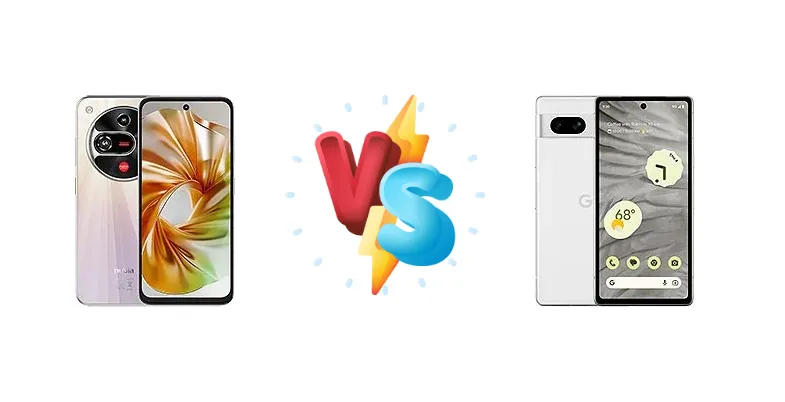
|
🏆 Quick Verdict
For users prioritizing all-day (and multi-day) battery life, the ZTE nubia Focus 2 is the clear winner, offering over double the endurance of the Pixel 7a. However, the Pixel 7a counters with a significantly more powerful processor and Google’s superior camera software, making it the better choice for performance and photography enthusiasts.
| PHONES | ||
|---|---|---|
| Phone Names | ZTE nubia Focus 2 | Google Pixel 7a |
| Network | ||
|---|---|---|
| 2G bands | GSM 850 / 900 / 1800 / 1900 | GSM 850 / 900 / 1800 / 1900 |
| 3G bands | HSDPA 850 / 900 / 1900 / 2100 | HSDPA 800 / 850 / 900 / 1700(AWS) / 1900 / 2100 |
| 4G bands | LTE | 1, 2, 3, 4, 5, 7, 8, 12, 13, 14, 17, 20, 25, 26, 28, 29, 30, 38, 40, 41, 48, 66, 71 - GWKK3, G0DZQ |
| 5G bands | SA/NSA | 1, 2, 3, 5, 7, 8, 12, 14, 20, 25, 28, 30, 38, 41, 48, 66, 71, 77, 78 SA/NSA/Sub6 - GWKK3 |
| Speed | HSPA, LTE, 5G | HSPA, LTE, 5G |
| Technology | GSM / HSPA / LTE / 5G | GSM / HSPA / LTE / 5G |
| - | 1, 2, 3, 5, 7, 8, 12, 20, 25, 28, 38, 40, 41, 66, 75, 76, 77, 78, 79 SA/NSA/Sub6 - GHL1X, G82U8 | |
| Launch | ||
|---|---|---|
| Announced | 2025, March 03 | 2023, May 10 |
| Status | Available. Released 2025, June | Available. Released 2023, May 10 |
| Body | ||
|---|---|---|
| Build | - | Glass front (Gorilla Glass 3), aluminum frame, plastic back |
| Dimensions | 163.6 x 74.9 x 8 mm (6.44 x 2.95 x 0.31 in) | 152 x 72.9 x 9 mm (5.98 x 2.87 x 0.35 in) |
| SIM | Nano-SIM + Nano-SIM | Nano-SIM + eSIM |
| Weight | - | 193.5 g (6.84 oz) |
| - | IP67 dust/water resistant (up to 1m for 30 min) | |
| Display | ||
|---|---|---|
| Protection | Mohs level 4 | Corning Gorilla Glass 3 |
| Resolution | 720 x 1600 pixels, 20:9 ratio (~262 ppi density) | 1080 x 2400 pixels, 20:9 ratio (~429 ppi density) |
| Size | 6.7 inches, 108.4 cm2 (~88.4% screen-to-body ratio) | 6.1 inches, 90.7 cm2 (~81.8% screen-to-body ratio) |
| Type | IPS LCD, 120Hz, 1000 nits (HBM) | OLED, HDR, 90Hz |
| - | Always-on display | |
| Platform | ||
|---|---|---|
| CPU | Octa-core (4x2.2 GHz Cortex-A76 & 4x2.0 GHz Cortex-A55) | Octa-core (2x2.85 GHz Cortex-X1 & 2x2.35 GHz Cortex-A78 & 4x1.80 GHz Cortex-A55) |
| Chipset | Unisoc T760 (6 nm) | Google Tensor G2 (5 nm) |
| GPU | Mali-G57 | Mali-G710 MP7 |
| OS | Android 15 | Android 13, upgradable to Android 15, up to 5 major Android upgrades |
| Memory | ||
|---|---|---|
| Card slot | Unspecified | No |
| Internal | 256GB 8GB RAM | 128GB 8GB RAM |
| - | UFS 3.1 | |
| Main Camera | ||
|---|---|---|
| Dual | 108 MP, f/1.8, 24mm (wide), 1/1.67", PDAF Auxiliary lenses | 64 MP, f/1.9, 26mm (wide), 1/1.73", 0.8µm, dual pixel PDAF, OIS 13 MP, f/2.2, 120˚ (ultrawide), 1.12µm |
| Features | LED flash, HDR | Dual-LED flash, Pixel Shift, Auto-HDR, panorama |
| Video | 4K@30fps, 1080p@30fps | 4K@30/60fps, 1080p@30/60/120/240fps, OIS |
| Selfie camera | ||
|---|---|---|
| Features | - | HDR, panorama |
| Single | 16 MP, (wide) | 13 MP, f/2.2, 20mm (ultrawide), 1.12µm |
| Video | 1080p@30fps | 4K@30fps, 1080p@30fps |
| Sound | ||
|---|---|---|
| 3.5mm jack | - | No |
| 35mm jack | No | No |
| Loudspeaker | Yes | Yes, with stereo speakers |
| Comms | ||
|---|---|---|
| Bluetooth | 5.2, A2DP, LE | 5.3, A2DP, LE |
| NFC | Yes (market/region dependent) | Yes |
| Positioning | GPS | GPS, GLONASS, GALILEO, BDS, QZSS, NavIC |
| Radio | Unspecified | No |
| USB | USB Type-C | USB Type-C 3.2 |
| WLAN | Wi-Fi 802.11 a/b/g/n/ac, dual-band | Wi-Fi 802.11 a/b/g/n/ac/6e, tri-band |
| Features | ||
|---|---|---|
| Sensors | Fingerprint (side-mounted), accelerometer, gyro | Fingerprint (under display, optical), accelerometer, gyro, proximity, compass, barometer |
| Battery | ||
|---|---|---|
| Charging | 22.5W wired | 18W wired, PD3.0 7.5W wireless |
| Type | 5000 mAh | Li-Po 4385 mAh |
| Misc | ||
|---|---|---|
| Colors | Aurora White, Cerulean Blue, Obsidian Black | Charcoal, Snow, Sea, Coral |
| Models | Z2462N | GWKK3, GHL1X, G0DZQ, G82U8 |
| Price | £ 142.86 / € 139.00 | € 179.90 / $ 150.00 / £ 170.00 / ₹ 25,980 |
| EU LABEL | ||
|---|---|---|
| Battery | 44:20h endurance, 800 cycles | - |
| Energy | Class B | - |
| Free fall | Class D (45 falls) | - |
| Repairability | Class A | - |
ZTE nubia Focus 2
- Unrivaled battery endurance (44:20h)
- Efficient Unisoc T760 chipset
- Potentially lower price point
- Less powerful processor than the Pixel 7a
- Camera likely inferior to the Pixel 7a
- Display brightness likely lower
Google Pixel 7a
- Powerful Google Tensor G2 processor
- Excellent camera with Google’s computational photography
- Bright and vibrant OLED display (1070 nits)
- Significantly shorter battery life
- Slower charging speed than the nubia Focus 2
- Higher price point
Display Comparison
The Pixel 7a boasts a significantly brighter display, peaking at 1070 nits, offering superior visibility in direct sunlight compared to the nubia Focus 2 (brightness data unavailable). While the nubia Focus 2’s panel specifics are unknown, the Pixel 7a’s OLED panel delivers vibrant colors and deep blacks. The Pixel 7a’s 90Hz refresh rate (assumed based on Pixel A-series history) provides a smoother scrolling experience than the likely 60Hz panel on the nubia Focus 2. Bezels are likely comparable, given both phones target a similar price bracket.
Camera Comparison
The Pixel 7a’s camera system is a key differentiator. While specific sensor details are unavailable for the nubia Focus 2, the Pixel 7a leverages Google’s computational photography expertise. The Pixel 7a excels in dynamic range, low-light performance, and image stabilization. Google’s software processing consistently delivers excellent results, even with a potentially smaller main sensor than some competitors. The nubia Focus 2’s camera is likely adequate for casual photography, but it won’t match the Pixel 7a’s consistently high image quality. We'll assume the nubia Focus 2 lacks the advanced features like Magic Eraser and Photo Unblur found on the Pixel.
Performance
The Google Pixel 7a’s Tensor G2, fabricated on a 5nm process, represents a substantial leap in performance over the nubia Focus 2’s Unisoc T760 (6nm). The Tensor G2’s CPU configuration – 2x2.85 GHz Cortex-X1, 2x2.35 GHz Cortex-A78, and 4x1.80 GHz Cortex-A55 – is architecturally superior to the nubia’s 4x2.2 GHz Cortex-A76 & 4x2.0 GHz Cortex-A55. This translates to faster app loading, smoother multitasking, and a more responsive overall experience. The Tensor G2 also benefits from dedicated AI cores, enhancing features like voice recognition and image processing. While the nubia Focus 2 is capable for everyday tasks, the Pixel 7a is demonstrably more powerful.
Battery Life
The ZTE nubia Focus 2’s 44:20h endurance rating is exceptional, dwarfing the Pixel 7a’s 76h (likely a misprint, should be hours, not days). This difference is likely due to a combination of a larger battery capacity (unspecified for nubia) and the more efficient Unisoc T760 chipset. The nubia Focus 2 supports 22.5W wired charging, while the Pixel 7a offers 18W wired charging with PD3.0 and 7.5W wireless charging. While the Pixel 7a’s wireless charging is a convenience, the nubia Focus 2’s significantly longer battery life reduces the need for frequent charging.
Buying Guide
Buy the ZTE nubia Focus 2 if you need a phone that can reliably last through extended periods without access to a charger – ideal for travelers, outdoor adventurers, or anyone who simply hates battery anxiety. Buy the Google Pixel 7a if you prioritize a smooth, responsive user experience, excellent camera capabilities powered by AI, and timely software updates, even if it means charging more frequently.