
Xiaomi Redmi Note 12 Pro+ vs. ZTE nubia Focus 2 Ultra: A Deep Dive Comparison
| Phones Images | |||||
|---|---|---|---|---|---|
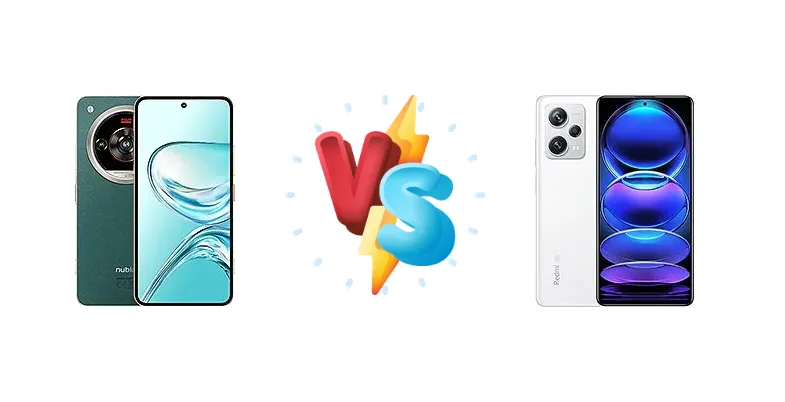
|
🏆 Quick Verdict
For the average user prioritizing convenience and quick top-ups, the Xiaomi Redmi Note 12 Pro+ is the clear winner. Its 120W charging is a game-changer, and the Dimensity 1080 provides ample performance. However, users who value extended battery life above all else will find the nubia Focus 2 Ultra a more compelling choice.
| PHONES | ||
|---|---|---|
| Phone Names | ZTE nubia Focus 2 Ultra | Xiaomi Redmi Note 12 Pro+ |
| Network | ||
|---|---|---|
| 2G bands | GSM 850 / 900 / 1800 / 1900 | GSM 850 / 900 / 1800 / 1900 - SIM 1 & SIM 2 |
| 3G bands | HSDPA 850 / 900 / 1900 / 2100 | HSDPA 800 / 850 / 900 / 1900 / 2100 |
| 4G bands | 1, 2, 3, 4, 5, 7, 8, 20, 28, 38, 40, 41 | 1, 3, 5, 8, 19, 34, 38, 39, 40, 41 - International, China |
| 5G bands | 1, 3, 7, 8, 20, 28, 38, 40, 41, 71, 77, 78 SA/NSA | 1, 3, 5, 8, 28, 38, 40, 41, 77, 78 SA/NSA - International |
| Speed | HSPA, LTE, 5G | HSPA, LTE-A (CA), 5G |
| Technology | GSM / HSPA / LTE / 5G | GSM / CDMA / HSPA / EVDO / LTE / 5G |
| - | 1, 3, 5, 8, 28, 38, 41, 77, 78 SA/NSA - China | |
| Launch | ||
|---|---|---|
| Announced | 2025, March 03 | 2022, October 27 |
| Status | Available. Released 2025, June | Available. Released 2022, November 01 |
| Body | ||
|---|---|---|
| Build | - | Glass front (Gorilla Glass 5), glass back |
| Dimensions | 163.2 x 77.2 x 7.5 mm (6.43 x 3.04 x 0.30 in) | 162.9 x 76 x 8.9 mm (6.41 x 2.99 x 0.35 in) |
| SIM | Nano-SIM + Nano-SIM | Dual SIM (Nano-SIM, dual stand-by) |
| Weight | 200 g (7.05 oz) | 208.4 g (7.34 oz) |
| - | IP53, dust and splash resistant | |
| Display | ||
|---|---|---|
| Protection | Mohs level 4 | Corning Gorilla Glass 5 |
| Resolution | 1080 x 2392 pixels (~386 ppi density) | 1080 x 2400 pixels, 20:9 ratio (~395 ppi density) |
| Size | 6.8 inches, 111.9 cm2 (~88.8% screen-to-body ratio) | 6.67 inches, 107.4 cm2 (~86.8% screen-to-body ratio) |
| Type | AMOLED, 120Hz, 2800 nits (peak) | OLED, 1B colors, 120Hz, Dolby Vision, HDR10+, 500 nits (typ), 900 nits (HBM) |
| Platform | ||
|---|---|---|
| CPU | Octa-core (4x2.2 GHz Cortex-A76 & 4x2.0 GHz Cortex-A55) | Octa-core (2x2.6 GHz Cortex-A78 & 6x2.0 GHz Cortex-A55) |
| Chipset | Unisoc T8100 (6 nm) | Mediatek MT6877V Dimensity 1080 (6 nm) |
| GPU | Mali-G57 | Mali-G68 MC4 |
| OS | Android 15 | Android 12, MIUI 13 |
| Memory | ||
|---|---|---|
| Card slot | No | No |
| Internal | 512GB 8GB RAM | 256GB 8GB RAM, 256GB 12GB RAM |
| - | UFS 2.2 | |
| Main Camera | ||
|---|---|---|
| Dual | 50 MP, f/1.5, 24mm (wide), 1/1.55", 1.0µm, PDAF 5 MP, f/2.2, 13mm (ultrawide), AF Auxiliary lens | - |
| Features | LED flash, HDR, rotatable lens ring | Dual-LED dual-tone flash, HDR, panorama |
| Triple | - | 200 MP, f/1.7, 24mm (wide), 1/1.4", 0.56µm, PDAF, OIS 8 MP, f/2.2, 120˚ (ultrawide), 1/4", 1.12µm 2 MP, f/2.4, (macro) |
| Video | 4K@30fps, 1080p@30fps | 4K@30fps, 1080p@30/60/120fps, 720p@960fps |
| Selfie camera | ||
|---|---|---|
| Features | - | HDR |
| Single | 32 MP, (wide) | 16 MP, f/2.5, (wide), 1/3.06", 1.0µm |
| Video | 1080p@30fps | 1080p@30/60fps |
| Sound | ||
|---|---|---|
| 3.5mm jack | - | Yes |
| 35mm jack | No | - |
| Loudspeaker | Yes | Yes, with stereo speakers |
| - | 24-bit/192kHz audio | |
| Comms | ||
|---|---|---|
| Bluetooth | Yes | 5.2, A2DP, LE |
| Infrared port | - | Yes |
| NFC | Yes (market/region dependent) | Yes (market/region dependent) |
| Positioning | GPS | GPS (L1), GLONASS (G1), BDS (B1I+B1c), GALILEO (E1), QZSS (L1) |
| Radio | FM radio | No |
| USB | USB Type-C | USB Type-C 2.0, OTG |
| WLAN | Yes | Wi-Fi 802.11 a/b/g/n/ac/6, dual-band, Wi-Fi Direct |
| Features | ||
|---|---|---|
| Sensors | Fingerprint, accelerometer, gyro, proximity, compass | Fingerprint (side-mounted), accelerometer, proximity, gyro, compass |
| Battery | ||
|---|---|---|
| Charging | 33W wired | 120W wired, PD3.0, 100% in 19 min (advertised) |
| Type | 5000 mAh | Li-Po 5000 mAh, non-removable |
| Misc | ||
|---|---|---|
| Colors | Forest Green, Sunrise White | Arctic White, Iceberg Blue, Obsidian Black, Trend edition |
| Models | Z2463N | 22101316UCP, 22101316UG |
| Price | £ 279.00 / € 243.55 | $ 348.00 / £ 439.00 / € 399.00 / ₹ 29,949 |
| Tests | ||
|---|---|---|
| Battery life | - | Endurance rating 88h |
| Camera | - | Photo / Video |
| Display | - | Contrast ratio: Infinite (nominal) |
| Loudspeaker | - | -26.7 LUFS (Good) |
| Performance | - | AnTuTu: 498710 (v9) GeekBench: 2208 (v5.1), 2372 (v6) GFXBench: 22fps (ES 3.1 onscreen) |
| EU LABEL | ||
|---|---|---|
| Battery | 40:41h endurance, 800 cycles | - |
| Energy | Class C | - |
| Free fall | Class D (45 falls) | - |
| Repairability | Class B | - |
ZTE nubia Focus 2 Ultra
- Exceptional 40:41 hour battery endurance
- 800 charge cycle rating suggests long battery lifespan
- Unisoc T8100 offers efficient performance
- Slow 33W charging
- Limited camera information available
Xiaomi Redmi Note 12 Pro+
- Blazing-fast 120W charging (19 min to 100%)
- Mediatek Dimensity 1080 provides strong performance
- Likely vibrant AMOLED display
- Battery endurance is not specified, potentially lower than nubia
- Camera details are sparse
Display Comparison
The Redmi Note 12 Pro+ boasts an 'Infinite' (nominal) contrast ratio, suggesting a high-quality AMOLED panel, though specific peak brightness and color accuracy data are absent. The nubia Focus 2 Ultra’s display specifications are not provided, making a direct comparison difficult. However, given its focus on endurance, it’s likely optimized for efficiency rather than peak visual fidelity. The Redmi Note 12 Pro+ likely offers a more vibrant and visually engaging experience, assuming a typical AMOLED implementation.
Camera Comparison
Camera details for the nubia Focus 2 Ultra are unavailable, hindering a thorough comparison. The Redmi Note 12 Pro+’s camera system is not detailed beyond 'Photo / Video', making it impossible to assess its capabilities. Without sensor size, aperture, or OIS information, it’s difficult to determine the Redmi’s imaging prowess. It's reasonable to assume, given the Redmi Note series' history, that it will offer a versatile camera experience, but the nubia’s potential remains unknown.
Performance
The Xiaomi Redmi Note 12 Pro+ utilizes the Mediatek Dimensity 1080, featuring a 2x2.6 GHz Cortex-A78 core configuration paired with 6x2.0 GHz Cortex-A55 cores. This contrasts with the ZTE nubia Focus 2 Ultra’s Unisoc T8100, which employs a 4x2.2 GHz Cortex-A76 and 4x2.0 GHz Cortex-A55 setup. The Dimensity 1080’s higher clock speeds on its prime cores suggest a performance advantage in demanding tasks and gaming. Both chipsets are fabricated on a 6nm process, indicating comparable efficiency, but the architectural differences favor the Xiaomi in raw processing power. The Redmi Note 12 Pro+ is likely to handle graphically intensive games and multitasking more smoothly.
Battery Life
The Redmi Note 12 Pro+’s 120W wired charging, with an advertised 100% charge in 19 minutes, is a significant advantage. This drastically reduces downtime compared to the nubia Focus 2 Ultra’s 33W charging. However, the nubia compensates with exceptional endurance, rated at 40:41 hours, and a claimed 800 charge cycles, suggesting long-term battery health. While the Redmi offers speed, the nubia prioritizes longevity and sustained usage. The Redmi’s fast charging is ideal for users who frequently need a quick boost, while the nubia is better suited for those who want to minimize charging frequency.
Buying Guide
Buy the ZTE nubia Focus 2 Ultra if you need a phone that can reliably last through a full day and beyond, even with heavy usage, and aren't concerned with the fastest possible charging speeds. Buy the Xiaomi Redmi Note 12 Pro+ if you prefer the convenience of incredibly fast charging, allowing you to quickly replenish the battery and minimize downtime, and require a strong all-around performer.