
ZTE nubia Focus 2 Ultra vs. Motorola Moto G Power 5G: A Deep Dive
| Phones Images | |||||
|---|---|---|---|---|---|
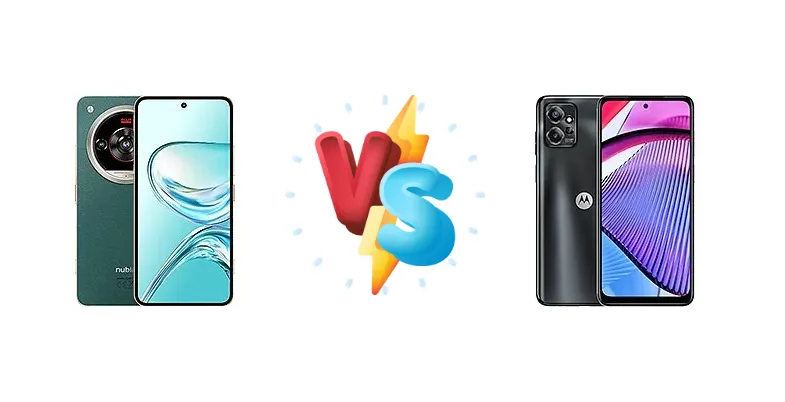
|
🏆 Quick Verdict
For users prioritizing all-day (and then some) battery life, the ZTE nubia Focus 2 Ultra is the clear winner, boasting a remarkable 40:41h endurance. However, the Motorola Moto G Power 5G offers a more powerful chipset, the Dimensity 930, making it a better choice for those who frequently game or multitask.
| PHONES | ||
|---|---|---|
| Phone Names | ZTE nubia Focus 2 Ultra | Motorola Moto G Power 5G |
| Network | ||
|---|---|---|
| 2G bands | GSM 850 / 900 / 1800 / 1900 | GSM 850 / 900 / 1800 / 1900 |
| 3G bands | HSDPA 850 / 900 / 1900 / 2100 | HSDPA 850 / 900 / 1700(AWS) / 1900 / 2100 |
| 4G bands | 1, 2, 3, 4, 5, 7, 8, 20, 28, 38, 40, 41 | 1, 2, 3, 4, 5, 7, 8, 12, 13, 14, 17, 20, 25, 26, 29, 30, 38, 39, 40, 41, 48, 66, 71 |
| 5G bands | 1, 3, 7, 8, 20, 28, 38, 40, 41, 71, 77, 78 SA/NSA | 2, 5, 7, 12, 25, 30, 41, 66, 71, 77, 78 SA/NSA/Sub6 |
| Speed | HSPA, LTE, 5G | HSPA, LTE, 5G |
| Technology | GSM / HSPA / LTE / 5G | GSM / HSPA / LTE / 5G |
| Launch | ||
|---|---|---|
| Announced | 2025, March 03 | 2023, April 06 |
| Status | Available. Released 2025, June | Available. Released 2023, April 13 |
| Body | ||
|---|---|---|
| Build | - | Glass front, plastic back, plastic frame |
| Dimensions | 163.2 x 77.2 x 7.5 mm (6.43 x 3.04 x 0.30 in) | 163.1 x 74.8 x 8.5 mm (6.42 x 2.94 x 0.33 in) |
| SIM | Nano-SIM + Nano-SIM | Nano-SIM |
| Weight | 200 g (7.05 oz) | 185 g (6.53 oz) |
| - | Water-repellent design | |
| Display | ||
|---|---|---|
| Protection | Mohs level 4 | - |
| Resolution | 1080 x 2392 pixels (~386 ppi density) | 1080 x 2400 pixels, 20:9 ratio (~405 ppi density) |
| Size | 6.8 inches, 111.9 cm2 (~88.8% screen-to-body ratio) | 6.5 inches, 102.0 cm2 (~83.6% screen-to-body ratio) |
| Type | AMOLED, 120Hz, 2800 nits (peak) | IPS LCD, 120Hz |
| Platform | ||
|---|---|---|
| CPU | Octa-core (4x2.2 GHz Cortex-A76 & 4x2.0 GHz Cortex-A55) | Octa-core (2x2.2 GHz Cortex-A78 & 6x2.0 GHz Cortex-A55) |
| Chipset | Unisoc T8100 (6 nm) | Mediatek Dimensity 930 (6 nm) |
| GPU | Mali-G57 | IMG BXM-8-256 |
| OS | Android 15 | Android 13, upgradable to Android 14 |
| Memory | ||
|---|---|---|
| Card slot | No | microSDXC (dedicated slot) |
| Internal | 512GB 8GB RAM | 128GB 4GB RAM, 256GB 6GB RAM |
| Main Camera | ||
|---|---|---|
| Dual | 50 MP, f/1.5, 24mm (wide), 1/1.55", 1.0µm, PDAF 5 MP, f/2.2, 13mm (ultrawide), AF Auxiliary lens | - |
| Features | LED flash, HDR, rotatable lens ring | LED flash, HDR, panorama |
| Triple | - | 50 MP, f/1.8, (wide), 0.64µm, PDAF 2 MP (macro) Auxiliary lens |
| Video | 4K@30fps, 1080p@30fps | 1080p@30fps, gyro-EIS |
| Selfie camera | ||
|---|---|---|
| Single | 32 MP, (wide) | 16 MP, f/2.4, (wide), 1.0µm |
| Video | 1080p@30fps | 1080p@30fps |
| Sound | ||
|---|---|---|
| 3.5mm jack | - | Yes |
| 35mm jack | No | Yes |
| Loudspeaker | Yes | Yes, with stereo speakers |
| Comms | ||
|---|---|---|
| Bluetooth | Yes | 5.3, A2DP, LE |
| NFC | Yes (market/region dependent) | No |
| Positioning | GPS | GPS, GLONASS, GALILEO |
| Radio | FM radio | No |
| USB | USB Type-C | USB Type-C 2.0 |
| WLAN | Yes | Wi-Fi 802.11 a/b/g/n/ac, dual-band |
| Features | ||
|---|---|---|
| Sensors | Fingerprint, accelerometer, gyro, proximity, compass | Fingerprint (side-mounted), accelerometer, gyro, proximity, compass |
| Battery | ||
|---|---|---|
| Charging | 33W wired | 15W wired |
| Type | 5000 mAh | Li-Po 5000 mAh |
| Misc | ||
|---|---|---|
| Colors | Forest Green, Sunrise White | Dark Blue |
| Models | Z2463N | - |
| Price | £ 279.00 / € 243.55 | $ 97.90 / £ 199.00 |
| EU LABEL | ||
|---|---|---|
| Battery | 40:41h endurance, 800 cycles | - |
| Energy | Class C | - |
| Free fall | Class D (45 falls) | - |
| Repairability | Class B | - |
ZTE nubia Focus 2 Ultra
- Exceptional battery life (40:41h endurance)
- Faster 33W charging
- 800 charge cycle rating for longevity
- Less powerful chipset compared to the competition
- Unisoc chipset may have limited software support
Motorola Moto G Power 5G
- More powerful Mediatek Dimensity 930 chipset
- Superior single-core performance
- Potentially better image processing
- Significantly shorter battery life
- Slower 15W charging
Display Comparison
Display specifications are not provided, so a direct comparison is limited. However, given the price points, both devices likely utilize LCD panels. The focus here shifts to internal performance. The nubia's longevity suggests a power-efficient display, while the Moto G Power 5G's chipset needs to drive a potentially higher-resolution or refresh-rate panel.
Camera Comparison
Camera details are absent beyond the devices themselves. Given the market segment, both phones likely feature a multi-camera setup with a primary sensor, ultrawide, and potentially a macro lens. Without sensor size or aperture information, it’s difficult to assess image quality. However, the Dimensity 930’s integrated ISP (Image Signal Processor) generally offers more advanced image processing capabilities than those found in Unisoc chipsets, potentially leading to better dynamic range and low-light performance on the Moto G Power 5G.
Performance
The Motorola Moto G Power 5G’s Mediatek Dimensity 930 (6nm) holds a clear architectural advantage over the ZTE nubia Focus 2 Ultra’s Unisoc T8100 (6nm). The Dimensity 930 features two high-performance Cortex-A78 cores clocked at 2.2 GHz, compared to the nubia’s four Cortex-A76 cores at the same speed. This translates to superior single-core performance and a noticeable boost in demanding tasks. While both chips are fabricated on a 6nm process, the A78 architecture is more efficient and powerful than the A76. The Moto G Power 5G will likely exhibit smoother multitasking and faster app loading times.
Battery Life
The ZTE nubia Focus 2 Ultra’s 40:41h endurance is its standout feature. This suggests a large battery capacity coupled with aggressive power management. The Motorola Moto G Power 5G, while likely possessing a respectable battery life, cannot compete with this level of longevity. The nubia’s 33W charging is faster than the Moto G Power 5G’s 15W charging, meaning quicker top-ups, but the nubia’s endurance minimizes the need for frequent charging in the first place. The 800 charge cycles rating on the nubia suggests a focus on long-term battery health.
Buying Guide
Buy the ZTE nubia Focus 2 Ultra if you need a phone that can reliably last through two full days of moderate use, or if you frequently find yourself away from a charger. Buy the Motorola Moto G Power 5G if you prefer a smoother, more responsive experience for gaming and demanding applications, and are willing to compromise on ultimate battery longevity. The Moto G Power 5G is also a better fit for users who value a more mainstream brand experience.