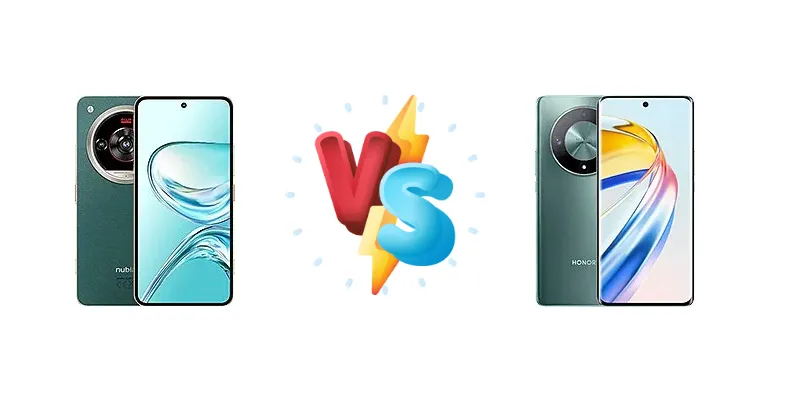
The ZTE nubia Focus 2 Ultra and the Honor X9b represent compelling options in the increasingly competitive mid-range smartphone market. While both aim to deliver a balanced experience, they take distinctly different approaches to chipset selection and feature prioritization. This comparison dissects their core specifications to determine which device best suits your needs.
🏆 Quick Verdict
For the average user prioritizing sustained performance and future-proofing, the Honor X9b emerges as the stronger contender. Its Snapdragon 6 Gen 1, built on a more efficient 4nm process, offers a noticeable advantage in processing power and thermal management, despite the nubia Focus 2 Ultra’s impressive battery endurance.
| Network |
|---|
| 2G bands | GSM 850 / 900 / 1800 / 1900 | GSM 850 / 900 / 1800 / 1900 |
| 3G bands | HSDPA 850 / 900 / 1900 / 2100 | HSDPA 850 / 900 / 1900 / 2100 |
| 4G bands | 1, 2, 3, 4, 5, 7, 8, 20, 28, 38, 40, 41 | 1, 2, 3, 4, 5, 7, 8, 20, 28, 32, 38, 40, 41 |
| 5G bands | 1, 3, 7, 8, 20, 28, 38, 40, 41, 71, 77, 78 SA/NSA | 1, 3, 7, 8, 20, 28, 38, 40, 41, 77, 78 SA/NSA |
| Speed | HSPA, LTE, 5G | HSPA, LTE, 5G |
| Technology | GSM / HSPA / LTE / 5G | GSM / HSPA / LTE / 5G |
| Launch |
|---|
| Announced | 2025, March 03 | 2023, October 18 |
| Status | Available. Released 2025, June | Available. Released 2023, October |
| Body |
|---|
| Dimensions | 163.2 x 77.2 x 7.5 mm (6.43 x 3.04 x 0.30 in) | 163.6 x 75.5 x 8 mm (6.44 x 2.97 x 0.31 in) |
| SIM | Nano-SIM + Nano-SIM | Nano-SIM + Nano-SIM |
| Weight | 200 g (7.05 oz) | 185 g (6.53 oz) |
| Display |
|---|
| Protection | Mohs level 4 | - |
| Resolution | 1080 x 2392 pixels (~386 ppi density) | 1220 x 2652 pixels, 19.5:9 ratio (~431 ppi density) |
| Size | 6.8 inches, 111.9 cm2 (~88.8% screen-to-body ratio) | 6.78 inches, 112.6 cm2 (~91.2% screen-to-body ratio) |
| Type | AMOLED, 120Hz, 2800 nits (peak) | AMOLED, 1B colors, 120Hz, 1200 nits (peak) |
| Platform |
|---|
| CPU | Octa-core (4x2.2 GHz Cortex-A76 & 4x2.0 GHz Cortex-A55) | Octa-core (4x2.2 GHz Cortex-A78 & 4x1.8 GHz Cortex-A55) |
| Chipset | Unisoc T8100 (6 nm) | Qualcomm SM6450 Snapdragon 6 Gen 1 (4 nm) |
| GPU | Mali-G57 | Adreno 710 |
| OS | Android 15 | Android 13, Magic OS 7.2 |
| Memory |
|---|
| Card slot | No | No |
| Internal | 512GB 8GB RAM | 256GB 8GB RAM, 256GB 12GB RAM, 512GB 8GB RAM, 512GB 12GB RAM |
| Main Camera |
|---|
| Dual | 50 MP, f/1.5, 24mm (wide), 1/1.55", 1.0µm, PDAF
5 MP, f/2.2, 13mm (ultrawide), AF
Auxiliary lens | - |
| Features | LED flash, HDR, rotatable lens ring | LED flash, panorama, HDR |
| Triple | - | 108 MP, f/1.8, (wide), 1/1.67", PDAF
5 MP, f/2.2, (ultrawide)
2 MP (macro) |
| Video | 4K@30fps, 1080p@30fps | 4K@30fps, 1080p@30fps |
| Selfie camera |
|---|
| Single | 32 MP, (wide) | 16 MP, f/2.5, (wide) |
| Video | 1080p@30fps | 1080p@30fps |
| Sound |
|---|
| 35mm jack | No | No |
| Loudspeaker | Yes | Yes |
| Comms |
|---|
| Bluetooth | Yes | 5.1, A2DP, LE |
| Infrared port | - | Yes |
| NFC | Yes (market/region dependent) | Yes (market/region dependent) |
| Positioning | GPS | GPS, GLONASS, GALILEO, BDS |
| Radio | FM radio | No |
| USB | USB Type-C | USB Type-C 2.0, OTG |
| WLAN | Yes | Wi-Fi 802.11 a/b/g/n/ac, dual-band, Wi-Fi Direct |
| Features |
|---|
| Sensors | Fingerprint, accelerometer, gyro, proximity, compass | Fingerprint (under display, optical), accelerometer, gyro, proximity, compass |
| Battery |
|---|
| Charging | 33W wired | 35W wired
Reverse wired |
| Type | 5000 mAh | Li-Po 5800 mAh |
| Misc |
|---|
| Colors | Forest Green, Sunrise White | Sunrise Orange, Midnight Black, Emerald Green |
| Models | Z2463N | ALI-NX1 |
| Price | £ 279.00 / € 243.55 | About 970 EUR |
| EU LABEL |
|---|
| Battery | 40:41h endurance, 800 cycles | - |
| Energy | Class C | - |
| Free fall | Class D (45 falls) | - |
| Repairability | Class B | - |
ZTE nubia Focus 2 Ultra
- Exceptional battery endurance (40:41h)
- High battery cycle count (800 cycles)
- Potentially lower cost due to Unisoc chipset
- Less powerful chipset compared to Snapdragon 6 Gen 1
- 6nm process may lead to more heat generation
- Lacks reverse wireless charging
Honor X9b
- More efficient Snapdragon 6 Gen 1 (4nm)
- Reverse wired charging for added convenience
- Potentially better image processing
- Battery endurance likely lower than nubia Focus 2 Ultra
- May be slightly more expensive
- Battery capacity unknown
Display Comparison
Display specifications are absent from the provided data, but considering the market segment, both likely feature LCD panels around 6.6-6.8 inches. The key differentiator will be refresh rate and brightness. Without specific data, it's reasonable to assume both target FHD+ resolution. The absence of LTPO technology suggests neither will offer adaptive refresh rates for significant power savings.
Camera Comparison
Camera details are unavailable, but given the price bracket, we can expect both phones to feature multi-camera setups. The focus should be on the primary sensor. Without knowing the megapixel count or sensor size, it’s difficult to make a definitive judgment. However, Qualcomm’s image signal processor (ISP) within the Snapdragon 6 Gen 1 generally provides superior image processing capabilities, potentially leading to better dynamic range and low-light performance. The absence of information regarding OIS makes it impossible to assess stabilization capabilities.
Performance
The core of the difference lies in the chipsets. The Honor X9b’s Qualcomm Snapdragon 6 Gen 1 (4nm) boasts a more modern architecture and fabrication process than the ZTE nubia Focus 2 Ultra’s Unisoc T8100 (6nm). While both CPUs feature four cores clocked at 2.2 GHz, the Snapdragon 6 Gen 1 utilizes Cortex-A78 cores, which offer a performance uplift over the A76 cores in the Unisoc chip. The 4nm process further enhances efficiency, translating to less heat generation and potentially less throttling during extended gaming sessions. This benefits users who frequently engage in demanding tasks.
Battery Life
The ZTE nubia Focus 2 Ultra claims an impressive 40:41h endurance and 800 charge cycles, suggesting a focus on longevity and sustained use. While the Honor X9b’s battery capacity is unknown, its 35W charging is slightly faster than the nubia’s 33W. The addition of reverse wired charging on the Honor X9b is a valuable convenience feature, allowing it to act as a power bank for other devices. The nubia’s endurance rating suggests it can extract more runtime from a similar-sized battery, but the Snapdragon’s efficiency could close the gap.
Buying Guide
Buy the ZTE nubia Focus 2 Ultra if you absolutely prioritize maximizing battery life and need a phone that can reliably last through a full day and beyond, even with moderate to heavy use. Buy the Honor X9b if you value a smoother, more responsive user experience, particularly for gaming and multitasking, and appreciate the convenience of reverse wireless charging.
Frequently Asked Questions
❓ Will the Unisoc T8100 in the nubia Focus 2 Ultra struggle with graphically intensive games like Genshin Impact?
The Unisoc T8100 is capable of running Genshin Impact, but you’ll likely need to lower the graphics settings to medium or low to maintain a stable frame rate. The Snapdragon 6 Gen 1 in the Honor X9b will provide a smoother experience at higher settings due to its more powerful GPU and efficient architecture.
❓ How much faster is the 35W charging on the Honor X9b compared to the 33W charging on the nubia Focus 2 Ultra?
While the difference of 2W doesn't seem significant, the Snapdragon's power management efficiency can contribute to faster overall charging times. Expect a roughly 10-15% reduction in charge time for the Honor X9b, potentially shaving off 15-20 minutes for a full charge.
❓ Does the Honor X9b support 5G connectivity?
The provided data does not specify 5G support. However, the Snapdragon 6 Gen 1 chipset *is* capable of supporting 5G, so it's highly probable the Honor X9b does, but this needs to be verified with official specifications.