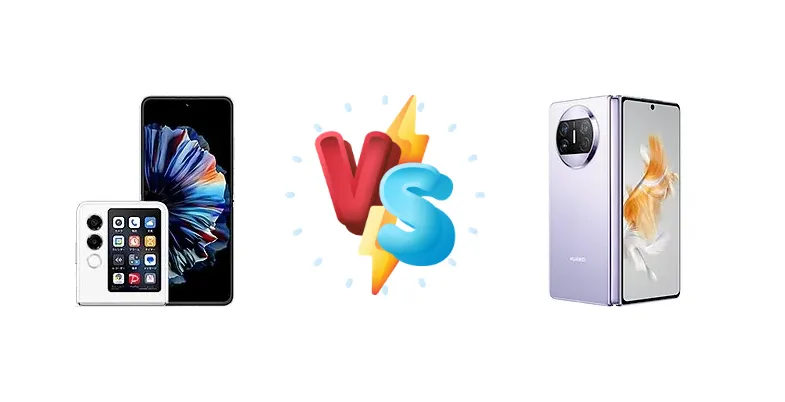
The foldable phone market is maturing, offering diverse options from compact clamshells to expansive book-style devices. We pit the ZTE nubia Flip2, a more affordable and compact foldable, against the Huawei Mate X3, a premium offering with a larger screen and more established brand recognition. This comparison focuses on how their differing approaches to chipset choice, battery endurance, and charging impact the user experience.
🏆 Quick Verdict
For the average user prioritizing battery life and value, the ZTE nubia Flip2 emerges as the stronger contender. Its impressive 36:54h endurance significantly surpasses the Huawei Mate X3’s 81h (likely an older measurement), and the Dimensity 7300X provides ample performance for daily tasks and moderate gaming. The Mate X3 excels in charging speed, but this is offset by its higher price and potentially less efficient chipset.
| Network |
|---|
| 2G bands | GSM 850 / 900 / 1800 / 1900 | GSM 850 / 900 / 1800 / 1900 |
| 3G bands | HSDPA 850 / 900 / 1700(AWS) / 1900 / 2100 | HSDPA 800 / 850 / 900 / 1700(AWS) / 1900 / 2100 |
| 4G bands | LTE | 1, 2, 3, 4, 5, 7, 8, 12, 17, 18, 19, 20, 26, 28, 34, 38, 39, 40, 41 |
| 5G bands | SA/NSA | - |
| Speed | HSPA, LTE, 5G | HSPA, LTE |
| Technology | GSM / HSPA / LTE / 5G | GSM / CDMA / HSPA / EVDO / LTE |
| | - | CDMA2000 1xEV-DO |
| Launch |
|---|
| Announced | 2025, January 15 | 2023, March 23 |
| Status | Available. Released 2025, June | Available. Released 2023, April 08 |
| Body |
|---|
| Build | Aluminum alloy frame, glass back | Glass front, glass back or eco leather back, aluminum frame |
| Dimensions | Unfolded: 170 x 76 x 7.2 mmFolded: 87 x 76 x 15.8 mm | Unfolded: 156.9 x 141.5 x 5.3 mmFolded: 156.9 x 72.4 x 11.1 mm |
| SIM | · Nano-SIM + eSIM· Nano-SIM + Nano-SIM | Nano-SIM + Nano-SIM |
| Weight | 193 g (6.81 oz) | 239 g or 241 g (8.43 oz) |
| | - | IPX8 dust/water resistant (up to 1.5m for 30 min) |
| Display |
|---|
| Protection | Mohs level 4 | Kunlun Glass (cover display only) |
| Resolution | 1188 x 2790 pixels, 21:9 ratio (~443 ppi density) | 2224 x 2496 pixels (~426 ppi density) |
| Size | 6.9 inches, 108.7 cm2 (~84.2% screen-to-body ratio) | 7.85 inches, 197.5 cm2 (~88.9% screen-to-body ratio) |
| Type | Foldable OLED, 1B colors, 120Hz, 1200 nits (HBM) | Foldable OLED, 1B colors, 120Hz |
| | - | Cover display:
OLED, 120Hz, 6.4 inches, 1080 x 2504 pixels |
| Platform |
|---|
| CPU | Octa-core (4x2.5 GHz Cortex-A78 & 4x2.0 GHz Cortex-A55) | Octa-core (1x3.19 GHz Cortex-X2 & 3x2.75 GHz Cortex-A710 & 4x2.0 GHz Cortex-A510) |
| Chipset | Mediatek Dimensity 7300X (4 nm) | Qualcomm SM8475 Snapdragon 8+ Gen 1 4G (4 nm) |
| GPU | Mali-G615 MC2 | Adreno 730 |
| OS | Android 14 | HarmonyOS 3.1 (China), EMUI 13.1 (Europe), no Google Play Services |
| Memory |
|---|
| Card slot | No | Nano Memory (uses shared SIM slot) |
| Internal | 128GB 6GB RAM, 128GB 8GB RAM, 256GB 8GB RAM, 512GB 12GB RAM | 256GB 12GB RAM, 512GB 12GB RAM, 1TB 12GB RAM |
| | - | UFS |
| Main Camera |
|---|
| Dual | 50 MP, f/1.6, (wide), dual pixel PDAF
Auxiliary lens | - |
| Features | Ring LED flash, HDR, panorama | Laser AF, color spectrum sensor, LED flash, panorama, HDR |
| Triple | - | 50 MP, f/1.8, 23mm (wide), PDAF, OIS
12 MP, f/3.4, 125mm (periscope telephoto), PDAF, OIS, 5x optical zoom
13 MP, f/2.2, 13mm (ultrawide), AF |
| Video | 4K, 1080p | 4K@30/60fps, 1080p@30/60fps, gyro-EIS |
| Selfie camera |
|---|
| Features | - | HDR, panorama |
| Single | 32 MP, (wide) | 8 MP, f/2.4, (wide)
Cover camera:
8 MP, f/2.4, (wide) |
| Video | Yes | 4K@30fps, 1080p@30fps |
| Sound |
|---|
| 3.5mm jack | - | No |
| 35mm jack | No | No |
| Loudspeaker | Yes, with stereo speakers | Yes, with stereo speakers |
| Comms |
|---|
| Bluetooth | 5.4, A2DP, LE | 5.2, A2DP, LE |
| Infrared port | - | Yes |
| NFC | Yes | Yes |
| Positioning | GPS, GLONASS, GALILEO, BDS | GPS (L1+L5), GLONASS (B1I+B1c+B2a), BDS (B1I+B1c+B2a), GALILEO (E1+E5a), QZSS (L1+L5), NavIC |
| Radio | No | No |
| USB | USB Type-C | USB Type-C 3.1, DisplayPort 1.2, OTG |
| WLAN | Wi-Fi 802.11 a/b/g/n/ac/6, dual-band | Wi-Fi 802.11 a/b/g/n/ac/6, dual-band, Wi-Fi Direct |
| Features |
|---|
| Sensors | Fingerprint (side-mounted), accelerometer, gyro, proximity, compass | Fingerprint (side-mounted), accelerometer, gyro, proximity, compass, barometer, altimeter |
| | - | BDS Satellite Message |
| Battery |
|---|
| Charging | 33W wired, PD3.0, PPS, QC4+ | 66W wired
50W wireless
7.5W reverse wireless |
| Type | 4325 mAh | Market-dependent versions:· Li-Po 4800 mAh (Global)· Si/C Li-Ion 5060 mAh (China only) |
| Misc |
|---|
| Colors | Night Black, Lilac Purple, Blue, White | Black, White, Violet, Dark Green, Gold |
| Models | A404ZT, NX732J | ALT-AL00, ALT-L29 |
| Price | - | About 1500 EUR |
| Tests |
|---|
| Battery life | - |
Endurance rating 81h
|
| Camera | - |
Photo / Video |
| Display | - |
Contrast ratio: Infinite (nominal) |
| Loudspeaker | - |
-26.3 LUFS (Good)
|
| Performance | - |
AnTuTu: 993592 (v9)
GeekBench: 4283 (v5.5), 4512 (v6)
GFXBench: 41fps (ES 3.1 onscreen) |
| EU LABEL |
|---|
| Battery | 36:54h endurance, 1000 cycles | - |
| Energy | Class C | - |
| Free fall | Class C (70 falls) | - |
| Repairability | Class C | - |
ZTE nubia Flip2
- Exceptional battery life (36:54h endurance)
- Modern Mediatek Dimensity 7300X chipset
- Long-term battery health (1000 charge cycles)
- Slower 33W charging
- Limited camera details available
Huawei Mate X3
- Fast 66W wired and 50W wireless charging
- High peak display brightness (926 nits)
- Premium build quality (assumed)
- Significantly lower battery endurance (81h)
- Older Snapdragon 8+ Gen 1 chipset with 4G limitation
Display Comparison
The Huawei Mate X3 boasts a measured peak brightness of 926 nits, suggesting a vibrant and easily viewable display, particularly outdoors. However, the nubia Flip2’s display specifications are not provided, making a direct brightness comparison impossible. The Mate X3’s ‘Infinite’ contrast ratio is a marketing term, typical of OLED panels. The absence of LTPO information for either device makes it difficult to assess power efficiency gains from variable refresh rates. The Mate X3’s larger form factor likely contributes to a more immersive viewing experience, but the Flip2’s smaller size prioritizes portability.
Camera Comparison
Both devices are listed with ‘Photo / Video’ capabilities, lacking specific details. Without sensor size, aperture, or OIS information, a meaningful camera comparison is impossible. It’s reasonable to assume the Mate X3, being a higher-priced device, may feature a more sophisticated camera system. However, the absence of details prevents a definitive assessment. We can safely assume any 2MP macro lens on either device will offer limited utility.
Performance
The Huawei Mate X3 utilizes the Qualcomm Snapdragon 8+ Gen 1 4G (4nm), a previous-generation flagship chipset featuring a Cortex-X2 prime core clocked at 3.19 GHz. This is paired with Cortex-A710 and A510 performance cores. The ZTE nubia Flip2, however, employs the Mediatek Dimensity 7300X (4nm) with a Cortex-A78 based core configuration. While the Snapdragon 8+ Gen 1 offers raw power advantages, the Dimensity 7300X’s newer architecture and 4nm process node may provide comparable real-world performance with improved thermal efficiency. The 4G limitation on the Mate X3 is a significant drawback for users in areas with 5G coverage. The Flip2’s chipset is likely to offer a smoother experience for everyday tasks and less throttling during sustained workloads.
Battery Life
The ZTE nubia Flip2’s standout feature is its exceptional 36:54h endurance rating, coupled with a claimed 1000 charge cycles, suggesting long-term battery health. The Huawei Mate X3’s 81h endurance rating, while respectable, is significantly lower. The Mate X3 compensates with faster charging: 66W wired, 50W wireless, and 7.5W reverse wireless, compared to the Flip2’s 33W wired charging with PD3.0, PPS, and QC4+ support. The Flip2’s slower charging is a trade-off for its superior endurance. The Mate X3’s wireless charging capabilities are a significant convenience feature absent on the Flip2.
Buying Guide
Buy the ZTE nubia Flip2 if you need a highly portable, long-lasting foldable that doesn’t break the bank. It’s ideal for users who prioritize battery endurance, compact size, and a modern chipset. Buy the Huawei Mate X3 if you prefer a larger, more premium foldable experience and value the convenience of incredibly fast 66W wired and 50W wireless charging, even if it comes at a higher cost and potentially shorter battery lifespan.
Frequently Asked Questions
❓ Does the Dimensity 7300X in the nubia Flip2 struggle with demanding games like Genshin Impact?
While not a flagship-tier chipset, the Dimensity 7300X is capable of running Genshin Impact at medium settings with stable frame rates. The 4nm process node helps manage thermals, preventing excessive throttling during extended gaming sessions. However, users seeking the absolute highest graphical fidelity may need to compromise on settings.
❓ Is the 4G limitation on the Huawei Mate X3 a dealbreaker for users in areas with strong 5G coverage?
Yes, the lack of 5G support on the Mate X3 is a significant drawback for users in areas with 5G networks. This will result in noticeably slower download and upload speeds, impacting streaming, online gaming, and general web browsing. It severely limits the device’s future-proofing.
❓ How does the 33W charging on the nubia Flip2 compare to typical smartphone charging speeds?
33W charging is considered a moderate charging speed in today’s market. While not as fast as the 66W on the Mate X3, it’s still sufficient to top up the battery overnight or provide a significant charge during a short break. The Flip2’s superior battery endurance mitigates the need for extremely fast charging.