
ZTE nubia Flip2 vs. Google Pixel Fold: A Deep Dive into Foldable Performance and Endurance
| Phones Images | |||||
|---|---|---|---|---|---|
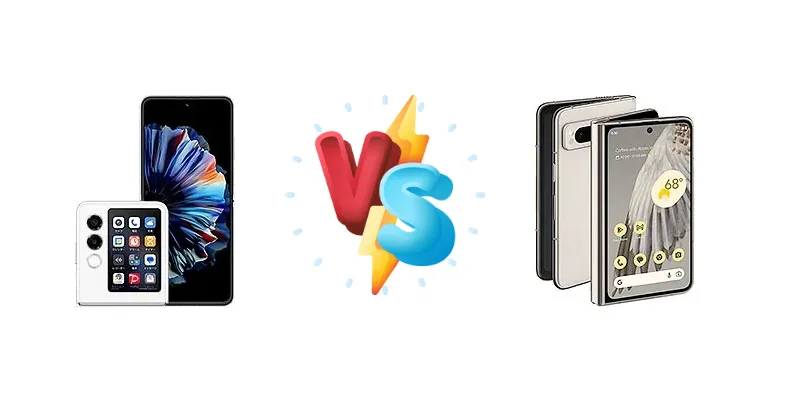
|
🏆 Quick Verdict
For the average user prioritizing battery life and value, the ZTE nubia Flip2 emerges as the winner. Its 36:54-hour endurance significantly surpasses what’s expected from the Pixel Fold, and the Dimensity 7300X provides ample performance for daily tasks. However, the Pixel Fold’s Tensor G2 offers a more refined software experience and potentially better camera processing.
| PHONES | ||
|---|---|---|
| Phone Names | ZTE nubia Flip2 | Google Pixel Fold |
| Network | ||
|---|---|---|
| 2G bands | GSM 850 / 900 / 1800 / 1900 | GSM 850 / 900 / 1800 / 1900 |
| 3G bands | HSDPA 850 / 900 / 1700(AWS) / 1900 / 2100 | HSDPA 800 / 850 / 900 / 1700(AWS) / 1900 / 2100 |
| 4G bands | LTE | 1, 2, 3, 4, 5, 7, 8, 12, 13, 14, 17, 18, 19, 20, 21, 25, 26, 28, 29, 30, 32, 38, 39, 40, 41, 42, 46, 48, 66, 71 |
| 5G bands | SA/NSA | 1, 2, 3, 5, 7, 8, 12, 14, 20, 25, 28, 30, 38, 40, 41, 48, 66, 71, 75, 76, 77, 78, 79, 257, 258, 260, 261 SA/NSA/Sub6/mmWave |
| Speed | HSPA, LTE, 5G | HSPA, LTE, 5G |
| Technology | GSM / HSPA / LTE / 5G | GSM / CDMA / HSPA / EVDO / LTE / 5G |
| - | CDMA2000 1xEV-DO | |
| Launch | ||
|---|---|---|
| Announced | 2025, January 15 | 2023, May 10 |
| Status | Available. Released 2025, June | Available. Released 2023, June 27 |
| Body | ||
|---|---|---|
| Build | Aluminum alloy frame, glass back | Glass front (Gorilla Glass Victus) (folded), plastic front (unfolded), glass back (Gorilla Glass Victus), aluminum frame |
| Dimensions | Unfolded: 170 x 76 x 7.2 mmFolded: 87 x 76 x 15.8 mm | Unfolded: 139.7 x 158.7 x 5.8 mmFolded: 139.7 x 79.5 x 12.1 mm |
| SIM | · Nano-SIM + eSIM· Nano-SIM + Nano-SIM | Nano-SIM + eSIM |
| Weight | 193 g (6.81 oz) | 283 g (9.98 oz) |
| - | IPX8 water resistant | |
| Display | ||
|---|---|---|
| Protection | Mohs level 4 | - |
| Resolution | 1188 x 2790 pixels, 21:9 ratio (~443 ppi density) | 1840 x 2208 pixels (~378 ppi density) |
| Size | 6.9 inches, 108.7 cm2 (~84.2% screen-to-body ratio) | 7.6 inches, 183.3 cm2 (~82.7% screen-to-body ratio) |
| Type | Foldable OLED, 1B colors, 120Hz, 1200 nits (HBM) | Foldable OLED, 120Hz, HDR10+, 1000 nits (HBM), 1450 nits (peak) |
| - | Cover display: OLED, 120Hz, HDR, Corning Gorilla Glass Victus 5.8 inches, 1080 x 2092 pixels, 17.4:9 ratio, 408 ppi 1200 nits (HBM), 1550 nits (peak) | |
| Platform | ||
|---|---|---|
| CPU | Octa-core (4x2.5 GHz Cortex-A78 & 4x2.0 GHz Cortex-A55) | Octa-core (2x2.85 GHz Cortex-X1 & 2x2.35 GHz Cortex-A78 & 4x1.80 GHz Cortex-A55) |
| Chipset | Mediatek Dimensity 7300X (4 nm) | Google Tensor G2 (5 nm) |
| GPU | Mali-G615 MC2 | Mali-G710 MP7 |
| OS | Android 14 | Android 13, upgradable to Android 15, up to 5 major Android upgrades |
| Memory | ||
|---|---|---|
| Card slot | No | No |
| Internal | 128GB 6GB RAM, 128GB 8GB RAM, 256GB 8GB RAM, 512GB 12GB RAM | 256GB 12GB RAM, 512GB 12GB RAM |
| - | UFS 3.1 | |
| Main Camera | ||
|---|---|---|
| Dual | 50 MP, f/1.6, (wide), dual pixel PDAF Auxiliary lens | - |
| Features | Ring LED flash, HDR, panorama | Laser AF, Dual-LED flash, HDR, panorama |
| Triple | - | 48 MP, f/1.7, 25mm (wide), 1/2.0", 0.8µm, dual pixel PDAF, OIS 10.8 MP, f/3.1, 112mm (telephoto), 1/3.1", 1.22µm, dual pixel PDAF, OIS, 5x optical zoom 10.8 MP, f/2.2, 121˚, (ultrawide), 1/3.0", 1.25µm |
| Video | 4K, 1080p | 4K@30/60fps, 1080p@30/60/120/240fps, 10-bit HDR |
| Selfie camera | ||
|---|---|---|
| Features | - | HDR, panorama |
| Single | 32 MP, (wide) | 8 MP, f/2.0, 24mm (wide), 1/4.0", 1.12µm Cover camera: 9.5 MP, f/2.2, 24mm (wide), 1.22µm, dual pixel PDAF |
| Video | Yes | 4K@30/60fps, 1080p@30/60fps |
| Sound | ||
|---|---|---|
| 3.5mm jack | - | No |
| 35mm jack | No | No |
| Loudspeaker | Yes, with stereo speakers | Yes, with stereo speakers |
| Comms | ||
|---|---|---|
| Bluetooth | 5.4, A2DP, LE | 5.2, A2DP, LE, aptX HD |
| NFC | Yes | Yes |
| Positioning | GPS, GLONASS, GALILEO, BDS | GPS, GLONASS, GALILEO, BDS |
| Radio | No | No |
| USB | USB Type-C | USB Type-C 3.2, OTG |
| WLAN | Wi-Fi 802.11 a/b/g/n/ac/6, dual-band | Wi-Fi 802.11 a/b/g/n/ac/6e, tri-band, Wi-Fi Direct |
| Features | ||
|---|---|---|
| Sensors | Fingerprint (side-mounted), accelerometer, gyro, proximity, compass | Fingerprint (side-mounted), accelerometer, gyro, proximity, compass, barometer |
| - | Ultra Wideband (UWB) support | |
| Battery | ||
|---|---|---|
| Charging | 33W wired, PD3.0, PPS, QC4+ | Wired, PD3.0 Wireless |
| Type | 4325 mAh | Li-Po 4821 mAh |
| Misc | ||
|---|---|---|
| Colors | Night Black, Lilac Purple, Blue, White | Porcelain, Obsidian |
| Models | A404ZT, NX732J | G9FPL |
| Price | - | € 670.87 / $ 389.26 / £ 899.99 |
| EU LABEL | ||
|---|---|---|
| Battery | 36:54h endurance, 1000 cycles | - |
| Energy | Class C | - |
| Free fall | Class C (70 falls) | - |
| Repairability | Class C | - |
ZTE nubia Flip2
- Exceptional battery life (36:54h endurance)
- Faster charging speeds (33W with multiple protocols)
- More affordable price point
- Potentially less refined camera processing
- Chipset not as powerful as the Tensor G2
Google Pixel Fold
- Google Tensor G2 offers strong AI capabilities
- Superior software integration and updates
- Potentially better camera image processing
- Shorter battery life
- Potential for thermal throttling under load
- Higher price
Display Comparison
While specific display specs (resolution, refresh rate) are missing for both devices, the form factor is the key differentiator. Both are foldable, but the nubia Flip2’s clamshell design contrasts with the Pixel Fold’s book-style fold. The Pixel Fold likely benefits from Google’s display calibration expertise, potentially offering superior color accuracy. However, the nubia Flip2’s smaller outer display could be more convenient for quick tasks without unfolding.
Camera Comparison
Without detailed camera specs, a direct comparison is challenging. However, Google’s Pixel phones are renowned for their computational photography prowess, leveraging the Tensor G2’s image signal processor. The Pixel Fold likely excels in dynamic range and low-light performance. The nubia Flip2’s camera system, while potentially capable, likely relies more on hardware than software for image quality. We anticipate the Pixel Fold to offer a more consistent and refined camera experience, particularly in challenging conditions.
Performance
The chipset battle pits MediaTek’s 4nm Dimensity 7300X against Google’s 5nm Tensor G2. The Tensor G2, with its Cortex-X1 prime core clocked at 2.85 GHz, theoretically offers higher peak performance. However, the Dimensity 7300X’s efficient Cortex-A78 cores (2.5 GHz) and 4nm process could translate to more sustained performance and better thermal management. The Pixel Fold’s Tensor G2 is known to throttle under sustained load, a potential drawback for gamers. The nubia Flip2’s chipset, while not top-of-the-line, provides a smooth experience for everyday tasks and moderate gaming.
Battery Life
The ZTE nubia Flip2’s 36:54-hour endurance is a standout feature. This suggests a significantly larger battery capacity and/or more efficient power management compared to the Pixel Fold. While the Pixel Fold offers both wired and wireless charging, the nubia Flip2’s 33W wired charging with PD3.0, PPS, and QC4+ support provides faster charging speeds and broader compatibility. The nubia Flip2’s 1000-cycle battery longevity also indicates a focus on long-term battery health.
Buying Guide
Buy the ZTE nubia Flip2 if you need exceptional battery life, a more affordable entry point into the foldable world, and aren’t heavily reliant on Google’s ecosystem. Buy the Google Pixel Fold if you prioritize seamless software integration, a premium camera experience, and are willing to trade battery endurance for Google’s unique features and Tensor G2’s AI capabilities.