
ZTE nubia Flip vs Motorola Razr 2022: A Detailed Foldable Phone Comparison
| Phones Images | |||||
|---|---|---|---|---|---|
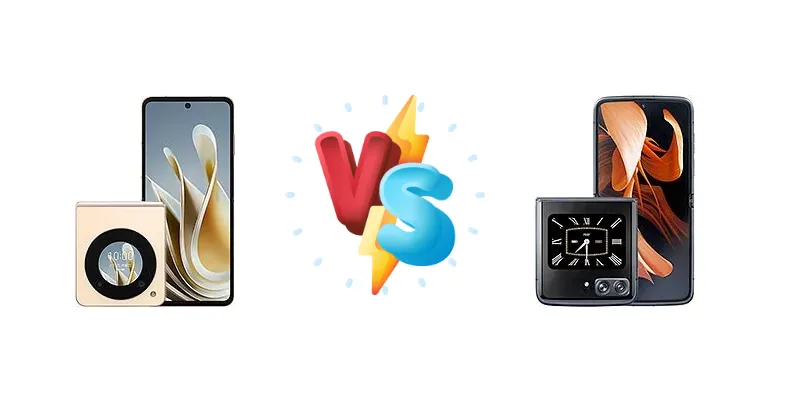
|
🏆 Quick Verdict
For most users, the Motorola Razr 2022 emerges as the stronger choice. Its Snapdragon 8+ Gen 1 chipset provides a substantial performance advantage, making it better suited for demanding tasks and future-proofing. While the nubia Flip offers a more affordable entry point, the Razr 2022’s superior processing power justifies the price premium.
| PHONES | ||
|---|---|---|
| Phone Names | ZTE nubia Flip | Motorola Razr 2022 |
| Network | ||
|---|---|---|
| 2G bands | GSM 850 / 900 / 1800 / 1900 | GSM 900 / 1800 / 1900 |
| 3G bands | HSDPA 850 / 900 / 1700(AWS) / 1900 / 2100 | HSDPA 850 / 900 / 1700(AWS) / 1900 / 2100 |
| 4G bands | 1, 2, 3, 4, 5, 7, 8, 12, 13, 17, 20, 26, 28, 38, 40, 41, 66 | 1, 2, 3, 4, 5, 7, 8, 12, 13, 14, 17, 18, 19, 20, 25, 26, 28, 34, 38, 39, 40, 41, 42, 43, 48, 66 |
| 5G bands | 1, 2, 3, 5, 7, 8, 20, 28, 38, 40, 41, 66, 77, 78 SA/NSA | 1, 2, 3, 5, 7, 8, 12, 20, 25, 26, 28, 38, 40, 41, 66, 77, 78, 79 SA/NSA/Sub6 |
| Speed | HSPA, LTE, 5G | HSPA, LTE, 5G |
| Technology | GSM / HSPA / LTE / 5G | GSM / CDMA / HSPA / EVDO / LTE / 5G |
| - | CDMA2000 1xEV-DO | |
| Launch | ||
|---|---|---|
| Announced | 2024, February 26 | 2022, August 11 |
| Status | Available. Released 2024, April 23 | Available. Released 2022, August 18 |
| Body | ||
|---|---|---|
| Build | Aluminum alloy frame, glass back | Plastic front (unfolded), glass front (folded, Gorilla Glass 5), glass back (Gorilla Glass 5), aluminum frame (7000 series), hinge (stainless steel) |
| Dimensions | Unfolded: 170 x 75.5 x 7.0 mmFolded: 87.6 x 75.5 x 15 mm | Unfolded: 167.0 x 79.8 x 7.6 mm Folded: 86.5 x 79.8 x 17 mm |
| SIM | · Nano-SIM + eSIM· Nano-SIM + Nano-SIM | Nano-SIM + eSIM |
| Weight | 214 g (7.55 oz) | 200 g (7.05 oz) |
| - | Water-repellent coating | |
| Display | ||
|---|---|---|
| Resolution | 1188 x 2790 pixels, 21:9 ratio (~439 ppi density) | 1080 x 2400 pixels, 20:9 ratio (~393 ppi density) |
| Size | 6.9 inches, 110.7 cm2 (~86.3% screen-to-body ratio) | 6.7 inches, 108.4 cm2 (~81.3% screen-to-body ratio) |
| Type | Foldable OLED, 1B colors, 120Hz | Foldable AMOLED, 1B colors, 144Hz, HDR10+ |
| - | Second external AMOLED display, 2.7 inches, 573 x 800 pixels | |
| Platform | ||
|---|---|---|
| CPU | Octa-core (1x2.4 GHz Cortex-A710 & 3x2.36 GHz Cortex-A710 & 4x1.8 GHz Cortex-A510) | Octa-core (1x3.19 GHz Cortex-X2 & 3x2.75 GHz Cortex-A710 & 4x1.80 GHz Cortex-A510) |
| Chipset | Qualcomm SM7450-AB Snapdragon 7 Gen 1 (4 nm) | Qualcomm SM8475 Snapdragon 8+ Gen 1 (4 nm) |
| GPU | Adreno 644 | Adreno 730 |
| OS | Android 13 | Android 13, upgradable to Android 14 |
| Memory | ||
|---|---|---|
| Card slot | No | No |
| Internal | 128GB 6GB RAM, 128GB 8GB RAM, 256GB 8GB RAM, 512GB 12GB RAM | 128GB 8GB RAM, 256GB 8GB RAM, 512GB 12GB RAM |
| - | UFS 3.1 | |
| Main Camera | ||
|---|---|---|
| Dual | 50 MP, (wide), PDAF Auxiliary lens | 50 MP, f/1.8, (wide), 1/1.55", 1.0µm, PDAF, OIS 13 MP, f/2.2, 120˚ (ultrawide), 1/3.0", 1.12µm, AF |
| Features | LED flash, HDR, panorama | LED flash, panorama, auto HDR |
| Video | 4K, 1080p | 8K@30fps, 4K@30/60fps, 1080p@30/60/120fps, gyro-EIS |
| Selfie camera | ||
|---|---|---|
| Features | - | Auto HDR |
| Single | 16 MP, (wide) | 32 MP, f/2.4, 25mm (wide), 1/3.2", 0.7µm |
| Video | 1080p@30fps | 1080p@30/60fps |
| Sound | ||
|---|---|---|
| 3.5mm jack | - | No |
| 35mm jack | No | No |
| Loudspeaker | Yes, with stereo speakers | Yes, with stereo speakers |
| Comms | ||
|---|---|---|
| Bluetooth | 5.1, A2DP, LE | 5.2, A2DP, LE, aptX HD, aptX Adaptive |
| NFC | Yes | Yes |
| Positioning | GPS, GLONASS, GALILEO, BDS | GPS (L1+L5), GLONASS (L1), BDS (B1I+B1c+B2a), GALILEO (E1+E5a), QZSS (L1+L5) |
| Radio | No | No |
| USB | USB Type-C | USB Type-C 3.1 |
| WLAN | Wi-Fi 802.11 a/b/g/n/ac/6, dual-band | Wi-Fi 802.11 a/b/g/n/ac/6e, dual-band, Wi-Fi Direct |
| Features | ||
|---|---|---|
| Sensors | Fingerprint (side-mounted), accelerometer, gyro, proximity, compass | Fingerprint (side-mounted), accelerometer, gyro, proximity, compass |
| Battery | ||
|---|---|---|
| Charging | 33W wired, PD3.0, PPS, QC4+, 50% in 18 min | 30W wired |
| Type | 4310 mAh | Li-Po 3500 mAh |
| Misc | ||
|---|---|---|
| Colors | Sunshine Gold, Cosmic Black, Flowering Lilac | Satin Black |
| Models | - | XT2251-1 |
| Price | € 249.00 / £ 299.00 | About 670 EUR |
| Tests | ||
|---|---|---|
| Battery life | - | Endurance rating 64h |
| Camera | - | Photo / Video |
| Display | - | Contrast ratio: Infinite (nominal) |
| Loudspeaker | - | -25.4 LUFS (Very good) |
| Performance | - | AnTuTu: 965260 (v9) GeekBench: 3944 (v5.1) GFXBench: 76fps (ES 3.1 onscreen) |
ZTE nubia Flip
- More affordable price point
- Faster charging speed (33W)
- Unique and eye-catching design
- Significantly less powerful processor
- Likely inferior camera performance
- Display brightness likely lower
Motorola Razr 2022
- Flagship-level Snapdragon 8+ Gen 1 performance
- Brighter and more vibrant display
- Potentially superior camera system
- Higher price tag
- Slower charging speed (30W)
- May experience more heat under sustained load
Display Comparison
The Motorola Razr 2022 boasts a significantly brighter display, reaching a measured 1033 nits, compared to an unspecified peak brightness for the nubia Flip. This translates to better outdoor visibility. Both feature foldable OLED panels, but the Razr’s infinite (nominal) contrast ratio suggests deeper blacks and a more vibrant image. While both likely employ high refresh rates (a common feature in this segment), the Razr’s brightness advantage is a clear win for users who frequently consume content outdoors or in brightly lit environments.
Camera Comparison
Both devices offer photo and video capabilities, but detailed sensor information is lacking for both. However, given the Razr 2022’s flagship positioning, it’s reasonable to expect a more sophisticated camera system with a larger main sensor and improved image processing. The nubia Flip likely focuses on social media-friendly shots, while the Razr aims for higher-quality images and videos. Without specific sensor details, it’s difficult to make a definitive judgment, but the Razr’s overall hardware tier suggests a superior camera experience.
Performance
The core difference lies in the chipsets. The Motorola Razr 2022’s Snapdragon 8+ Gen 1 (4nm) is a generational leap ahead of the ZTE nubia Flip’s Snapdragon 7 Gen 1 (4nm). The 8+ Gen 1 features a Cortex-X2 prime core clocked at 3.19 GHz, versus the Flip’s Cortex-A710 at 2.4 GHz. This translates to a noticeable performance difference in CPU-intensive tasks and gaming. The Razr’s Adreno 730 GPU also significantly outperforms the Flip’s Adreno 644. While both utilize a 4nm process for improved efficiency, the architectural advantages of the 8+ Gen 1 provide a substantial edge in sustained performance and thermal management.
Battery Life
Both phones share an endurance rating of 64 hours, suggesting similar real-world battery life despite the Razr’s more powerful chipset. This is likely due to optimizations in software and power management. However, charging speeds differ: the nubia Flip supports 33W wired charging with PD3.0, PPS, and QC4+, claiming 50% charge in 18 minutes, while the Razr 2022 is limited to 30W. The nubia Flip’s faster charging could be a deciding factor for users who prioritize quick top-ups.
Buying Guide
Buy the ZTE nubia Flip if you prioritize affordability and a unique aesthetic, and your primary use case revolves around social media, light gaming, and everyday communication. You’re willing to trade raw power for a lower price tag and a distinctive design. Buy the Motorola Razr 2022 if you demand flagship-level performance, a brighter display, and a more responsive user experience. You’re a power user who values speed, multitasking, and future-proofing in a compact form factor.