
ZTE nubia Flip vs Huawei P50 Pocket: A Detailed Foldable Phone Comparison
| Phones Images | |||||
|---|---|---|---|---|---|
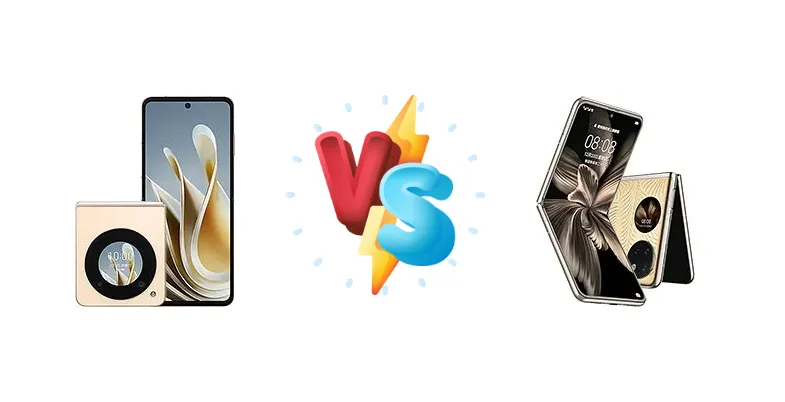
|
🏆 Quick Verdict
For most users, the ZTE nubia Flip offers a more compelling package. While the Huawei P50 Pocket boasts a slightly brighter display and comparable battery endurance, the nubia Flip’s newer Snapdragon 7 Gen 1 provides a more efficient and modern chipset, coupled with faster charging, all at a potentially lower price point.
| PHONES | ||
|---|---|---|
| Phone Names | ZTE nubia Flip | Huawei P50 Pocket |
| Network | ||
|---|---|---|
| 2G bands | GSM 850 / 900 / 1800 / 1900 | GSM 850 / 900 / 1800 / 1900 |
| 3G bands | HSDPA 850 / 900 / 1700(AWS) / 1900 / 2100 | HSDPA 800 / 850 / 900 / 1700(AWS) / 1900 / 2100 |
| 4G bands | 1, 2, 3, 4, 5, 7, 8, 12, 13, 17, 20, 26, 28, 38, 40, 41, 66 | 1, 2, 3, 4, 5, 7, 8, 12, 17, 18, 19, 20, 26, 28, 32, 34, 38, 39, 40, 41 - International |
| 5G bands | 1, 2, 3, 5, 7, 8, 20, 28, 38, 40, 41, 66, 77, 78 SA/NSA | - |
| Speed | HSPA, LTE, 5G | HSPA, LTE |
| Technology | GSM / HSPA / LTE / 5G | GSM / CDMA / HSPA / CDMA2000 / LTE |
| - | 1, 2, 3, 4, 5, 7, 8, 12, 17, 18, 19, 20, 26, 28, 34, 38, 39, 40, 41 - China | |
| Launch | ||
|---|---|---|
| Announced | 2024, February 26 | 2021, December 23 |
| Status | Available. Released 2024, April 23 | Available. Released 2021, December 23 |
| Body | ||
|---|---|---|
| Build | Aluminum alloy frame, glass back | - |
| Dimensions | Unfolded: 170 x 75.5 x 7.0 mmFolded: 87.6 x 75.5 x 15 mm | Unfolded: 170 x 75.5 x 7.2 mm Folded: 87.3 x 75.5 x 15.2 mm |
| SIM | · Nano-SIM + eSIM· Nano-SIM + Nano-SIM | Nano-SIM + Nano-SIM |
| Weight | 214 g (7.55 oz) | 190 g (6.70 oz) |
| Display | ||
|---|---|---|
| Resolution | 1188 x 2790 pixels, 21:9 ratio (~439 ppi density) | 1188 x 2790 pixels, 21:9 ratio (~442 ppi density) |
| Size | 6.9 inches, 110.7 cm2 (~86.3% screen-to-body ratio) | 6.9 inches, 109.2 cm2 (~85.1% screen-to-body ratio) |
| Type | Foldable OLED, 1B colors, 120Hz | Foldable OLED, 1B colors, 120Hz |
| - | Cover display: OLED, 1.04 inch, 340 x 340 pixels, 328 ppi | |
| Platform | ||
|---|---|---|
| CPU | Octa-core (1x2.4 GHz Cortex-A710 & 3x2.36 GHz Cortex-A710 & 4x1.8 GHz Cortex-A510) | Octa-core (1x2.84 GHz Cortex-X1 & 3x2.42 GHz Cortex-A78 & 4x1.80 GHz Cortex-A55) |
| Chipset | Qualcomm SM7450-AB Snapdragon 7 Gen 1 (4 nm) | Qualcomm SM8350 Snapdragon 888 4G (5 nm) |
| GPU | Adreno 644 | Adreno 660 |
| OS | Android 13 | HarmonyOS 2.0 (China), EMUI 12 (Europe), no Google Play Services |
| Memory | ||
|---|---|---|
| Card slot | No | Nano Memory (uses shared SIM slot) |
| Internal | 128GB 6GB RAM, 128GB 8GB RAM, 256GB 8GB RAM, 512GB 12GB RAM | 256GB 8GB RAM, 256GB 12GB RAM, 512GB 8GB RAM, 512GB 12GB RAM |
| Main Camera | ||
|---|---|---|
| Dual | 50 MP, (wide), PDAF Auxiliary lens | - |
| Features | LED flash, HDR, panorama | Laser AF, color spectrum sensor, LED flash, HDR, panorama |
| Single | - | 10.7 MP, f/2.2, (ultrawide) |
| Triple | - | 40 MP, f/1.8, (wide), PDAF 13 MP, f/2.2, 120˚ (ultrawide), AF 32 MP, f/1.8, (wide), 1/3.14", 0.7µm, AF |
| Video | 4K, 1080p | 4K@30/60fps, 1080p@30/120/240fps, gyro-EIS |
| Selfie camera | ||
|---|---|---|
| Features | - | HDR, panorama |
| Single | 16 MP, (wide) | 10.7 MP, f/2.2, (ultrawide) |
| Video | 1080p@30fps | 4K@30/60fps, 1080p@30/60/120/240fps |
| Sound | ||
|---|---|---|
| 3.5mm jack | - | No |
| 35mm jack | No | No |
| Loudspeaker | Yes, with stereo speakers | Yes, with stereo speakers |
| Comms | ||
|---|---|---|
| Bluetooth | 5.1, A2DP, LE | 5.2, A2DP, LE |
| NFC | Yes | Yes |
| Positioning | GPS, GLONASS, GALILEO, BDS | GPS (L1+L5), GLONASS (L1), BDS (B1I+B1c+B2a), GALILEO (E1+E5a), QZSS (L1+L5), NavIC (L5) |
| Radio | No | No |
| USB | USB Type-C | USB Type-C 2.0, OTG |
| WLAN | Wi-Fi 802.11 a/b/g/n/ac/6, dual-band | Wi-Fi 802.11 a/b/g/n/ac/6, dual-band, Wi-Fi Direct |
| Features | ||
|---|---|---|
| Sensors | Fingerprint (side-mounted), accelerometer, gyro, proximity, compass | Fingerprint (side-mounted), accelerometer, gyro, proximity, compass, barometer |
| - | UV illuminator | |
| Battery | ||
|---|---|---|
| Charging | 33W wired, PD3.0, PPS, QC4+, 50% in 18 min | 40W wired 5W reverse wired |
| Type | 4310 mAh | Li-Po 4000 mAh |
| Misc | ||
|---|---|---|
| Colors | Sunshine Gold, Cosmic Black, Flowering Lilac | Black, Gold, Silver |
| Models | - | BAL-AL00, BAL-L49 |
| Price | € 249.00 / £ 299.00 | About 870 EUR |
| Tests | ||
|---|---|---|
| Battery life | - | Endurance rating 66h |
| Camera | - | Photo / Video |
| Display | - | Contrast ratio: Infinite (nominal) |
| Loudspeaker | - | -30.1 LUFS (Below average) |
| Performance | - | AnTuTu: 768513 (v9) GeekBench: 3077 (v5.1) GFXBench: 40fps (ES 3.1 onscreen) |
ZTE nubia Flip
- More modern and efficient Snapdragon 7 Gen 1 chipset
- Faster 33W charging with advanced protocol support
- Potentially lower price point
- Better long-term software support
- Display brightness likely lower than P50 Pocket
- Camera performance potentially less refined than Huawei
Huawei P50 Pocket
- Slightly brighter display (803 nits)
- Huawei’s established camera processing algorithms
- Reverse wireless charging capability
- Potentially more premium build quality
- Older Snapdragon 888 4G chipset with throttling concerns
- Limited to 4G connectivity
- Potentially higher price
- Uncertainty regarding long-term software updates
Display Comparison
The Huawei P50 Pocket edges out the nubia Flip in peak brightness, achieving a measured 803 nits. While the nubia Flip’s brightness isn’t specified, the P50 Pocket’s higher figure translates to better visibility in direct sunlight. Both devices feature foldable OLED panels with an 'infinite' contrast ratio, typical of OLED technology. However, the absence of LTPO technology in either device suggests a less dynamically adaptive refresh rate, potentially impacting battery life during variable content viewing. The hinge mechanism and crease visibility are critical, but not specified in the provided data, requiring further hands-on evaluation.
Camera Comparison
Both devices are listed as having 'Photo / Video' capabilities, lacking specific details. However, the camera experience will likely differ significantly. The P50 Pocket, given Huawei’s history, likely prioritizes computational photography and image processing. The nubia Flip, being a more budget-oriented device, may rely more on hardware limitations. Without sensor size or aperture information, it’s difficult to assess image quality. The absence of detail regarding OIS (Optical Image Stabilization) suggests neither phone prioritizes advanced stabilization features. Any 2MP macro cameras on either device are likely to offer limited practical benefit.
Performance
The nubia Flip’s Qualcomm SM7450-AB Snapdragon 7 Gen 1 (4nm) represents a significant architectural leap over the P50 Pocket’s Snapdragon 888 4G (5nm). Despite the 888’s higher clock speeds (2.84 GHz Cortex-X1 vs 2.4 GHz Cortex-A710), the 7 Gen 1’s newer CPU core design (Cortex-A710) and more efficient 4nm process offer improved sustained performance and thermal management. The Snapdragon 888 is known to throttle under sustained load, a potential issue for gaming or video editing. The nubia Flip’s chipset should deliver a smoother experience for everyday tasks and moderate gaming, while the P50 Pocket may struggle with demanding applications over extended periods. The 4G limitation of the P50 Pocket is a major drawback for users requiring fast mobile data.
Battery Life
Both the ZTE nubia Flip and Huawei P50 Pocket share an endurance rating of 66 hours, suggesting comparable battery life under similar usage patterns. However, charging speeds differ significantly. The nubia Flip supports 33W wired charging with PD3.0, PPS, and QC4+, claiming a 50% charge in 18 minutes. The P50 Pocket offers 40W wired charging, which is faster, but also includes 5W reverse wired charging – a niche feature. The nubia Flip’s support for modern charging protocols (PD3.0, PPS, QC4+) ensures compatibility with a wider range of chargers and potentially faster charging speeds with compatible adapters. The 4nm process of the Snapdragon 7 Gen 1 in the nubia Flip also contributes to better power efficiency.
Buying Guide
Buy the ZTE nubia Flip if you prioritize a modern chipset for smoother daily use and future software support, alongside faster 33W charging. It’s ideal for users seeking a balance between affordability and functionality in a foldable form factor. Buy the Huawei P50 Pocket if you value a slightly brighter display and are already invested in the Huawei ecosystem, accepting the limitations of the 4G-only Snapdragon 888 and potentially higher price.