
ZTE nubia Air vs. vivo iQOO 11 Pro: A Detailed Comparison of Battery Life and Performance
| Phones Images | |||||
|---|---|---|---|---|---|
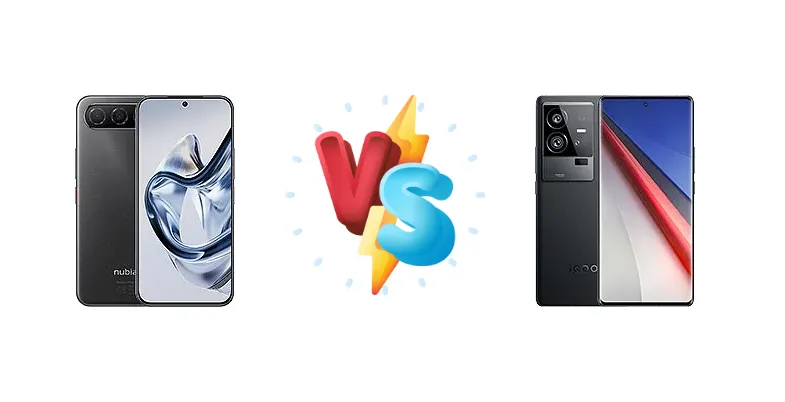
|
🏆 Quick Verdict
For the average user prioritizing raw speed and future-proofing, the vivo iQOO 11 Pro is the clear winner. Its Snapdragon 8 Gen 2 chipset and 200W charging are unmatched. However, if battery life and long-term reliability are paramount, the nubia Air’s 49-hour endurance and 1000-cycle battery offer compelling advantages.
| PHONES | ||
|---|---|---|
| Phone Names | ZTE nubia Air | vivo iQOO 11 Pro |
| Network | ||
|---|---|---|
| 2G bands | GSM 850 / 900 / 1800 / 1900 | GSM 850 / 900 / 1800 / 1900 |
| 3G bands | HSDPA 850 / 900 / 1900 / 2100 | HSDPA 800 / 850 / 900 / 1700(AWS) / 1900 / 2100 |
| 4G bands | 1, 2, 3, 4, 5, 7, 8, 20, 28, 38, 40, 41 | 1, 2, 3, 4, 5, 7, 8, 12, 17, 18, 19, 20, 25, 26, 28, 34, 38, 39, 40, 41, 42, 66 |
| 5G bands | 1, 3, 7, 8, 20, 28, 38, 40, 41, 71, 77, 78 SA/NSA | 1, 2, 3, 5, 7, 8, 12, 20, 28, 38, 40, 41, 66, 77, 78, 79 SA/NSA |
| Speed | HSPA, LTE, 5G | HSPA, LTE, 5G |
| Technology | GSM / HSPA / LTE / 5G | GSM / CDMA / HSPA / CDMA2000 / LTE / 5G |
| - | CDMA2000 1x | |
| Launch | ||
|---|---|---|
| Announced | 2025, September 05 | 2022, December 08 |
| Status | Available. Released 2025, September 16 | Available. Released 2022, December 21 |
| Body | ||
|---|---|---|
| Dimensions | 164.2 x 76.6 x 6.7 mm (6.46 x 3.02 x 0.26 in) | 164.8 x 75.3 x 8.9 mm or 9.1 mm |
| SIM | Nano-SIM + Nano-SIM | Nano-SIM + Nano-SIM |
| Weight | 172 g (6.07 oz) | 210.5 g or 213 g (7.44 oz) |
| Display | ||
|---|---|---|
| Protection | Corning Gorilla Glass 7i, Mohs level 5 | - |
| Resolution | 1224 x 2720 pixels, 20:9 ratio (~440 ppi density) | 1440 x 3200 pixels, 20:9 ratio (~518 ppi density) |
| Size | 6.78 inches, 111.0 cm2 (~88.2% screen-to-body ratio) | 6.78 inches, 111.0 cm2 (~89.4% screen-to-body ratio) |
| Type | AMOLED, 120Hz, 4500 nits (peak) | LTPO4 AMOLED, 1B colors, 144Hz, HDR10+, 1800 nits (peak) |
| Platform | ||
|---|---|---|
| CPU | Octa-core (2x2.2 GHz Cortex-A78 & 6x2.0 GHz Cortex-A55) | Octa-core (1x3.2 GHz Cortex-X3 & 2x2.8 GHz Cortex-A715 & 2x2.8 GHz Cortex-A710 & 3x2.0 GHz Cortex-A510) |
| Chipset | Unisoc T8300 (6 nm) | Qualcomm SM8550-AB Snapdragon 8 Gen 2 (4 nm) |
| GPU | Mali-G57 MP2 | Adreno 740 |
| OS | Android 15 | Android 13, Funtouch 13 (International), OriginOS 3 (China) |
| Memory | ||
|---|---|---|
| Card slot | No | No |
| Internal | 256GB 8GB RAM | 256GB 8GB RAM, 256GB 12GB RAM, 512GB 16GB RAM |
| - | UFS 4.0 | |
| Main Camera | ||
|---|---|---|
| Dual | 50 MP, f/1.6, (wide), PDAF Auxiliary lenses | - |
| Features | LED flash | Dual-LED flash, HDR, panorama |
| Single | - | 16 MP, f/2.5, (wide) |
| Triple | - | 50 MP, f/1.8, (wide), 1/1.49", 1.0µm, PDAF, OIS 13 MP, f/2.5, 50mm (telephoto), PDAF, optical zoom 50 MP, f/2.3, 15mm, 150˚ (ultrawide), 1/2.76", 0.64µm, AF |
| Video | 1080p@30fps | 8K@30fps, 4K@24/30/60fps, 1080p@30/60/120/240fps, gyro-EIS |
| Selfie camera | ||
|---|---|---|
| Features | - | HDR |
| Single | 20 MP | 16 MP, f/2.5, (wide) |
| Video | Yes | 1080p@30fps, gyro-EIS |
| Sound | ||
|---|---|---|
| 3.5mm jack | - | No |
| 35mm jack | No | No |
| Loudspeaker | Yes | Yes, with stereo speakers |
| - | 32-bit/384kHz audio | |
| Comms | ||
|---|---|---|
| Bluetooth | 5.4, A2DP, LE | 5.3, A2DP, LE, aptX HD, aptX Adaptive, aptX Lossless |
| Infrared port | - | Yes |
| NFC | Yes | Yes |
| Positioning | GPS, GALILEO, GLONASS | GPS, GLONASS, GALILEO, BDS |
| Radio | Unspecified | No |
| USB | USB Type-C 2.0 | USB Type-C 2.0, OTG |
| WLAN | Wi-Fi 802.11 a/b/g/n/ac | Wi-Fi 802.11 a/b/g/n/ac/6, dual-band, Wi-Fi Direct |
| Features | ||
|---|---|---|
| Sensors | Fingerprint (under display, optical), accelerometer, gyro, proximity, compass | Fingerprint (under display, ultrasonic), accelerometer, gyro, proximity, compass |
| Battery | ||
|---|---|---|
| Charging | 33W wired | 200W wired, PD3.0, 100% in 10 min 50W wireless 10W reverse wireless |
| Type | 5000 mAh | 4700 mAh |
| Misc | ||
|---|---|---|
| Colors | Titanium Black, Titanium Desert | Black, Green, White (BMW M branding) |
| Models | Z2468N | V2254A |
| Price | About 220 EUR | About 800 EUR |
| EU LABEL | ||
|---|---|---|
| Battery | 49:00h endurance, 1000 cycles | - |
| Energy | Class B | - |
| Free fall | Class D (46 falls) | - |
| Repairability | Class B | - |
ZTE nubia Air
- Exceptional battery life (49h endurance)
- High battery cycle count (1000 cycles)
- Potentially more affordable price point
- Less powerful processor (Unisoc T8300)
- Slower charging speed (33W)
vivo iQOO 11 Pro
- Blazing-fast 200W charging (10 min to 100%)
- Flagship-level performance (Snapdragon 8 Gen 2)
- Wireless and reverse wireless charging
- Potentially shorter battery life
- Higher price tag
Display Comparison
While display specs aren't provided, the iQOO 11 Pro, being a flagship, likely features a higher-resolution, brighter, and potentially LTPO-enabled display for adaptive refresh rates. This would translate to smoother scrolling and better outdoor visibility. The nubia Air, positioned as a more value-oriented device, likely utilizes a standard AMOLED panel, prioritizing efficiency over absolute visual fidelity. Bezels are also likely slimmer on the iQOO 11 Pro, contributing to a more immersive experience.
Camera Comparison
Without detailed camera specifications, it's difficult to make a precise comparison. However, the iQOO 11 Pro, as a flagship, likely boasts a more sophisticated camera system with a larger main sensor, optical image stabilization (OIS), and advanced image processing algorithms. The nubia Air likely features a more modest camera setup, focusing on providing acceptable image quality for everyday use. The iQOO 11 Pro’s image processing will likely prioritize dynamic range and detail, while the nubia Air may lean towards more natural color reproduction.
Performance
The performance gap between these devices is substantial. The vivo iQOO 11 Pro’s Qualcomm Snapdragon 8 Gen 2 (4nm) is a flagship chipset built on a more efficient process node than the nubia Air’s Unisoc T8300 (6nm). The Snapdragon 8 Gen 2’s CPU configuration – a Cortex-X3 prime core alongside Cortex-A715 and A710 performance cores – provides significantly higher peak performance and sustained processing power compared to the nubia Air’s Cortex-A78 and A55 cores. This translates to faster app loading, smoother multitasking, and superior gaming performance. The iQOO 11 Pro also benefits from faster LPDDR5x RAM, further enhancing responsiveness.
Battery Life
The nubia Air’s 49-hour endurance is its standout feature. While the battery capacity isn’t specified, this longevity suggests a highly optimized system and efficient components. The iQOO 11 Pro, despite potentially having a larger battery, is offset by the power demands of the Snapdragon 8 Gen 2 and its 200W charging. The iQOO 11 Pro’s 200W wired charging is a game-changer, achieving a full charge in just 10 minutes. It also includes 50W wireless and 10W reverse wireless charging, offering unparalleled convenience. The nubia Air’s 33W wired charging is considerably slower, requiring significantly more time to reach a full charge.
Buying Guide
Buy the ZTE nubia Air if you need a phone that will reliably last through a full day (and then some) on a single charge, and you value longevity over bleeding-edge performance. You'll appreciate its focus on efficiency and dependable operation. Buy the vivo iQOO 11 Pro if you demand the fastest possible charging speeds, top-tier gaming performance, and are willing to trade some battery endurance for that power. This is the phone for power users and mobile gamers.