
ZTE nubia Air vs. Samsung Galaxy S23 FE: A Deep Dive into Battery, Performance, and Value
| Phones Images | |||||
|---|---|---|---|---|---|
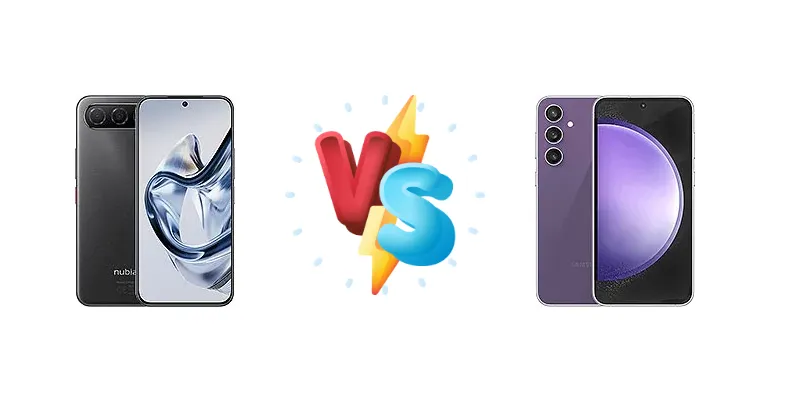
|
🏆 Quick Verdict
For users prioritizing all-day (and then some) battery life, the ZTE nubia Air is the clear winner, boasting a remarkable 49-hour endurance. However, the Samsung Galaxy S23 FE offers a more polished experience with a brighter display and a more powerful processor, making it ideal for demanding users.
| PHONES | ||
|---|---|---|
| Phone Names | ZTE nubia Air | Samsung Galaxy S23 FE |
| Network | ||
|---|---|---|
| 2G bands | GSM 850 / 900 / 1800 / 1900 | GSM 850 / 900 / 1800 / 1900 |
| 3G bands | HSDPA 850 / 900 / 1900 / 2100 | HSDPA 850 / 900 / 1700(AWS) / 1900 / 2100 |
| 4G bands | 1, 2, 3, 4, 5, 7, 8, 20, 28, 38, 40, 41 | 1, 2, 3, 4, 5, 7, 8, 12, 13, 17, 20, 26, 28, 38, 40, 41, 66 - International |
| 5G bands | 1, 3, 7, 8, 20, 28, 38, 40, 41, 71, 77, 78 SA/NSA | 1, 2, 3, 5, 7, 8, 20, 28, 38, 40, 41, 66, 77, 78 SA/NSA/Sub6 - International |
| Speed | HSPA, LTE, 5G | HSPA, LTE, 5G |
| Technology | GSM / HSPA / LTE / 5G | GSM / HSPA / LTE / 5G |
| Launch | ||
|---|---|---|
| Announced | 2025, September 05 | 2023, October 04 |
| Status | Available. Released 2025, September 16 | Available. Released 2023, October 05 |
| Body | ||
|---|---|---|
| Build | - | Glass front (Gorilla Glass 5), glass back (Gorilla Glass 5), aluminum frame |
| Dimensions | 164.2 x 76.6 x 6.7 mm (6.46 x 3.02 x 0.26 in) | 158 x 76.5 x 8.2 mm (6.22 x 3.01 x 0.32 in) |
| SIM | Nano-SIM + Nano-SIM | · Nano-SIM· Nano-SIM + Nano-SIM· Nano-SIM + Nano-SIM + eSIM (max 2 at a time) |
| Weight | 172 g (6.07 oz) | 209 g (7.37 oz) |
| Display | ||
|---|---|---|
| Protection | Corning Gorilla Glass 7i, Mohs level 5 | Corning Gorilla Glass 5 |
| Resolution | 1224 x 2720 pixels, 20:9 ratio (~440 ppi density) | 1080 x 2340 pixels, 19.5:9 ratio (~403 ppi density) |
| Size | 6.78 inches, 111.0 cm2 (~88.2% screen-to-body ratio) | 6.4 inches, 100.5 cm2 (~83.2% screen-to-body ratio) |
| Type | AMOLED, 120Hz, 4500 nits (peak) | Dynamic AMOLED 2X, 120Hz, HDR10+, 1450 nits (peak) |
| Platform | ||
|---|---|---|
| CPU | Octa-core (2x2.2 GHz Cortex-A78 & 6x2.0 GHz Cortex-A55) | Octa-core (1x2.8 GHz Cortex-X2 & 3x2.50 GHz Cortex-A710 & 4x1.8 GHz Cortex-A510) - InternationalOcta-core (1x3.00 GHz Cortex-X2 & 3x2.50 GHz Cortex-A710 & 4x1.80 GHz Cortex-A510) - USA |
| Chipset | Unisoc T8300 (6 nm) | Exynos 2200 (4 nm) - InternationalQualcomm SM8450 Snapdragon 8 Gen 1 (4 nm) - USA |
| GPU | Mali-G57 MP2 | Xclipse 920 - InternationalAdreno 730 - USA |
| OS | Android 15 | Android 13, up to 4 major Android upgrades, One UI 8 |
| Memory | ||
|---|---|---|
| Card slot | No | No |
| Internal | 256GB 8GB RAM | 128GB 8GB RAM, 256GB 8GB RAM |
| Main Camera | ||
|---|---|---|
| Dual | 50 MP, f/1.6, (wide), PDAF Auxiliary lenses | - |
| Features | LED flash | LED flash, HDR, panorama |
| Triple | - | 50 MP, f/1.8, 23mm (wide), 1/1.57", 1.0µm, dual pixel PDAF, OIS 8 MP, f/2.4, 76mm (telephoto), 1/4.5", 1.0µm, PDAF, OIS, 3x optical zoom 12 MP, f/2.2, 13mm, 123˚ (ultrawide), 1/3.0", 1.12µm |
| Video | 1080p@30fps | 8K@24fps, 4K@30/60fps, 1080p@30/60/120/240fps |
| Selfie camera | ||
|---|---|---|
| Single | 20 MP | 10 MP, f/2.4, 25mm (wide), 1/3.0", 1.22µm |
| Video | Yes | 4K@30/60fps, 1080p@30/60fps; gyro-EIS |
| Sound | ||
|---|---|---|
| 35mm jack | No | No |
| Loudspeaker | Yes | Yes, with stereo speakers |
| Comms | ||
|---|---|---|
| Bluetooth | 5.4, A2DP, LE | 5.3, A2DP, LE |
| NFC | Yes | Yes |
| Positioning | GPS, GALILEO, GLONASS | GPS, GLONASS, GALILEO, BDS |
| Radio | Unspecified | Unspecified |
| USB | USB Type-C 2.0 | USB Type-C, OTG |
| WLAN | Wi-Fi 802.11 a/b/g/n/ac | Wi-Fi 802.11 a/b/g/n/ac/6e, dual-band, Wi-Fi Direct |
| Features | ||
|---|---|---|
| Sensors | Fingerprint (under display, optical), accelerometer, gyro, proximity, compass | Fingerprint (under display, optical), accelerometer, gyro, compass |
| Battery | ||
|---|---|---|
| Charging | 33W wired | 25W wired, PD3.0, 50% in 30 min 15W wireless Reverse wireless |
| Type | 5000 mAh | Li-Ion 4500 mAh |
| Misc | ||
|---|---|---|
| Colors | Titanium Black, Titanium Desert | Mint, Cream, Graphite, Purple, Indigo, Tangerine |
| Models | Z2468N | SM-S711B, SM-S711B/DS, SM-S711U1, SM-S711U, SM-S711W, SM-S7110, SM-S711N |
| Price | About 220 EUR | $ 219.95 / C$ 327.90 / £ 248.99 / € 272.00 / ₹ 34,999 |
| SAR | - | 0.80 W/kg (head) 0.72 W/kg (body) |
| SAR EU | - | 0.76 W/kg (head) 1.04 W/kg (body) |
| EU LABEL | ||
|---|---|---|
| Battery | 49:00h endurance, 1000 cycles | - |
| Energy | Class B | - |
| Free fall | Class D (46 falls) | - |
| Repairability | Class B | - |
ZTE nubia Air
- Exceptional 49-hour battery life
- High battery cycle count (1000 cycles)
- Potentially more affordable price point
- Less powerful processor
- Limited camera information suggests a basic system
- Display specifications are unknown, likely less vibrant
Samsung Galaxy S23 FE
- Bright 985 nit display
- Powerful Exynos 2200 or Snapdragon 8 Gen 1 chipset
- Versatile camera system (expected)
- Significantly shorter battery life (8:28h)
- Faster charging doesn't fully compensate for battery size
- Potential for thermal throttling under sustained load
Display Comparison
The Samsung Galaxy S23 FE immediately distinguishes itself with a measured peak brightness of 985 nits, offering superior visibility in direct sunlight. While the nubia Air’s display specifications are not provided, the S23 FE’s panel likely benefits from Samsung’s color science and potentially LTPO technology for adaptive refresh rates (though not confirmed in the data). This translates to a more immersive viewing experience for media consumption and outdoor use. The nubia Air’s display, while functional, likely prioritizes power efficiency over visual fidelity.
Camera Comparison
The provided data only indicates 'Photo / Video' capabilities for the S23 FE. Given Samsung’s history, we can expect a versatile camera system with features like optical image stabilization (OIS) and advanced image processing. The nubia Air’s camera specifications are absent, making a direct comparison difficult. However, the S23 FE’s likely larger sensor and more sophisticated software will result in superior image quality, particularly in low-light conditions. The absence of detail regarding the nubia Air’s camera suggests it’s a more basic implementation.
Performance
The chipset choice is a critical differentiator. The Galaxy S23 FE utilizes either the Exynos 2200 (International) or the Snapdragon 8 Gen 1 (USA), both fabricated on a 4nm process. This contrasts with the nubia Air’s Unisoc T8300 (6nm). The 4nm node offers superior transistor density and thermal efficiency, meaning the S23 FE’s chips can sustain higher performance for longer periods. The S23 FE’s CPU, featuring a Cortex-X2 prime core, significantly outperforms the A78 cores in the nubia Air’s processor, especially in single-core tasks. The S23 FE’s LPDDR5 RAM (assumed, based on market segment) further enhances responsiveness. While the Unisoc T8300 is capable for everyday tasks, it won’t match the S23 FE’s gaming prowess.
Battery Life
The nubia Air’s 49-hour endurance is its standout feature. This is a substantial advantage over the S23 FE’s 8:28h active use score. While the S23 FE offers faster charging at 25W (with 50% charge in 30 minutes) and even 15W wireless charging with reverse wireless capabilities, the nubia Air’s longevity minimizes the need for frequent top-ups. The nubia Air also boasts a claimed 1000 charge cycles, suggesting a longer lifespan for the battery itself. The S23 FE’s charging speed is convenient, but the nubia Air’s endurance is a more significant benefit for many users.
Buying Guide
Buy the ZTE nubia Air if you need a phone that can reliably last through two full days of moderate use, and aren't heavily reliant on graphically intensive games or demanding applications. Buy the Samsung Galaxy S23 FE if you prefer a brighter, more vibrant display, a more versatile camera system, and the processing power to handle any task, even if it means charging more frequently.