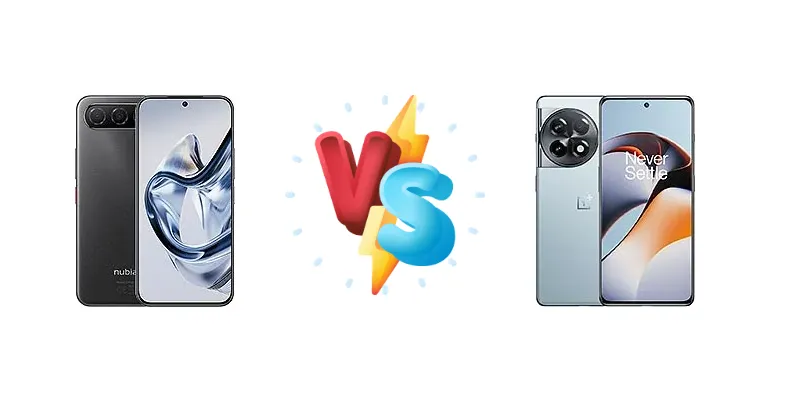
The ZTE nubia Air and OnePlus 11R represent compelling options in the increasingly competitive mid-range smartphone market. The nubia Air focuses on maximizing battery endurance, while the OnePlus 11R aims to deliver near-flagship performance at a more accessible price point. This comparison dissects their key differences to help you determine which device best suits your needs.
🏆 Quick Verdict
For the average user prioritizing raw speed and quick charging, the OnePlus 11R is the clear winner. Its Snapdragon 8+ Gen 1 chipset provides a significant performance advantage. However, if extended battery life and longevity are paramount, the ZTE nubia Air’s 49-hour endurance and 1000-cycle battery make it a compelling alternative.
| Network |
|---|
| 2G bands | GSM 850 / 900 / 1800 / 1900 | GSM 850 / 900 / 1800 / 1900 |
| 3G bands | HSDPA 850 / 900 / 1900 / 2100 | HSDPA 850 / 900 / 1700(AWS) / 2100 |
| 4G bands | 1, 2, 3, 4, 5, 7, 8, 20, 28, 38, 40, 41 | 1, 3, 4, 5, 8, 28, 34, 38, 39, 40, 41 |
| 5G bands | 1, 3, 7, 8, 20, 28, 38, 40, 41, 71, 77, 78 SA/NSA | 1, 3, 5, 8, 28, 40, 41, 77, 78 SA/NSA |
| Speed | HSPA, LTE, 5G | HSPA, LTE (3CA), 5G |
| Technology | GSM / HSPA / LTE / 5G | GSM / CDMA / HSPA / LTE / 5G |
| | - | CDMA 800 |
| Launch |
|---|
| Announced | 2025, September 05 | 2023, February 07 |
| Status | Available. Released 2025, September 16 | Available. Released 2023, February 21 |
| Body |
|---|
| Build | - | Glass front, glass back (Gorilla Glass 5), plastic frame |
| Dimensions | 164.2 x 76.6 x 6.7 mm (6.46 x 3.02 x 0.26 in) | 163.4 x 74.3 x 8.7 mm (6.43 x 2.93 x 0.34 in) |
| SIM | Nano-SIM + Nano-SIM | Nano-SIM + Nano-SIM |
| Weight | 172 g (6.07 oz) | 204 g (7.20 oz) |
| Display |
|---|
| Protection | Corning Gorilla Glass 7i, Mohs level 5 | - |
| Resolution | 1224 x 2720 pixels, 20:9 ratio (~440 ppi density) | 1240 x 2772 pixels, 20:9 ratio (~451 ppi density) |
| Size | 6.78 inches, 111.0 cm2 (~88.2% screen-to-body ratio) | 6.74 inches, 109.2 cm2 (~90.0% screen-to-body ratio) |
| Type | AMOLED, 120Hz, 4500 nits (peak) | Fluid AMOLED, 1B colors, 120Hz, HDR10+, 1450 nits (peak) |
| Platform |
|---|
| CPU | Octa-core (2x2.2 GHz Cortex-A78 & 6x2.0 GHz Cortex-A55) | Octa-core (1x3.0 GHz Cortex-X2 & 3x2.5 GHz Cortex-A710 & 4x1.80 GHz Cortex-A510) |
| Chipset | Unisoc T8300 (6 nm) | Qualcomm SM8475 Snapdragon 8+ Gen 1 (4 nm) |
| GPU | Mali-G57 MP2 | Adreno 730 |
| OS | Android 15 | Android 13, upgradable to Android 15, OxygenOS 15 |
| Memory |
|---|
| Card slot | No | No |
| Internal | 256GB 8GB RAM | 128GB 8GB RAM, 256GB 16GB RAM, 512GB 18GB RAM |
| | - | UFS 3.1 |
| Main Camera |
|---|
| Dual | 50 MP, f/1.6, (wide), PDAF
Auxiliary lenses | - |
| Features | LED flash | Color spectrum sensor, LED flash, HDR, panorama |
| Single | - | 16 MP, f/2.4, 24mm (wide), 1/3.09", 1.0µm |
| Triple | - | 50 MP, f/1.8, 24mm (wide), 1/1.56", 1.0µm, multi-directional PDAF, OIS
8 MP, f/2.2, 120˚ (ultrawide), 1/4.0", 1.12µm
2 MP (macro) |
| Video | 1080p@30fps | 4K@30/60fps, 1080p@30/60/240fps, gyro-EIS |
| Selfie camera |
|---|
| Features | - | HDR |
| Single | 20 MP | 16 MP, f/2.4, 24mm (wide), 1/3.09", 1.0µm |
| Video | Yes | 1080p@30fps |
| Sound |
|---|
| 3.5mm jack | - | No |
| 35mm jack | No | No |
| Loudspeaker | Yes | Yes, with stereo speakers |
| | - | 24-bit/192kHz audio |
| Comms |
|---|
| Bluetooth | 5.4, A2DP, LE | 5.3, A2DP, LE, aptX HD |
| Infrared port | - | Yes |
| NFC | Yes | Yes |
| Positioning | GPS, GALILEO, GLONASS | GPS (L1+L5), GLONASS (G1), BDS (B1I+B1c+B2a), GALILEO (E1+E5a), QZSS (L1+L5) |
| Radio | Unspecified | No |
| USB | USB Type-C 2.0 | USB Type-C 2.0 |
| WLAN | Wi-Fi 802.11 a/b/g/n/ac | Wi-Fi 802.11 a/b/g/n/ac/6, dual-band |
| Features |
|---|
| Sensors | Fingerprint (under display, optical), accelerometer, gyro, proximity, compass | Fingerprint (under display, optical), accelerometer, gyro, proximity, compass |
| Battery |
|---|
| Charging | 33W wired | 100W wired |
| Type | 5000 mAh | Li-Po 5000 mAh |
| Misc |
|---|
| Colors | Titanium Black, Titanium Desert | Galactic Silver, Sonic Black, Solar Red |
| Models | Z2468N | CPH2487 |
| Price | About 220 EUR | About 600 EUR |
| SAR | - | 1.16 W/kg (head) 0.61 W/kg (body) |
| EU LABEL |
|---|
| Battery | 49:00h endurance, 1000 cycles | - |
| Energy | Class B | - |
| Free fall | Class D (46 falls) | - |
| Repairability | Class B | - |
ZTE nubia Air
- Exceptional 49-hour battery life
- 1000-cycle battery longevity
- Potentially more efficient power management
- Less powerful Unisoc T8300 chipset
- Slower 33W charging
- Likely less capable camera system
OnePlus 11R
- Powerful Snapdragon 8+ Gen 1 processor
- Ultra-fast 100W wired charging
- Likely superior camera performance
- Shorter battery life compared to nubia Air
- Potential for thermal throttling under heavy load
- Faster battery degradation with frequent fast charging
Display Comparison
While display specifications aren't provided, both phones likely feature high refresh rate AMOLED panels common in this price bracket. However, the core difference lies beneath the surface. The OnePlus 11R, being a more performance-focused device, may have a slightly brighter panel for better outdoor visibility. The nubia Air, with its focus on endurance, might prioritize power efficiency in display settings. Bezels are likely comparable, and color accuracy will depend on software calibration.
Camera Comparison
Without detailed camera specs, it's difficult to make a definitive judgment. However, given the OnePlus 11R’s positioning, it likely features a more sophisticated camera system with a larger main sensor and potentially optical image stabilization (OIS). The nubia Air may focus on computational photography to compensate for potentially smaller sensors. Image processing styles will also differ; OnePlus typically aims for vibrant, social media-ready images, while ZTE might lean towards a more natural look. The absence of details makes it hard to assess low-light performance or video capabilities.
Performance
The performance gap is substantial. The OnePlus 11R’s Qualcomm Snapdragon 8+ Gen 1 (4nm) is a significant leap ahead of the ZTE nubia Air’s Unisoc T8300 (6nm). The Snapdragon 8+ Gen 1 features a Cortex-X2 prime core clocked at 3.0 GHz, alongside Cortex-A710 performance cores, offering superior single-core and multi-core performance. The Unisoc T8300, while capable, relies on Cortex-A78 and A55 cores, resulting in lower peak performance. The 4nm process node of the Snapdragon 8+ Gen 1 also contributes to better thermal efficiency, potentially reducing throttling during sustained workloads like gaming. The OnePlus 11R will demonstrably outperform the nubia Air in graphically intensive tasks.
Battery Life
The ZTE nubia Air’s 49-hour endurance is its standout feature. This suggests a highly optimized software experience and efficient components. While the OnePlus 11R’s battery capacity isn’t specified, its more powerful chipset will consume more power. However, the 100W wired charging on the 11R is a game-changer, allowing for a full charge in under 30 minutes. The nubia Air’s 33W charging is considerably slower. The nubia Air prioritizes longevity, while the 11R prioritizes convenience and rapid replenishment.
Buying Guide
Buy the ZTE nubia Air if you need a phone that can reliably last through two full days of moderate use, and value long-term battery health. This is ideal for travelers, or those who frequently find themselves away from a charger. Buy the OnePlus 11R if you prioritize gaming, demanding applications, and the convenience of incredibly fast 100W charging, even if it means more frequent charging cycles.
Frequently Asked Questions
❓ Will the Unisoc T8300 in the nubia Air struggle with demanding games like Genshin Impact?
Yes, the Unisoc T8300 will likely require significant graphics settings reductions to achieve playable frame rates in demanding titles like Genshin Impact. The Snapdragon 8+ Gen 1 in the OnePlus 11R offers a much smoother gaming experience with higher graphical fidelity.
❓ How long will it *actually* take to fully charge the OnePlus 11R with the 100W charger?
OnePlus claims the 11R can charge from 1-100% in around 25 minutes with the included 100W charger. Real-world results may vary slightly depending on ambient temperature and battery health, but it remains significantly faster than the nubia Air's 33W charging.
❓ Is the 1000-cycle battery claim for the nubia Air realistic, and what does it mean for long-term use?
While 1000 cycles is an ambitious claim, it suggests ZTE has implemented battery health management features to minimize degradation. A battery cycle is defined as a full discharge and recharge. Reaching 1000 cycles means the battery should retain a significant portion of its original capacity after extended use, offering longer-term reliability.
❓ Does the OnePlus 11R experience significant thermal throttling during prolonged gaming sessions?
The Snapdragon 8+ Gen 1 is generally well-managed, but can still experience some throttling under sustained heavy load. The OnePlus 11R incorporates cooling solutions to mitigate this, but expect some performance reduction after extended gaming sessions. The nubia Air, with its less powerful chipset, is less prone to throttling.