
ZTE nubia Air vs. Google Pixel 7 Pro: A Deep Dive into Battery, Performance, and Camera
| Phones Images | |||||
|---|---|---|---|---|---|
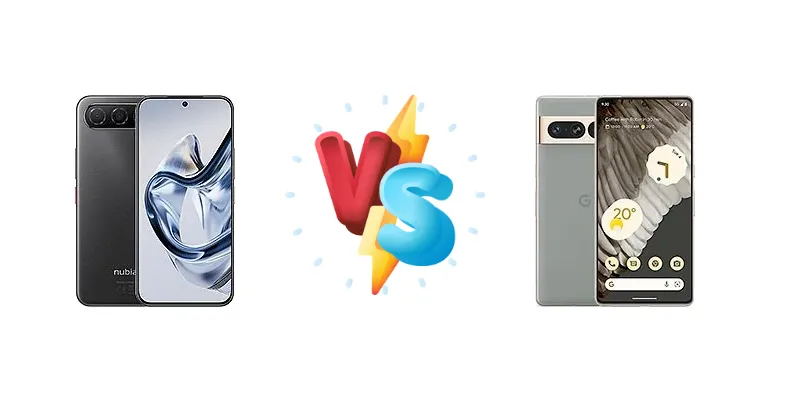
|
🏆 Quick Verdict
For users prioritizing all-day (and multi-day) battery life and affordability, the ZTE nubia Air is the clear winner. However, the Google Pixel 7 Pro delivers a superior overall experience with its faster processor, advanced camera capabilities, and premium features, justifying its higher price for those seeking a flagship experience.
| PHONES | ||
|---|---|---|
| Phone Names | ZTE nubia Air | Google Pixel 7 Pro |
| Network | ||
|---|---|---|
| 2G bands | GSM 850 / 900 / 1800 / 1900 | GSM 850 / 900 / 1800 / 1900 |
| 3G bands | HSDPA 850 / 900 / 1900 / 2100 | HSDPA 800 / 850 / 900 / 1700(AWS) / 1900 / 2100 |
| 4G bands | 1, 2, 3, 4, 5, 7, 8, 20, 28, 38, 40, 41 | 1, 2, 3, 4, 5, 7, 8, 12, 13, 14, 17, 18, 19, 20, 25, 26, 28, 29, 30, 38, 39, 40, 41, 42, 46, 48, 66, 71 - GE2AE |
| 5G bands | 1, 3, 7, 8, 20, 28, 38, 40, 41, 71, 77, 78 SA/NSA | 1, 2, 3, 5, 7, 8, 12, 14, 20, 25, 28, 30, 38, 40, 41, 48, 66, 71, 77, 78, 257, 258, 260, 261 SA/NSA/Sub6/mmWave - GE2AE |
| Speed | HSPA, LTE, 5G | HSPA, LTE, 5G |
| Technology | GSM / HSPA / LTE / 5G | GSM / CDMA / HSPA / EVDO / LTE / 5G |
| - | 1, 2, 3, 5, 7, 8, 12, 14, 20, 25, 28, 30, 38, 40, 41, 48, 66, 71, 75, 76, 77, 78 SA/NSA/Sub6 - GP4BC | |
| Launch | ||
|---|---|---|
| Announced | 2025, September 05 | 2022, October 06 |
| Status | Available. Released 2025, September 16 | Available. Released 2022, October 13 |
| Body | ||
|---|---|---|
| Build | - | Glass front (Gorilla Glass Victus), glass back (Gorilla Glass Victus), aluminum frame |
| Dimensions | 164.2 x 76.6 x 6.7 mm (6.46 x 3.02 x 0.26 in) | 162.9 x 76.6 x 8.9 mm (6.41 x 3.02 x 0.35 in) |
| SIM | Nano-SIM + Nano-SIM | Nano-SIM + eSIM |
| Weight | 172 g (6.07 oz) | 212 g (7.48 oz) |
| - | IP68 dust/water resistant (up to 1.5m for 30 min) | |
| Display | ||
|---|---|---|
| Protection | Corning Gorilla Glass 7i, Mohs level 5 | Corning Gorilla Glass Victus |
| Resolution | 1224 x 2720 pixels, 20:9 ratio (~440 ppi density) | 1440 x 3120 pixels, 19.5:9 ratio (~512 ppi density) |
| Size | 6.78 inches, 111.0 cm2 (~88.2% screen-to-body ratio) | 6.7 inches, 110.6 cm2 (~88.7% screen-to-body ratio) |
| Type | AMOLED, 120Hz, 4500 nits (peak) | LTPO AMOLED, 120Hz, HDR10+, 1000 nits (HBM), 1500 nits (peak) |
| - | Always-on display | |
| Platform | ||
|---|---|---|
| CPU | Octa-core (2x2.2 GHz Cortex-A78 & 6x2.0 GHz Cortex-A55) | Octa-core (2x2.85 GHz Cortex-X1 & 2x2.35 GHz Cortex-A78 & 4x1.80 GHz Cortex-A55) |
| Chipset | Unisoc T8300 (6 nm) | Google Tensor G2 (5 nm) |
| GPU | Mali-G57 MP2 | Mali-G710 MP7 |
| OS | Android 15 | Android 13, upgradable to Android 15, up to 5 major Android upgrades |
| Memory | ||
|---|---|---|
| Card slot | No | No |
| Internal | 256GB 8GB RAM | 128GB 8GB RAM, 256GB 8GB RAM, 128GB 12GB RAM, 256GB 12GB RAM, 512GB 12GB RAM |
| - | UFS 3.1 | |
| Main Camera | ||
|---|---|---|
| Dual | 50 MP, f/1.6, (wide), PDAF Auxiliary lenses | - |
| Features | LED flash | Laser AF, Dual-LED flash, Pixel Shift, Auto-HDR, panorama |
| Single | - | 10.8 MP, f/2.2, 21mm (ultrawide), 1/3.1", 1.22µm |
| Triple | - | 50 MP, f/1.9, 25mm (wide), 1/1.31", 1.2µm, dual pixel PDAF, OIS 48 MP, f/3.5, 120mm (periscope telephoto), 1/2.55", 0.7µm, dual pixel PDAF, OIS, 5x optical zoom 12 MP, f/2.2, 126˚ (ultrawide), 1/2.9", 1.25µm, AF |
| Video | 1080p@30fps | 4K@30/60fps, 1080p@30/60/120/240fps; gyro-EIS, OIS, 10-bit HDR |
| Selfie camera | ||
|---|---|---|
| Features | - | HDR, panorama |
| Single | 20 MP | 10.8 MP, f/2.2, 21mm (ultrawide), 1/3.1", 1.22µm |
| Video | Yes | 4K@30/60fps, 1080p@30/60fps |
| Sound | ||
|---|---|---|
| 3.5mm jack | - | No |
| 35mm jack | No | No |
| Loudspeaker | Yes | Yes, with stereo speakers |
| Comms | ||
|---|---|---|
| Bluetooth | 5.4, A2DP, LE | 5.2, A2DP, LE, aptX HD |
| NFC | Yes | Yes |
| Positioning | GPS, GALILEO, GLONASS | GPS (L1+L5), GLONASS (G1), BDS (B1I+B1c+B2a), GALILEO (E1+E5a), QZSS (L1+L5) |
| Radio | Unspecified | No |
| USB | USB Type-C 2.0 | USB Type-C 3.2 |
| WLAN | Wi-Fi 802.11 a/b/g/n/ac | Wi-Fi 802.11 a/b/g/n/ac/6e, tri-band, Wi-Fi Direct |
| Features | ||
|---|---|---|
| Sensors | Fingerprint (under display, optical), accelerometer, gyro, proximity, compass | Fingerprint (under display, optical), accelerometer, gyro, proximity, compass, barometer |
| - | Ultra Wideband (UWB) support | |
| Battery | ||
|---|---|---|
| Charging | 33W wired | 23W wired, PD3.0, 50% in 30 min 23W wireless Reverse wireless |
| Type | 5000 mAh | Li-Ion 5000 mAh |
| Misc | ||
|---|---|---|
| Colors | Titanium Black, Titanium Desert | Obsidian, Snow, Hazel |
| Models | Z2468N | GP4BC, GE2AE, GFE4J |
| Price | About 220 EUR | € 248.84 / $ 204.00 / £ 259.99 / ₹ 36,999 |
| Tests | ||
|---|---|---|
| Battery life | - | Endurance rating 83h |
| Camera | - | Photo / Video |
| Display | - | Contrast ratio: Infinite (nominal) |
| Loudspeaker | - | -24.8 LUFS (Very good) |
| Performance | - | AnTuTu: 796369 (v9) GeekBench: 3187 (v5.1) GFXBench: 34fps (ES 3.1 onscreen) |
| EU LABEL | ||
|---|---|---|
| Battery | 49:00h endurance, 1000 cycles | - |
| Energy | Class B | - |
| Free fall | Class D (46 falls) | - |
| Repairability | Class B | - |
ZTE nubia Air
- Exceptional 49-hour battery endurance
- 1000 charge cycle lifespan for long-term battery health
- More affordable price point
- Less powerful Unisoc T8300 chipset
- Slower 33W charging speed
- Missing premium features like wireless charging
Google Pixel 7 Pro
- Powerful Google Tensor G2 chipset with AI capabilities
- Superior camera system with advanced image processing
- Brighter display with adaptive refresh rate (likely)
- Shorter battery life compared to nubia Air
- Higher price point
- Faster charging is still relatively slow compared to some competitors
Display Comparison
The Google Pixel 7 Pro boasts a significantly brighter display, peaking at 1090 nits, compared to the nubia Air (brightness data unavailable). This translates to better visibility outdoors under direct sunlight. While the nubia Air’s display specs are unknown, the Pixel 7 Pro’s infinite (nominal) contrast ratio ensures deep blacks and vibrant colors. The Pixel 7 Pro likely utilizes an LTPO panel for adaptive refresh rates, conserving battery, a feature not confirmed for the nubia Air. The Pixel 7 Pro’s larger display size and higher resolution also contribute to a more immersive viewing experience.
Camera Comparison
Both devices offer photo and video capabilities, but the Pixel 7 Pro is expected to excel due to Google’s renowned computational photography. While specific sensor details for the nubia Air are missing, the Pixel 7 Pro benefits from Google’s advanced image processing algorithms, delivering exceptional dynamic range and low-light performance. The Pixel 7 Pro’s camera system likely includes features like Magic Eraser and Photo Unblur, powered by the Tensor G2’s AI capabilities. Ignoring potential 2MP macro lenses on either device, the Pixel 7 Pro’s larger main sensor and optical image stabilization (OIS) will result in sharper, more detailed images and smoother videos.
Performance
The Google Pixel 7 Pro’s Google Tensor G2 (5nm) chipset, with its Cortex-X1 prime core clocked at 2.85 GHz, demonstrably outperforms the ZTE nubia Air’s Unisoc T8300 (6nm). The Tensor G2’s architecture, including the Cortex-A78 and A55 cores, is optimized for machine learning tasks, enhancing features like voice recognition and image processing. While the nubia Air’s octa-core CPU is capable, the Tensor G2’s 5nm fabrication process offers superior power efficiency and thermal management, reducing throttling during sustained workloads. The Pixel 7 Pro’s likely use of faster LPDDR5x RAM further contributes to its performance advantage.
Battery Life
The ZTE nubia Air’s standout feature is its exceptional 49-hour endurance rating and 1000 charge cycles, suggesting a focus on long-term battery health. The Google Pixel 7 Pro, despite having a comparable 83-hour endurance rating, charges faster at 23W with PD3.0, reaching 50% in 30 minutes. The Pixel 7 Pro also offers 23W wireless charging and reverse wireless charging, features absent on the nubia Air. The nubia Air’s 33W wired charging is slower, but its longevity is prioritized. The nubia Air’s endurance suggests a larger battery capacity, compensating for the less efficient Unisoc chipset.
Buying Guide
Buy the ZTE nubia Air if you need a phone that can reliably last through two full days of moderate use, and value long-term battery health with its 1000-cycle lifespan. Buy the Google Pixel 7 Pro if you prefer a phone with a cutting-edge camera, smooth performance for demanding tasks, and the latest software features powered by Google’s AI, even if it means charging more frequently.