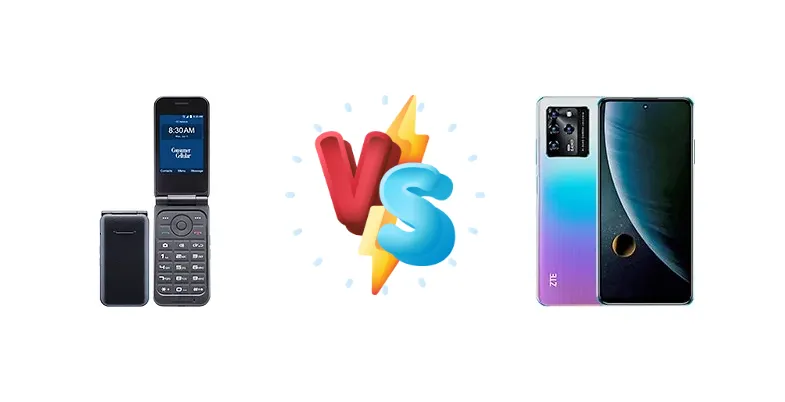
ZTE offers two compelling options in the ultra-budget smartphone space: the ZTE Link II and the ZTE Blade V30. While both aim to deliver affordability, they take distinctly different approaches to achieving it. The Link II relies on a tried-and-true, albeit older, Qualcomm chipset, while the Blade V30 opts for a newer Unisoc processor. This comparison dives deep into the specifications to determine which device offers the best overall experience.
🏆 Quick Verdict
For most users, the ZTE Blade V30 is the superior choice. Its Unisoc Tiger T618 chipset provides a significant performance uplift over the Link II’s Snapdragon 215, offering a smoother experience for everyday tasks and even some light gaming. The 18W charging is also a welcome addition, mitigating the impact of a potentially similar battery capacity.
| Network |
|---|
| 2G bands | GSM 850 / 1900 | GSM 850 / 900 / 1800 / 1900 |
| 3G bands | HSDPA 850 / 1700(AWS) / 1900 | HSDPA 850 / 1700(AWS) / 1900 - Mexico |
| 4G bands | 2, 4, 5, 12, 25, 41, 66, 71 | 1, 2, 3, 4, 5, 7, 12, 13, 26, 28, 66 - Mexico |
| Speed | HSPA, LTE | HSPA, LTE |
| Technology | GSM / HSPA / LTE | GSM / HSPA / LTE |
| Launch |
|---|
| Announced | 2021, February 22 | 2021, July 16 |
| Status | Available. Released 2021, February 22 | Available. Released 2021, September 01 |
| Body |
|---|
| Dimensions | 108.7 x 56.1 x 19.8 mm (4.28 x 2.21 x 0.78 in) | 165.8 x 77.8 x 8.9 mm (6.53 x 3.06 x 0.35 in) |
| SIM | Nano-SIM | Nano-SIM + Nano-SIM |
| Weight | 128 g (4.52 oz) | 193 g (6.81 oz) |
| Display |
|---|
| Resolution | 128 x 160 pixels (~73 ppi density) | 1080 x 2400 pixels, 20:9 ratio (~395 ppi density) |
| Size | 2.8 inches, 24.7 cm2 (~40.5% screen-to-body ratio) | 6.67 inches, 107.4 cm2 (~83.3% screen-to-body ratio) |
| Type | TFT LCD | IPS LCD |
| | Cover display:
TFT LCD, 1.77 inches, 240 x 320 pixels | - |
| Platform |
|---|
| CPU | Quad-core 1.3 GHz Cortex-A53 | Octa-core (2x2.0 GHz Cortex-A75 & 6x2.0 GHz Cortex-A55) |
| Chipset | Qualcomm QM215 Snapdragon 215 (28 nm) | Unisoc Tiger T618 (12 nm) |
| GPU | Adreno 308 | Mali G52 MP2 |
| OS | Proprietary | Android 11 |
| Memory |
|---|
| Card slot | microSDHC (dedicated slot) | microSDXC |
| Internal | 8GB 1GB RAM | 128GB 4GB RAM |
| Main Camera |
|---|
| Features | - | LED flash, HDR, panorama |
| Single | 2 MP | 16 MP, f/2.0, (wide) |
| Triple | - | 64 MP, f/1.8, 26mm (wide), PDAF
8 MP, f/2.4, 120˚, 16mm (ultrawide)
5 MP (macro)
Auxiliary lens |
| Video | 720p@30fps | 1080p@30fps |
| Selfie camera |
|---|
| Single | - | 16 MP, f/2.0, (wide) |
| Sound |
|---|
| 3.5mm jack | Yes | Yes |
| 35mm jack | Yes | Yes |
| Loudspeaker | Yes | Yes |
| Comms |
|---|
| Bluetooth | 4.2, A2DP | 5.0, A2DP, LE |
| NFC | No | No |
| Positioning | GPS | GPS |
| Radio | No | Unspecified |
| USB | microUSB 2.0 | USB Type-C 2.0 |
| WLAN | Wi-Fi 802.11 b/g/n, hotspot | Wi-Fi 802.11 b/g/n/ac |
| Features |
|---|
| Sensors | Accelerometer | Fingerprint (side-mounted), accelerometer, gyro, proximity |
| Battery |
|---|
| Charging | - | 18W wired |
| Type | Li-Ion 1600 mAh, removable | Li-Po 5000 mAh |
| Misc |
|---|
| Colors | Red, Black | Black, Blue |
| Models | - | 9030 |
| Price | About 40 EUR | About 200 EUR |
ZTE Link II
- Lowest possible price point
- Functional for basic tasks
- Qualcomm chipset familiarity
- Significantly slower performance
- Outdated chipset architecture
- Likely limited software support
ZTE Blade V30
- Much faster performance with Unisoc T618
- 18W fast charging
- More efficient chipset (12nm process)
- Unisoc chipset may have limited software optimization
- Potentially slightly higher price
Display Comparison
Neither ZTE provides detailed display specifications in the provided data. However, given the price points, it’s safe to assume both utilize LCD panels. The absence of information regarding resolution, refresh rate, or brightness suggests both are targeting the bare minimum for functionality. Bezels are likely to be substantial on both devices. Color accuracy is unlikely to be a strong point on either model.
Camera Comparison
Without sensor size or aperture information, a detailed camera comparison is difficult. However, it’s reasonable to assume both phones feature basic camera setups geared towards casual photography. The Blade V30’s image signal processor (ISP), integrated within the Unisoc T618, is likely more advanced than the one in the Snapdragon 215, potentially resulting in better image processing and noise reduction. Any claims of advanced features on either device should be viewed with skepticism. The presence of a 2MP macro camera on either device is largely a marketing tactic, offering minimal practical benefit.
Performance
The core difference lies in the chipsets. The ZTE Blade V30’s Unisoc Tiger T618, fabricated on a 12nm process, is a substantial upgrade over the ZTE Link II’s Qualcomm QM215 Snapdragon 215 (28nm). The T618’s octa-core configuration (2x2.0 GHz Cortex-A75 & 6x2.0 GHz Cortex-A55) provides significantly more processing power than the Link II’s quad-core 1.3 GHz Cortex-A53. The A75 cores in the T618 offer a noticeable performance boost in single-core tasks, while the six A55 cores improve multi-tasking capabilities. The 12nm process also contributes to better power efficiency compared to the older 28nm node of the Snapdragon 215, potentially leading to longer battery life under load. The Link II will struggle with anything beyond basic app usage.
Battery Life
Battery capacity isn’t specified for either device. However, given their budget nature, it’s likely both feature batteries in the 3000-4000 mAh range. The Blade V30’s 18W wired charging is a significant advantage. While not fast charging by modern standards, it will substantially reduce charging times compared to the Link II, which likely supports only 5W or 10W charging. This means the Blade V30 can recover from low battery levels much faster, making it more convenient for users on the go.
Buying Guide
Buy the ZTE Link II if you absolutely need the lowest possible price and your smartphone usage is limited to basic tasks like calls, texts, and light web browsing. It’s a functional device for those with minimal demands. Buy the ZTE Blade V30 if you prioritize a more responsive user experience, enjoy occasional gaming, or value faster charging. The performance gains justify the likely price difference for the vast majority of users.
Frequently Asked Questions
❓ Is the Unisoc Tiger T618 chipset reliable? Are there concerns about software updates?
Unisoc has been steadily improving its chipsets, and the T618 offers a solid performance-per-dollar ratio. However, software support from ZTE for Unisoc-powered devices can be less consistent than for Qualcomm-based phones. Check online forums for user reports regarding update frequency before making a decision.
❓ Will the ZTE Link II struggle with popular apps like WhatsApp and Facebook?
The Snapdragon 215 in the ZTE Link II is a very basic processor. While it *can* run apps like WhatsApp and Facebook, you may experience noticeable lag and slowdowns, especially when multitasking or using the apps for extended periods. The Blade V30 will provide a much smoother experience with these apps.
❓ Does the ZTE Blade V30 support any form of fast charging protocol like Quick Charge or Power Delivery?
The provided specifications only state 18W wired charging. It's unlikely to support advanced protocols like Quick Charge or Power Delivery, but it will still charge significantly faster than the Link II, even without those protocols.