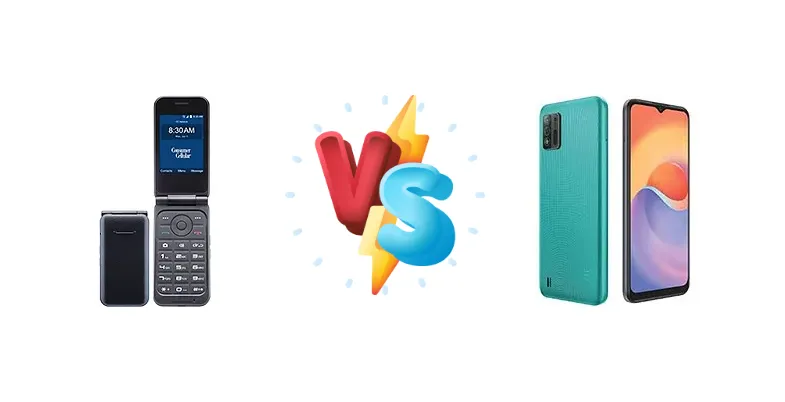
ZTE offers two compelling options in the ultra-budget smartphone space: the ZTE Link II and the ZTE Blade A52 Lite. While both aim to deliver essential smartphone functionality at a low price point, they differ significantly in their core processing power. This comparison dissects those differences, helping you determine which device best suits your needs.
🏆 Quick Verdict
For the average user prioritizing basic tasks like calls, messaging, and light social media, the ZTE Blade A52 Lite is the better choice. Its octa-core processor provides a noticeably smoother experience than the ZTE Link II’s quad-core Snapdragon 215, justifying a potential price premium.
| Network |
|---|
| 2G bands | GSM 850 / 1900 | GSM 850 / 900 / 1800 / 1900 |
| 3G bands | HSDPA 850 / 1700(AWS) / 1900 | HSDPA 850 / 900 / 2100 |
| 4G bands | 2, 4, 5, 12, 25, 41, 66, 71 | LTE |
| Speed | HSPA, LTE | HSPA, LTE |
| Technology | GSM / HSPA / LTE | GSM / HSPA / LTE |
| Launch |
|---|
| Announced | 2021, February 22 | 2022, August 20 |
| Status | Available. Released 2021, February 22 | Available. Released 2022, August |
| Body |
|---|
| Dimensions | 108.7 x 56.1 x 19.8 mm (4.28 x 2.21 x 0.78 in) | 164.8 x 75.9 x 8.6 mm (6.49 x 2.99 x 0.34 in) |
| SIM | Nano-SIM | Nano-SIM + Nano-SIM |
| Weight | 128 g (4.52 oz) | 188 g (6.63 oz) |
| Display |
|---|
| Resolution | 128 x 160 pixels (~73 ppi density) | 720 x 1600 pixels, 20:9 ratio (~269 ppi density) |
| Size | 2.8 inches, 24.7 cm2 (~40.5% screen-to-body ratio) | 6.52 inches, 102.6 cm2 (~82.1% screen-to-body ratio) |
| Type | TFT LCD | IPS LCD |
| | Cover display:
TFT LCD, 1.77 inches, 240 x 320 pixels | - |
| Platform |
|---|
| CPU | Quad-core 1.3 GHz Cortex-A53 | Octa-core |
| Chipset | Qualcomm QM215 Snapdragon 215 (28 nm) | - |
| GPU | Adreno 308 | - |
| OS | Proprietary | Android 11 (Go edition) |
| Memory |
|---|
| Card slot | microSDHC (dedicated slot) | microSDXC |
| Internal | 8GB 1GB RAM | 32GB 2GB RAM |
| Main Camera |
|---|
| Features | - | LED flash |
| Single | 2 MP | 13 MP, AF |
| Video | 720p@30fps | 1080p@30fps |
| Selfie camera |
|---|
| Single | - | 5 MP |
| Video | - | 720p@30fps |
| Sound |
|---|
| 3.5mm jack | Yes | Yes |
| 35mm jack | Yes | Yes |
| Loudspeaker | Yes | Yes |
| Comms |
|---|
| Bluetooth | 4.2, A2DP | Yes |
| NFC | No | No |
| Positioning | GPS | GPS |
| Radio | No | Unspecified |
| USB | microUSB 2.0 | Yes |
| WLAN | Wi-Fi 802.11 b/g/n, hotspot | Yes |
| Features |
|---|
| Sensors | Accelerometer | Accelerometer, proximity |
| Battery |
|---|
| Type | Li-Ion 1600 mAh, removable | Li-Ion 4000 mAh |
| Misc |
|---|
| Colors | Red, Black | Gray, Green |
| Price | About 40 EUR | - |
ZTE Link II
- Lowest possible price point
- Potentially slightly better battery life under minimal use
- Functional for basic communication
- Slow performance with the Snapdragon 215
- Limited multitasking capabilities
- Outdated 28nm process node
ZTE Blade A52 Lite
- Significantly better performance with octa-core processor
- Smoother multitasking experience
- More responsive user interface
- Potentially slightly shorter battery life under heavy use
- May be slightly more expensive than the Link II
- Camera quality likely similar to Link II
Display Comparison
Information regarding display specifications (resolution, panel type, brightness) is absent from the provided data. However, given the price segment, both devices likely utilize LCD panels with 720p+ resolutions. Bezels are expected to be substantial on both. Color accuracy will likely be standard for this price range, prioritizing power efficiency over color fidelity.
Camera Comparison
Camera details are limited. Both devices likely feature basic camera setups geared towards casual photography. Without sensor size or aperture information, it's difficult to make a direct comparison. The presence of a 2MP macro camera on either device is unlikely to provide significant image quality improvements; these sensors often lack the detail and dynamic range needed for compelling macro shots. Image processing will likely be minimal on both, relying heavily on software algorithms to enhance photos.
Performance
The core difference lies in the processors. The ZTE Link II features a quad-core 1.3 GHz Cortex-A53 CPU built on the Qualcomm QM215 Snapdragon 215 (28nm) chipset. This is an entry-level processor designed for basic functionality. The ZTE Blade A52 Lite boasts an octa-core CPU, though specific core architecture and clock speeds are unknown. An octa-core configuration inherently allows for better multitasking and smoother performance in applications optimized for multiple threads. The 28nm process node of the Snapdragon 215 is relatively inefficient compared to more modern fabrication processes, potentially leading to higher power consumption for similar tasks. The Blade A52 Lite, with its octa-core processor, will offer a more fluid user experience, especially when switching between apps or loading moderately demanding websites.
Battery Life
Battery capacity and charging wattage are not specified. Given the budget nature of these phones, expect battery capacities in the 3000-4000 mAh range. The Snapdragon 215 in the Link II, being less power-hungry, *might* offer slightly better battery life under extremely light usage. However, the more efficient octa-core processor in the Blade A52 Lite, coupled with optimized software, could offset this difference with more efficient power management during typical use. Charging speeds are likely to be slow on both devices, potentially taking several hours to fully charge.
Buying Guide
Buy the ZTE Link II if you absolutely need the lowest possible price and your smartphone usage is extremely limited to essential communication. It's a functional device for first-time smartphone users or as a backup phone. Buy the ZTE Blade A52 Lite if you want a more responsive and capable device for everyday tasks, including browsing, social media, and occasional light gaming. The octa-core processor offers a significant performance boost for a minimal increase in cost.
Frequently Asked Questions
❓ Will the ZTE Blade A52 Lite handle popular social media apps like Facebook and Instagram smoothly?
Yes, the octa-core processor in the ZTE Blade A52 Lite provides sufficient power to run social media apps like Facebook and Instagram without significant lag or stuttering. The increased processing capability compared to the ZTE Link II’s Snapdragon 215 will result in a more responsive and enjoyable user experience.
❓ Is the ZTE Link II suitable for playing mobile games?
The ZTE Link II is not well-suited for gaming. The Snapdragon 215 processor is an entry-level chip that will struggle with even basic mobile games. Expect low frame rates, long loading times, and potential crashes. The ZTE Blade A52 Lite, while not a gaming powerhouse, will offer a slightly better gaming experience due to its octa-core processor.
❓ How much storage do these phones typically offer, and can it be expanded?
While not specified, both phones likely come with 32GB or 64GB of internal storage. Crucially, both devices almost certainly include a microSD card slot for storage expansion, allowing you to add more space for photos, videos, and apps. This is essential given the limited internal storage typically found in this price range.
❓ What version of Android do these phones run?
Given their budget nature, both devices likely run a relatively older version of Android, potentially Android 11 or 12, with a customized ZTE user interface. Software updates are unlikely to be frequent or extensive.