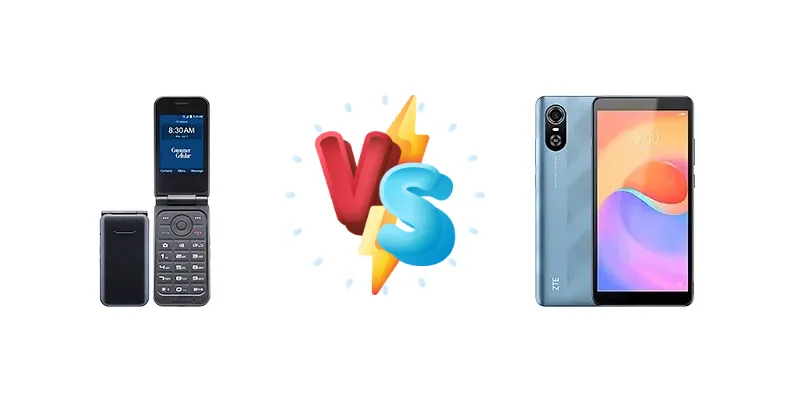
Both the ZTE Link II and Blade A31 Plus target the ultra-budget smartphone market, but they take different approaches to achieving affordability. The Link II relies on Qualcomm's aging Snapdragon 215, while the Blade A31 Plus opts for Unisoc's SC9863A. This comparison dissects the core differences to determine which device delivers the best user experience for the price.
🏆 Quick Verdict
For most users, the ZTE Blade A31 Plus is the better choice. Its octa-core processor, utilizing Cortex-A55 cores, provides a noticeable performance advantage over the Link II’s quad-core Cortex-A53, resulting in smoother multitasking and app loading. While neither phone is a powerhouse, the A31 Plus offers a more responsive experience.
| Network |
|---|
| 2G bands | GSM 850 / 1900 | GSM 850 / 900 / 1800 / 1900 |
| 3G bands | HSDPA 850 / 1700(AWS) / 1900 | HSDPA 850 / 900 / 2100 |
| 4G bands | 2, 4, 5, 12, 25, 41, 66, 71 | 1, 2, 3, 5, 7, 8, 20, 28, 38, 40, 41 |
| Speed | HSPA, LTE | HSPA, LTE |
| Technology | GSM / HSPA / LTE | GSM / HSPA / LTE |
| Launch |
|---|
| Announced | 2021, February 22 | 2021, October 31 |
| Status | Available. Released 2021, February 22 | Available. Released 2021, October 31 |
| Body |
|---|
| Dimensions | 108.7 x 56.1 x 19.8 mm (4.28 x 2.21 x 0.78 in) | 159.2 x 77.5 x 9.6 mm (6.27 x 3.05 x 0.38 in) |
| SIM | Nano-SIM | Nano-SIM + Nano-SIM |
| Weight | 128 g (4.52 oz) | - |
| Display |
|---|
| Resolution | 128 x 160 pixels (~73 ppi density) | 480 x 960 pixels, 18:9 ratio (~179 ppi density) |
| Size | 2.8 inches, 24.7 cm2 (~40.5% screen-to-body ratio) | 6.0 inches, 92.9 cm2 (~75.3% screen-to-body ratio) |
| Type | TFT LCD | IPS LCD |
| | Cover display:
TFT LCD, 1.77 inches, 240 x 320 pixels | - |
| Platform |
|---|
| CPU | Quad-core 1.3 GHz Cortex-A53 | Octa-core (4x1.6 GHz Cortex-A55 & 4x1.2 GHz Cortex-A55) |
| Chipset | Qualcomm QM215 Snapdragon 215 (28 nm) | Unisoc SC9863A (28 nm) |
| GPU | Adreno 308 | IMG8322 |
| OS | Proprietary | Android 11 (Go edition) |
| Memory |
|---|
| Card slot | microSDHC (dedicated slot) | microSDXC |
| Internal | 8GB 1GB RAM | 32GB 1GB RAM |
| | - | eMMC 5.1 |
| Main Camera |
|---|
| Features | - | LED flash, HDR |
| Single | 2 MP | 5 MP (up-scaled to 8 MP) |
| Video | 720p@30fps | 720p@30fps |
| Selfie camera |
|---|
| Single | - | 2 MP (up-scaled to 5 MP) |
| Sound |
|---|
| 3.5mm jack | Yes | Yes |
| 35mm jack | Yes | Yes |
| Loudspeaker | Yes | Yes |
| Comms |
|---|
| Bluetooth | 4.2, A2DP | 4.2, A2DP, LE |
| NFC | No | Yes |
| Positioning | GPS | GPS, GLONASS |
| Radio | No | FM radio |
| USB | microUSB 2.0 | microUSB 2.0 |
| WLAN | Wi-Fi 802.11 b/g/n, hotspot | Wi-Fi 802.11 b/g/n |
| Features |
|---|
| Sensors | Accelerometer | Accelerometer |
| Battery |
|---|
| Type | Li-Ion 1600 mAh, removable | Li-Ion 3000 mAh |
| Misc |
|---|
| Colors | Red, Black | Blue, Gray |
| Price | About 40 EUR | - |
ZTE Link II
- Qualcomm chipset may offer better software support (potentially)
- Extremely affordable price point
- Simple and straightforward user experience
- Outdated Cortex-A53 processor
- Limited performance for multitasking
- Likely lower quality display
ZTE Blade A31 Plus
- Octa-core Cortex-A55 processor for improved performance
- More responsive user interface
- Potentially better battery efficiency
- Unisoc chipset may have limited software updates
- Build quality may be slightly lower to achieve price point
- Unknown camera performance
Display Comparison
Neither ZTE provides display specifications beyond size, so a detailed comparison is limited. Both phones are likely to utilize LCD panels given their price point. The absence of information regarding brightness, resolution, or color gamut suggests a focus on cost reduction over display quality. Expect basic viewing experiences suitable for essential tasks.
Camera Comparison
Detailed camera specifications are unavailable for either device. Given the target market, expect basic camera modules. It's reasonable to assume both phones feature a primary camera and potentially a secondary depth sensor. Image quality will likely be adequate for casual snapshots in good lighting conditions, but struggles in low light. Without sensor size or aperture information, a direct comparison is impossible, but the chipset's image signal processor (ISP) on the A31 Plus *may* offer slightly better image processing capabilities.
Performance
The core difference lies in the chipsets. The ZTE Link II’s Qualcomm QM215 Snapdragon 215 features a quad-core Cortex-A53 processor clocked at 1.3 GHz. This is an older architecture, designed for basic smartphone functionality. Conversely, the ZTE Blade A31 Plus boasts the Unisoc SC9863A, an octa-core processor with four Cortex-A55 cores running at 1.6 GHz and another four at 1.2 GHz. The Cortex-A55 architecture is significantly more efficient and offers improved performance per clock cycle compared to the A53. The higher core count and newer architecture of the A31 Plus translate to a more responsive user interface and better multitasking capabilities. While neither chipset is suited for demanding games, the A31 Plus will handle everyday apps with greater ease.
Battery Life
Battery capacity is not specified for either device. However, given the low-power chipsets, both phones should offer at least a full day of battery life with moderate usage. Charging wattage is also unknown, suggesting slow charging speeds. The more efficient Cortex-A55 cores in the Blade A31 Plus *could* contribute to slightly longer battery life, but the difference is unlikely to be substantial without knowing the actual battery capacities.
Buying Guide
Buy the ZTE Link II if your primary need is a basic, extremely affordable phone for calls, texts, and light web browsing, and you prioritize Qualcomm's brand recognition. Buy the ZTE Blade A31 Plus if you want a more capable device for everyday tasks, occasional social media use, and a slightly smoother overall experience, even if it means opting for a less well-known chipset manufacturer.
Frequently Asked Questions
❓ Will the ZTE Blade A31 Plus handle popular social media apps like Facebook and WhatsApp smoothly?
Yes, the Unisoc SC9863A’s octa-core processor and Cortex-A55 cores are sufficient to run social media apps like Facebook and WhatsApp without significant lag. While it won’t offer a flagship-level experience, it will provide a usable and responsive experience for these common tasks.
❓ Is the ZTE Link II suitable for playing mobile games?
The ZTE Link II’s Snapdragon 215 is not ideal for gaming. While it can handle very basic 2D games, it will struggle with most modern 3D titles. Expect low frame rates and potential stuttering. The Blade A31 Plus offers a slightly better gaming experience, but still isn't designed for demanding games.
❓ Which phone is likely to receive more software updates?
Historically, Qualcomm-powered devices have a slightly better track record for software updates, though ZTE's update commitment is generally limited on these budget models. However, the difference is likely to be minimal, and neither phone is expected to receive extensive long-term support.
❓ Does either phone support 4G LTE connectivity?
Both the ZTE Link II and Blade A31 Plus are expected to support 4G LTE connectivity, allowing for mobile data access. However, the specific LTE bands supported may vary depending on the region, so it's important to check compatibility with your carrier.