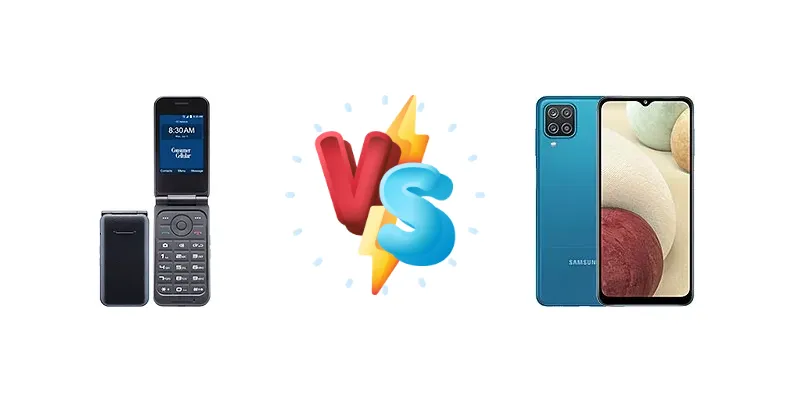
The ZTE Link II and Samsung Galaxy A12 (India) represent opposite ends of the entry-level smartphone spectrum. The Link II prioritizes extreme affordability, while the A12 aims for a more balanced experience. This comparison dissects their core components to determine which device offers the best value for users seeking a basic smartphone experience.
🏆 Quick Verdict
For the average user, the Samsung Galaxy A12 (India) is the superior choice. Its Exynos 850 chipset provides a significantly faster and more responsive experience than the ZTE Link II’s Snapdragon 215, making everyday tasks and even light multitasking noticeably smoother. While the Link II is cheaper, the performance gap is substantial.
| Network |
|---|
| 2G bands | GSM 850 / 1900 | GSM 850 / 900 / 1800 / 1900 |
| 3G bands | HSDPA 850 / 1700(AWS) / 1900 | HSDPA 850 / 900 / 2100 |
| 4G bands | 2, 4, 5, 12, 25, 41, 66, 71 | 1, 3, 5, 7, 8, 20, 28, 38, 40, 41 |
| Speed | HSPA, LTE | HSPA 42.2/5.76 Mbps, LTE Cat4 150/50 Mbps |
| Technology | GSM / HSPA / LTE | GSM / HSPA / LTE |
| Launch |
|---|
| Announced | 2021, February 22 | 2021, August 12 |
| Status | Available. Released 2021, February 22 | Available. Released 2021, August 12 |
| Body |
|---|
| Build | - | Glass front, plastic back, plastic frame |
| Dimensions | 108.7 x 56.1 x 19.8 mm (4.28 x 2.21 x 0.78 in) | 164 x 75.8 x 8.9 mm (6.46 x 2.98 x 0.35 in) |
| SIM | Nano-SIM | · Nano-SIM· Nano-SIM + Nano-SIM |
| Weight | 128 g (4.52 oz) | 205 g (7.23 oz) |
| Display |
|---|
| Resolution | 128 x 160 pixels (~73 ppi density) | 720 x 1600 pixels, 20:9 ratio (~270 ppi density) |
| Size | 2.8 inches, 24.7 cm2 (~40.5% screen-to-body ratio) | 6.5 inches, 102.0 cm2 (~82.1% screen-to-body ratio) |
| Type | TFT LCD | PLS LCD |
| | Cover display:
TFT LCD, 1.77 inches, 240 x 320 pixels | - |
| Platform |
|---|
| CPU | Quad-core 1.3 GHz Cortex-A53 | Octa-core (4x2.0 GHz Cortex-A55 & 4x2.0 GHz Cortex-A55) |
| Chipset | Qualcomm QM215 Snapdragon 215 (28 nm) | Exynos 850 (8 nm) |
| GPU | Adreno 308 | Mali-G52 |
| OS | Proprietary | Android 11, upgradable to Android 13, One UI 5.1 |
| Memory |
|---|
| Card slot | microSDHC (dedicated slot) | microSDXC (dedicated slot) |
| Internal | 8GB 1GB RAM | 64GB 4GB RAM, 128GB 4GB RAM, 128GB 6GB RAM |
| | - | eMMC 5.1 |
| Main Camera |
|---|
| Features | - | LED flash, panorama, HDR |
| Quad | - | 48 MP, f/2.0, 26mm (wide), AF
5 MP, f/2.2, 123˚ (ultrawide)
2 MP (macro)
Auxiliary lens |
| Single | 2 MP | - |
| Video | 720p@30fps | 1080p@30fps |
| Selfie camera |
|---|
| Single | - | 8 MP, f/2.2 |
| Video | - | 1080p@30fps |
| Sound |
|---|
| 3.5mm jack | Yes | Yes |
| 35mm jack | Yes | Yes |
| Loudspeaker | Yes | Yes |
| Comms |
|---|
| Bluetooth | 4.2, A2DP | 5.0, A2DP, LE |
| NFC | No | No |
| Positioning | GPS | GPS, GLONASS, GALILEO, BDS |
| Radio | No | FM radio, RDS, recording |
| USB | microUSB 2.0 | USB Type-C 2.0 |
| WLAN | Wi-Fi 802.11 b/g/n, hotspot | Wi-Fi 802.11 b/g/n, Wi-Fi Direct |
| Features |
|---|
| Sensors | Accelerometer | Fingerprint (side-mounted), accelerometer |
| | - | Virtual proximity sensing |
| Battery |
|---|
| Charging | - | 15W wired |
| Type | Li-Ion 1600 mAh, removable | Li-Po 5000 mAh |
| Misc |
|---|
| Colors | Red, Black | Black, Blue, White |
| Models | - | SM-A127F, SM-A127F/DS |
| Price | About 40 EUR | About 160 EUR |
| SAR | - | 0.79 W/kg (head) |
ZTE Link II
- Lowest possible price point
- Potentially good battery life due to efficient processor
- Functional for basic tasks
- Extremely slow performance
- Outdated processor architecture
- Likely low-quality display
Samsung Galaxy A12 (India)
- Significantly faster performance
- More efficient processor
- 15W fast charging support
- Higher price than ZTE Link II
- Basic camera system
- LCD display lacks advanced features
Display Comparison
Neither device boasts a standout display. Specifics regarding panel type, resolution, and brightness are missing for the ZTE Link II, suggesting a very basic LCD. The Samsung Galaxy A12 (India) also utilizes an LCD, but its larger size and potentially higher peak brightness (based on typical Samsung LCDs) likely offer a more pleasant viewing experience. The absence of features like high refresh rates or HDR support on both devices confirms their budget positioning.
Camera Comparison
Camera performance is likely to be similar in real-world usage, given both devices target the budget segment. Details on sensor sizes and apertures are unavailable for the ZTE Link II, but it’s safe to assume a basic configuration. The Samsung Galaxy A12 (India) likely features a more refined image processing pipeline, typical of Samsung’s mid-range and budget offerings. The inclusion of a 2MP macro camera on the A12 is largely a marketing gimmick, offering limited practical benefit due to its low resolution and lack of optical image stabilization (OIS).
Performance
The performance disparity is the most significant difference. The Samsung Galaxy A12 (India)'s Exynos 850, an octa-core processor built on an 8nm process, dwarfs the ZTE Link II’s quad-core Snapdragon 215 (28nm). The 8nm fabrication process of the Exynos 850 translates to better power efficiency and significantly improved thermal management, allowing for sustained performance. The Cortex-A55 cores in the A12, while not high-end, are architecturally superior to the Cortex-A53 cores in the Link II, resulting in faster processing speeds. This difference will be acutely felt in app loading times, web browsing, and multitasking.
Battery Life
Battery life will depend heavily on usage patterns. While the specific battery capacity of the ZTE Link II is unknown, the Snapdragon 215’s power efficiency could potentially offer competitive endurance. The Samsung Galaxy A12 (India) supports 15W wired charging, a modest but welcome feature. The Exynos 850, while more powerful, is also relatively efficient, and the larger screen size may offset some of the battery gains. Without specific mAh figures, it’s difficult to definitively declare a winner, but the A12’s charging capability provides a convenience advantage.
Buying Guide
Buy the ZTE Link II if you absolutely need the lowest possible price point and your usage is limited to basic calling, texting, and very light app use. It’s a functional device for those with minimal smartphone requirements. Buy the Samsung Galaxy A12 (India) if you prioritize a smoother user experience, occasional multitasking, and a more future-proof device, even if it means spending a bit more. The Exynos 850 offers a tangible performance boost for everyday tasks.
Frequently Asked Questions
❓ Does the Exynos 850 in the Galaxy A12 (India) get hot during prolonged use, like gaming?
The Exynos 850, built on an 8nm process, is relatively efficient and manages heat well. While it won't deliver flagship-level gaming performance, it should handle moderate gaming sessions without significant throttling. The larger surface area of the A12 also aids in heat dissipation compared to the more compact Link II.
❓ Is the 2MP macro camera on the Samsung Galaxy A12 (India) worth using?
Realistically, no. 2MP macro cameras typically produce images with limited detail and sharpness. They are often included as a marketing feature rather than a genuinely useful addition to the camera system. The primary camera on the A12 will deliver far superior results for most photography scenarios.
❓ Can the Samsung Galaxy A12 (India) run popular games like PUBG Mobile smoothly?
The Galaxy A12 (India) can run PUBG Mobile, but expect to play at lower graphics settings (Balanced or Low) to maintain a stable frame rate. The Exynos 850 is capable of handling the game, but it's not a dedicated gaming chipset. The ZTE Link II would struggle significantly with PUBG Mobile.
❓ What kind of storage options are available on each device, and can it be expanded?
Specific storage configurations vary by region. However, both devices typically offer expandable storage via microSD card. The Samsung Galaxy A12 (India) generally comes with more base storage options than the ZTE Link II, which often starts with a very limited internal storage capacity.