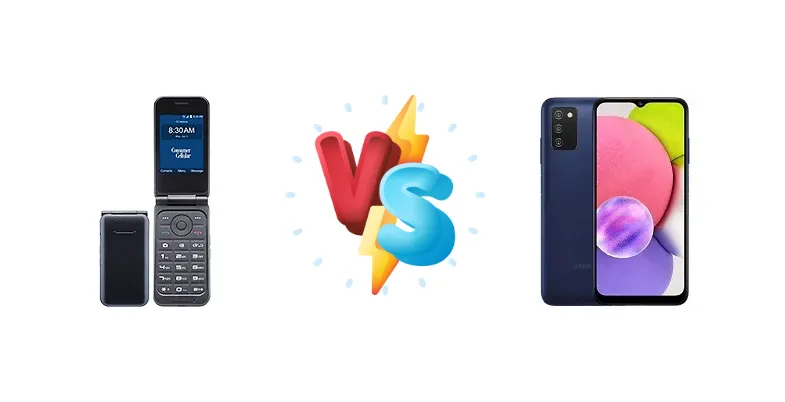
The ZTE Link II and Samsung Galaxy A03s represent the extreme end of the smartphone price spectrum. Both aim to deliver essential functionality at a minimal cost, but they take different approaches. The Link II relies on Qualcomm's aging Snapdragon 215, while the A03s opts for MediaTek's Helio P35. This comparison dissects their strengths and weaknesses to determine which offers the best value for budget-conscious consumers.
🏆 Quick Verdict
For most users, the Samsung Galaxy A03s is the better choice. Its octa-core Helio P35 chipset provides a significantly smoother experience than the ZTE Link II’s quad-core Snapdragon 215, especially when multitasking. While both phones offer similar battery endurance, the A03s’ brighter display and faster charging provide a more refined user experience.
| Network |
|---|
| 2G bands | GSM 850 / 1900 | GSM 850 / 900 / 1800 / 1900 |
| 3G bands | HSDPA 850 / 1700(AWS) / 1900 | HSDPA 850 / 900 / 2100 |
| 4G bands | 2, 4, 5, 12, 25, 41, 66, 71 | 1, 3, 5, 7, 8, 20, 28, 38, 40, 41 |
| Speed | HSPA, LTE | HSPA 42.2/5.76 Mbps, LTE Cat4 150/50 Mbps |
| Technology | GSM / HSPA / LTE | GSM / HSPA / LTE |
| | - | 2, 4, 5, 7, 12, 13, 14, 25, 26, 41, 66, 71 - SM-A037U |
| Launch |
|---|
| Announced | 2021, February 22 | 2021, August 18 |
| Status | Available. Released 2021, February 22 | Available. Released 2021, August 18 |
| Body |
|---|
| Build | - | Glass front, plastic frame, plastic back |
| Dimensions | 108.7 x 56.1 x 19.8 mm (4.28 x 2.21 x 0.78 in) | 164.2 x 75.9 x 9.1 mm (6.46 x 2.99 x 0.36 in) |
| SIM | Nano-SIM | Nano-SIM + Nano-SIM |
| Weight | 128 g (4.52 oz) | 196 g (6.91 oz) |
| Display |
|---|
| Resolution | 128 x 160 pixels (~73 ppi density) | 720 x 1600 pixels, 20:9 ratio (~270 ppi density) |
| Size | 2.8 inches, 24.7 cm2 (~40.5% screen-to-body ratio) | 6.5 inches, 102.0 cm2 (~81.8% screen-to-body ratio) |
| Type | TFT LCD | PLS LCD |
| | Cover display:
TFT LCD, 1.77 inches, 240 x 320 pixels | - |
| Platform |
|---|
| CPU | Quad-core 1.3 GHz Cortex-A53 | Octa-core (4x2.35 GHz Cortex-A53 & 4x1.8 GHz Cortex-A53) |
| Chipset | Qualcomm QM215 Snapdragon 215 (28 nm) | Mediatek MT6765 Helio P35 (12 nm) |
| GPU | Adreno 308 | PowerVR GE8320 |
| OS | Proprietary | Android 11, upgradable to Android 13, One UI 5.1 Core |
| Memory |
|---|
| Card slot | microSDHC (dedicated slot) | microSDXC (dedicated slot) |
| Internal | 8GB 1GB RAM | 32GB 2GB RAM, 32GB 3GB RAM, 32GB 4GB RAM, 64GB 3GB RAM, 64GB 4GB RAM |
| | - | eMMC 5.1 |
| Main Camera |
|---|
| Features | - | LED flash |
| Single | 2 MP | 5 MP, f/2.2 |
| Triple | - | 13 MP, f/2.2, (wide), AF
2 MP (macro)
Auxiliary lens |
| Video | 720p@30fps | 1080p@30fps |
| Selfie camera |
|---|
| Single | - | 5 MP, f/2.2 |
| Video | - | 1080p@30fps |
| Sound |
|---|
| 3.5mm jack | Yes | Yes |
| 35mm jack | Yes | Yes |
| Loudspeaker | Yes | Yes |
| Comms |
|---|
| Bluetooth | 4.2, A2DP | 5.0, A2DP |
| NFC | No | Yes (market/region dependent) |
| Positioning | GPS | GPS, GLONASS, GALILEO, BDS |
| Radio | No | No |
| USB | microUSB 2.0 | USB Type-C 2.0 |
| WLAN | Wi-Fi 802.11 b/g/n, hotspot | Wi-Fi 802.11 b/g/n, Wi-Fi Direct |
| Features |
|---|
| Sensors | Accelerometer | Fingerprint (side-mounted), accelerometer, proximity |
| Battery |
|---|
| Charging | - | 15W wired |
| Type | Li-Ion 1600 mAh, removable | Li-Po 5000 mAh |
| Misc |
|---|
| Colors | Red, Black | Black, Blue, White |
| Models | - | SM-A037F, SM-A037F/DS, SM-A037M, SM-A037G, SM-A037U, SM-S134DL, SM-A037W, SM-A037U1, SM-S135DL |
| Price | About 40 EUR | $ 65.65 / £ 82.99 / ₹ 10,800 |
| SAR EU | - | 0.36 W/kg (head) 1.09 W/kg (body) |
| Tests |
|---|
| Battery life | - |
Endurance rating 122h
|
| Camera | - |
Photo / Video |
| Display | - |
Contrast ratio: 1718:1 (nominal) |
| Loudspeaker | - |
-27.4 LUFS (Good)
|
| Performance | - |
AnTuTu: 103465 (v8), 101299 (v9)
GeekBench: 889 (v5.1)
GFXBench: 5.5fps (ES 3.1 onscreen) |
ZTE Link II
- Ultra-affordable price point
- Basic functionality for calls and texts
- Potentially longer software support (ZTE's commitment varies)
- Significantly slower performance
- Likely lower display brightness
- Slower charging speeds
Samsung Galaxy A03s
- Faster and more responsive performance
- Brighter and more usable display
- Faster 15W charging
- More versatile chipset for apps
- Slightly higher price
- Image quality limited by budget sensors
- Potential for bloatware
Display Comparison
The Samsung Galaxy A03s boasts a significantly more usable display experience. While both share a 1718:1 contrast ratio, the A03s achieves a measured peak brightness of 488 nits, crucial for outdoor visibility. The ZTE Link II’s display specifications are not provided, suggesting a lower brightness level. This difference impacts readability in direct sunlight. Both displays likely utilize LCD technology, common in this price bracket, and lack features like high refresh rates or HDR support.
Camera Comparison
Both devices list 'Photo / Video' capabilities, but lack specific details. Given their price points, image quality will be limited. The absence of sensor size or aperture information suggests both utilize basic sensors. The ZTE Link II is likely to have a simpler camera setup. The A03s may offer slightly better image processing due to the more powerful Helio P35 chipset, but don't expect flagship-level results. The inclusion of a 2MP macro camera on the A03s is largely a marketing gimmick, offering minimal practical benefit.
Performance
The core difference lies in the chipsets. The Samsung Galaxy A03s’ MediaTek Helio P35, fabricated on a 12nm process, features an octa-core configuration (4x2.35 GHz Cortex-A53 & 4x1.8 GHz Cortex-A53). This contrasts sharply with the ZTE Link II’s Qualcomm QM215 Snapdragon 215, a quad-core 1.3 GHz Cortex-A53 processor built on a larger 28nm node. The Helio P35’s higher clock speeds and core count translate to noticeably faster app loading times and smoother multitasking. The 12nm process also contributes to better power efficiency compared to the Snapdragon 215’s 28nm process, though the overall impact is limited by the battery capacities.
Battery Life
Both the ZTE Link II and Samsung Galaxy A03s achieve an endurance rating of 122 hours, indicating similar battery life under typical usage. However, the A03s benefits from 15W wired charging, allowing for faster replenishment. The Link II’s charging speed is unspecified, likely being significantly slower. While both will last a full day for light users, the A03s’ faster charging is a convenience advantage.
Buying Guide
Buy the ZTE Link II if your primary need is a basic, ultra-affordable phone for calls, texts, and very light app usage. It’s a viable option for those needing a secondary device or a first smartphone for a child. Buy the Samsung Galaxy A03s if you prioritize a more responsive user experience, a brighter and more usable display, and faster charging, even if it means spending a little more. It’s better suited for everyday tasks and occasional social media browsing.
Frequently Asked Questions
❓ Is the MediaTek Helio P35 in the Galaxy A03s capable of running popular games like PUBG Mobile?
The Helio P35 can run PUBG Mobile, but expect to play at lower graphics settings and frame rates to maintain a stable experience. It's not a gaming-focused chipset, so demanding titles will likely require significant compromises. The Snapdragon 215 in the ZTE Link II would struggle significantly with PUBG Mobile.
❓ Does the Samsung Galaxy A03s suffer from significant overheating during prolonged use?
The Helio P35 is not known for excessive overheating. While it may get warm during extended gaming sessions or video recording, it's unlikely to throttle performance severely. The 12nm process helps with thermal efficiency compared to older, larger-node chipsets.
❓ How much storage does each phone offer, and is it expandable?
While not specified in the provided data, both phones typically come with 32GB of internal storage, expandable via microSD card. This is standard for devices in this price range. Checking the specific retailer listing is crucial to confirm the exact storage configuration.
❓ What Android version do these phones ship with, and are software updates guaranteed?
The Samsung Galaxy A03s likely ships with Android 12 or 13, with Samsung's One UI skin. Software update support is generally better with Samsung than ZTE, but long-term updates are not guaranteed for either device. The ZTE Link II may ship with an older version of Android.