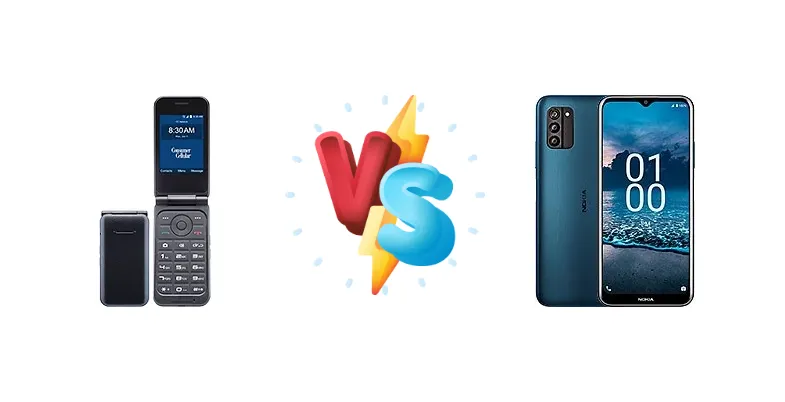
The ZTE Link II and Nokia G100 represent opposite ends of the ultra-budget smartphone spectrum. The Link II aims for absolute affordability, while the G100 attempts to deliver a more complete experience without breaking the bank. This comparison dissects their key differences, focusing on the impact of their vastly different chipsets.
🏆 Quick Verdict
For most users, the Nokia G100 is the superior choice. Its Snapdragon 662 chipset provides a significantly faster and more responsive experience than the ZTE Link II’s Snapdragon 215. While the Link II is cheaper, the performance deficit is substantial, impacting everyday tasks and app responsiveness.
| Network |
|---|
| 2G bands | GSM 850 / 1900 | GSM 850 / 900 / 1800 / 1900 |
| 3G bands | HSDPA 850 / 1700(AWS) / 1900 | HSDPA 850 / 1700(AWS) / 1900 |
| 4G bands | 2, 4, 5, 12, 25, 41, 66, 71 | 2, 4, 5, 7, 12, 13, 17, 44, 66, 71 |
| Speed | HSPA, LTE | HSPA, LTE |
| Technology | GSM / HSPA / LTE | GSM / HSPA / LTE |
| Launch |
|---|
| Announced | 2021, February 22 | 2022, September 22 |
| Status | Available. Released 2021, February 22 | Available. Released 2022, October |
| Body |
|---|
| Build | - | Glass front, plastic frame, plastic back |
| Dimensions | 108.7 x 56.1 x 19.8 mm (4.28 x 2.21 x 0.78 in) | 166.6 x 76.7 x 8.9 mm (6.56 x 3.02 x 0.35 in) |
| SIM | Nano-SIM | Nano-SIM |
| Weight | 128 g (4.52 oz) | 195.1 g (6.88 oz) |
| Display |
|---|
| Resolution | 128 x 160 pixels (~73 ppi density) | 720 x 1600 pixels, 20:9 ratio (~269 ppi density) |
| Size | 2.8 inches, 24.7 cm2 (~40.5% screen-to-body ratio) | 6.52 inches, 102.6 cm2 (~80.3% screen-to-body ratio) |
| Type | TFT LCD | IPS LCD |
| | Cover display:
TFT LCD, 1.77 inches, 240 x 320 pixels | - |
| Platform |
|---|
| CPU | Quad-core 1.3 GHz Cortex-A53 | Octa-core (4x2.0 GHz Kryo 260 Gold & 4x1.8 GHz Kryo 260 Silver) |
| Chipset | Qualcomm QM215 Snapdragon 215 (28 nm) | Qualcomm SM6115 Snapdragon 662 (11 nm) |
| GPU | Adreno 308 | Adreno 610 |
| OS | Proprietary | Android 12 |
| Memory |
|---|
| Card slot | microSDHC (dedicated slot) | microSDXC |
| Internal | 8GB 1GB RAM | 32GB 3GB RAM, 128GB 4GB RAM |
| Main Camera |
|---|
| Features | - | LED flash, HDR, panorama |
| Single | 2 MP | - |
| Triple | - | 13 MP, f/1.8, (wide), AF
5 MP, f/2.2, 115˚ (ultrawide), 1/5.0"
Auxiliary lens |
| Video | 720p@30fps | 1080p@30fps |
| Selfie camera |
|---|
| Single | - | 8 MP, f/2.0, (wide), 1/4.0", 1.12µm |
| Video | - | 1080p@30fps |
| Sound |
|---|
| 3.5mm jack | Yes | - |
| 35mm jack | Yes | Yes |
| Loudspeaker | Yes | Yes |
| Comms |
|---|
| Bluetooth | 4.2, A2DP | 5.0, A2DP, LE |
| NFC | No | No |
| Positioning | GPS | GPS |
| Radio | No | FM radio |
| USB | microUSB 2.0 | USB Type-C 2.0, OTG |
| WLAN | Wi-Fi 802.11 b/g/n, hotspot | Wi-Fi 802.11 b/g/n/ac, dual-band |
| Features |
|---|
| Sensors | Accelerometer | Fingerprint (side-mounted), accelerometer, gyro, proximity, barometer |
| Battery |
|---|
| Charging | - | 15W wired |
| Type | Li-Ion 1600 mAh, removable | Li-Po 5000 mAh |
| Misc |
|---|
| Colors | Red, Black | Nordic Blue |
| Price | About 40 EUR | About 60 EUR |
ZTE Link II
- Lowest possible price point
- Potentially slightly better battery life during basic tasks (speculative)
- Simple and straightforward user experience
- Extremely slow performance
- Poor multitasking capabilities
- Limited app compatibility
Nokia G100
- Significantly faster performance
- 15W fast charging
- More responsive user interface
- Higher price than the ZTE Link II
- May still struggle with demanding games
- Likely a plastic build to maintain affordability
Display Comparison
Neither device boasts a standout display. Given the context data, we can assume both utilize LCD panels, common in this price bracket. The Nokia G100’s chipset allows for potentially better image processing, leading to slightly more vibrant colors. However, the ZTE Link II’s lower power draw might translate to marginally better battery life during video playback, though this is speculative. Bezels are likely substantial on both devices, prioritizing cost reduction over premium aesthetics.
Camera Comparison
Without detailed camera specifications, a direct comparison is difficult. However, given the market segment, both devices likely feature basic camera setups. The Nokia G100’s more powerful chipset could enable better image processing algorithms, potentially resulting in slightly improved image quality in good lighting conditions. The ZTE Link II will likely struggle with low-light photography and complex scenes. We can assume both will have a primary camera and potentially a depth sensor, but detailed analysis is impossible without sensor size and aperture information.
Performance
The performance gap is the defining characteristic of this comparison. The Nokia G100’s Snapdragon 662, built on an 11nm process, is a substantial upgrade over the ZTE Link II’s 28nm Snapdragon 215. The 662’s octa-core configuration (4x2.0 GHz Kryo 260 Gold & 4x1.8 GHz Kryo 260 Silver) provides significantly more processing power than the Link II’s quad-core 1.3 GHz Cortex-A53. This translates to faster app loading times, smoother multitasking, and a more responsive user interface on the Nokia G100. The 11nm process also contributes to better thermal efficiency, reducing the likelihood of throttling under sustained load.
Battery Life
The Nokia G100 includes 15W wired charging, a feature absent from the ZTE Link II’s specifications. While battery capacity isn’t specified for either device, the Snapdragon 662’s improved power efficiency, coupled with faster charging, gives the Nokia G100 an advantage. The ZTE Link II will likely require longer charging times and may not last a full day with moderate usage, given the less efficient Snapdragon 215.
Buying Guide
Buy the ZTE Link II if you absolutely need the lowest possible price and your smartphone usage is limited to basic calling, texting, and very light app use. Buy the Nokia G100 if you value a smoother, more capable experience for social media, streaming, and occasional gaming, and are willing to spend a bit more for it.
Frequently Asked Questions
❓ Will the Nokia G100 be able to run popular games like PUBG Mobile?
The Snapdragon 662 in the Nokia G100 can run PUBG Mobile, but likely at lower graphics settings and frame rates to maintain a playable experience. Don't expect flagship-level performance, but it's significantly more capable than the ZTE Link II, which would struggle considerably.
❓ Is the ZTE Link II suitable for someone who primarily uses WhatsApp and makes calls?
Yes, the ZTE Link II is perfectly adequate for basic communication tasks like WhatsApp and phone calls. Its limited processing power won't be a hindrance for these simple applications. However, expect slow loading times for the apps themselves.
❓ Does the Nokia G100 support software updates?
Nokia generally provides a reasonable level of software support for its devices, including security updates. While it won't receive updates for as long as flagship models, the G100 is likely to receive at least a couple of major Android version updates and regular security patches.
❓ How much storage does each phone have, and is it expandable?
Storage capacity isn't specified in the provided data. However, budget phones typically start with 32GB or 64GB of internal storage. Both devices likely support microSD card expansion, allowing you to increase storage capacity if needed.