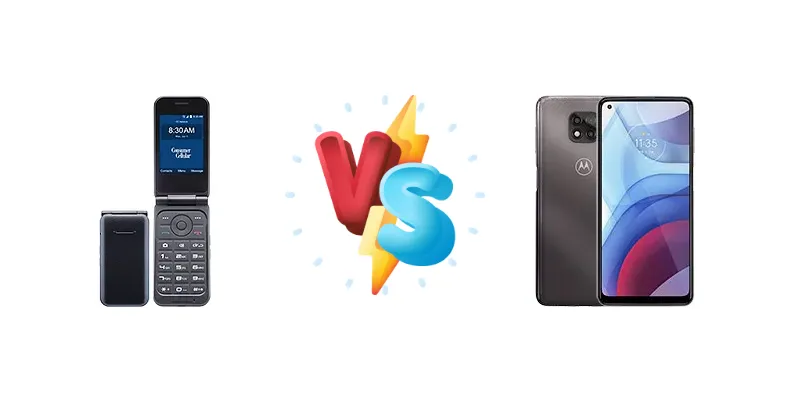
The ZTE Link II and Motorola Moto G Power (2021) represent opposite ends of the entry-level smartphone spectrum. The Link II aims for extreme affordability, while the Moto G Power (2021) prioritizes a more balanced experience with a focus on battery life and usable performance. This comparison dissects the core differences to help you determine which device best suits your needs.
🏆 Quick Verdict
For the average user, the Motorola Moto G Power (2021) is the clear winner. Its Snapdragon 662 chipset delivers significantly faster performance and a smoother user experience than the ZTE Link II’s Snapdragon 215, making it a more future-proof and enjoyable daily driver despite a potentially higher price.
| Network |
|---|
| 2G bands | GSM 850 / 1900 | GSM 850 / 900 / 1800 / 1900 |
| 3G bands | HSDPA 850 / 1700(AWS) / 1900 | HSDPA 850 / 900 / 1700(AWS) / 1900 / 2100 |
| 4G bands | 2, 4, 5, 12, 25, 41, 66, 71 | 1, 2, 3, 4, 5, 7, 8, 12, 13, 14, 17, 25, 26, 29, 30, 38, 41, 66, 71 |
| Speed | HSPA, LTE | HSPA, LTE |
| Technology | GSM / HSPA / LTE | GSM / CDMA / HSPA / EVDO / LTE |
| | - | CDMA2000 1xEV-DO |
| Launch |
|---|
| Announced | 2021, February 22 | 2021, January 08 |
| Status | Available. Released 2021, February 22 | Available. Released 2021, January 14 |
| Body |
|---|
| Build | - | Glass front, plastic back, plastic frame |
| Dimensions | 108.7 x 56.1 x 19.8 mm (4.28 x 2.21 x 0.78 in) | 165.3 x 75.9 x 9.5 mm (6.51 x 2.99 x 0.37 in) |
| SIM | Nano-SIM | Nano-SIM |
| Weight | 128 g (4.52 oz) | 206.5 g (7.30 oz) |
| | - | Water-repellent coating |
| Display |
|---|
| Resolution | 128 x 160 pixels (~73 ppi density) | 720 x 1600 pixels, 20:9 ratio (~266 ppi density) |
| Size | 2.8 inches, 24.7 cm2 (~40.5% screen-to-body ratio) | 6.6 inches, 105.2 cm2 (~83.8% screen-to-body ratio) |
| Type | TFT LCD | IPS LCD |
| | Cover display:
TFT LCD, 1.77 inches, 240 x 320 pixels | - |
| Platform |
|---|
| CPU | Quad-core 1.3 GHz Cortex-A53 | Octa-core (4x2.0 GHz Kryo 260 Gold & 4x1.8 GHz Kryo 260 Silver) |
| Chipset | Qualcomm QM215 Snapdragon 215 (28 nm) | Qualcomm SM6115 Snapdragon 662 (11 nm) |
| GPU | Adreno 308 | Adreno 610 |
| OS | Proprietary | Android 10 |
| Memory |
|---|
| Card slot | microSDHC (dedicated slot) | microSDXC (dedicated slot) |
| Internal | 8GB 1GB RAM | 32GB 3GB RAM, 64GB 4GB RAM |
| | - | eMMC 5.1 |
| Main Camera |
|---|
| Features | - | LED flash, HDR, panorama |
| Single | 2 MP | - |
| Triple | - | 48 MP, f/1.7, (wide), 1/2.0", 0.8µm, PDAF
2 MP (macro)
Auxiliary lens |
| Video | 720p@30fps | 1080p@30/60fps, gyro-EIS |
| Selfie camera |
|---|
| Features | - | HDR |
| Single | - | 8 MP, f/2.0, 1.12µm |
| Video | - | 1080p@30fps, gyro-EIS |
| Sound |
|---|
| 3.5mm jack | Yes | Yes |
| 35mm jack | Yes | Yes |
| Loudspeaker | Yes | Yes |
| Comms |
|---|
| Bluetooth | 4.2, A2DP | 5.0, A2DP, LE |
| NFC | No | No |
| Positioning | GPS | GPS, GLONASS, GALILEO |
| Radio | No | FM radio |
| USB | microUSB 2.0 | USB Type-C 2.0 |
| WLAN | Wi-Fi 802.11 b/g/n, hotspot | Wi-Fi 802.11 a/b/g/n/ac, dual-band, Wi-Fi Direct |
| Features |
|---|
| Sensors | Accelerometer | Fingerprint (side-mounted), accelerometer, gyro, proximity, compass, barometer |
| Battery |
|---|
| Charging | - | 15W wired |
| Type | Li-Ion 1600 mAh, removable | Li-Po 5000 mAh |
| Misc |
|---|
| Colors | Red, Black | Flash Gray, Polar Silver |
| Price | About 40 EUR | About 60 EUR |
ZTE Link II
- Extremely affordable price point
- Potentially longer standby time due to simpler functionality
- Compact size (likely)
- Significantly slower performance
- Limited app compatibility
- Poor multitasking capabilities
Motorola Moto G Power (2021)
- Faster and smoother performance
- Better multitasking capabilities
- 15W fast charging support
- Higher price compared to ZTE Link II
- Potentially shorter battery life under heavy load (though mitigated by efficiency)
- Larger size (likely)
Display Comparison
Neither device boasts a standout display. Given the context data focuses on processing power, we can infer both likely utilize LCD panels, common in this price bracket. The Moto G Power (2021) likely benefits from a larger screen size (typical for the G Power line) offering a more immersive experience. The ZTE Link II, aiming for cost reduction, likely has a smaller, lower-resolution display. Color accuracy and brightness are expected to be basic on both, prioritizing functionality over visual fidelity.
Camera Comparison
Without specific camera specs, we can assume both phones feature basic camera setups. The Motorola Moto G Power (2021) likely has a more capable main sensor, benefiting from Qualcomm’s image signal processing (ISP) within the Snapdragon 662. The ZTE Link II’s camera performance will likely be limited by the Snapdragon 215’s less advanced ISP. Expect acceptable photos in good lighting conditions from both, but significant degradation in low-light scenarios. The inclusion of a 2MP macro lens on either device is largely a marketing gimmick and offers minimal practical benefit.
Performance
The performance disparity is the most significant difference. The Motorola Moto G Power (2021)’s Snapdragon 662, an octa-core processor built on an 11nm process, is a substantial upgrade over the ZTE Link II’s quad-core Snapdragon 215 (28nm). The 662’s Kryo 260 cores, split into performance (Gold) and efficiency (Silver) clusters, allow for dynamic power allocation, resulting in smoother multitasking and faster app loading times. The 28nm process of the Snapdragon 215 is older and less efficient, leading to lower performance and potentially more heat generation. Users will notice a dramatic difference in responsiveness when navigating the UI, opening apps, and even browsing the web.
Battery Life
The Motorola Moto G Power (2021) includes 15W wired charging, a feature absent from the ZTE Link II’s specifications. While the Link II may have a comparable or even slightly larger battery capacity, the 662’s improved power efficiency and the 15W charging on the Moto G Power will likely translate to faster charging times and potentially longer real-world battery life. The Snapdragon 662’s efficiency allows the Moto G Power to maintain performance for longer periods without draining the battery as quickly.
Buying Guide
Buy the ZTE Link II if you absolutely need the cheapest possible smartphone for basic communication – calls, texts, and light app usage. It’s a viable option for those on a severely restricted budget or as a temporary device. Buy the Motorola Moto G Power (2021) if you prioritize a responsive user experience, longer battery life, and the ability to run modern apps and games without significant lag. It’s the better choice for anyone who wants a phone that can handle more than just the essentials.
Frequently Asked Questions
❓ Will the ZTE Link II struggle with popular apps like Facebook or WhatsApp?
Yes, the Snapdragon 215’s limited processing power and RAM will likely result in slow loading times, lag, and occasional crashes when running demanding apps like Facebook or WhatsApp. While they may function, the experience will be far from smooth.
❓ Is the Motorola Moto G Power (2021) a good choice for mobile gaming?
The Moto G Power (2021) can handle casual mobile games, but it’s not a gaming powerhouse. The Snapdragon 662 can run titles like PUBG Mobile or Call of Duty Mobile at lower settings. Expect some frame drops and reduced graphical fidelity. The ZTE Link II is unlikely to provide a playable experience for most modern games.
❓ How much faster is the Snapdragon 662 compared to the Snapdragon 215 in real-world use?
The Snapdragon 662 is significantly faster – roughly 2-3 times faster in CPU performance and considerably faster in GPU performance. This translates to noticeably quicker app launches, smoother scrolling, and a more responsive overall user experience on the Moto G Power (2021).
❓ Does the Motorola Moto G Power (2021) support software updates?
Motorola typically provides at least one major Android update and several security patches for its G Power series. While it may not receive the latest Android version indefinitely, it will likely receive updates for a reasonable period, offering better security and feature enhancements compared to the ZTE Link II, which may receive limited or no updates.