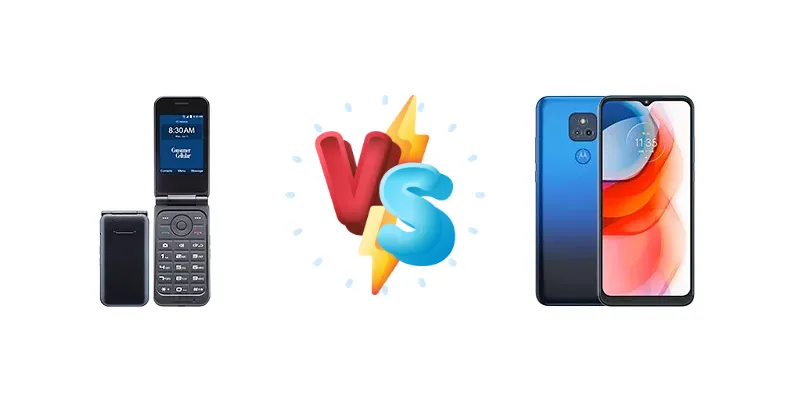
The ZTE Link II and Motorola Moto G Play (2021) represent the extreme end of the budget smartphone spectrum. Both aim to deliver essential smartphone functionality at the lowest possible price, but they achieve this with significantly different hardware. This comparison dissects the core differences, focusing on the impact of their respective chipsets on real-world performance and usability.
🏆 Quick Verdict
For the average user, the Motorola Moto G Play (2021) is the superior choice. Its Snapdragon 460 chipset, with its octa-core CPU, provides a demonstrably smoother and more responsive experience than the ZTE Link II’s aging Snapdragon 215. While both phones are limited, the Moto G Play offers a better balance of performance and usability for everyday tasks.
| Network |
|---|
| 2G bands | GSM 850 / 1900 | GSM 850 / 900 / 1800 / 1900 |
| 3G bands | HSDPA 850 / 1700(AWS) / 1900 | HSDPA 850 / 900 / 1700(AWS) / 1900 / 2100 |
| 4G bands | 2, 4, 5, 12, 25, 41, 66, 71 | 1, 2, 3, 4, 5, 7, 8, 12, 13, 17, 25, 26, 38, 41, 66, 71 |
| Speed | HSPA, LTE | HSPA, LTE |
| Technology | GSM / HSPA / LTE | GSM / CDMA / HSPA / LTE |
| | - | 2, 4, 5, 12, 14, 30, 66 |
| Launch |
|---|
| Announced | 2021, February 22 | 2021, January 08 |
| Status | Available. Released 2021, February 22 | Available. Released 2021, January 14 |
| Body |
|---|
| Build | - | Plastic frame, plastic back |
| Dimensions | 108.7 x 56.1 x 19.8 mm (4.28 x 2.21 x 0.78 in) | 166.6 x 76 x 9.4 mm (6.56 x 2.99 x 0.37 in) |
| SIM | Nano-SIM | Nano-SIM |
| Weight | 128 g (4.52 oz) | 204 g (7.20 oz) |
| | - | Water-repellent coating |
| Display |
|---|
| Resolution | 128 x 160 pixels (~73 ppi density) | 720 x 1600 pixels, 20:9 ratio (~270 ppi density) |
| Size | 2.8 inches, 24.7 cm2 (~40.5% screen-to-body ratio) | 6.5 inches, 102.0 cm2 (~80.6% screen-to-body ratio) |
| Type | TFT LCD | IPS LCD |
| | Cover display:
TFT LCD, 1.77 inches, 240 x 320 pixels | - |
| Platform |
|---|
| CPU | Quad-core 1.3 GHz Cortex-A53 | Octa-core (4x1.8 GHz Kryo 240 & 4x1.6 GHz Kryo 240) |
| Chipset | Qualcomm QM215 Snapdragon 215 (28 nm) | Qualcomm SM4250 Snapdragon 460 (11 nm) |
| GPU | Adreno 308 | Adreno 610 |
| OS | Proprietary | Android 10 |
| Memory |
|---|
| Card slot | microSDHC (dedicated slot) | microSDXC (dedicated slot) |
| Internal | 8GB 1GB RAM | 32GB 3GB RAM |
| | - | eMMC 5.1 |
| Main Camera |
|---|
| Dual | - | 13 MP, f/2.0, (wide), 1/3.1", 1.12µm, PDAF
Auxiliary lens |
| Features | - | LED flash, HDR, panorama |
| Single | 2 MP | - |
| Video | 720p@30fps | 1080p@30/60fps |
| Selfie camera |
|---|
| Features | - | HDR |
| Single | - | 5 MP, f/2.2, (wide), 1.12µm |
| Video | - | 1080p@30fps |
| Sound |
|---|
| 3.5mm jack | Yes | Yes |
| 35mm jack | Yes | Yes |
| Loudspeaker | Yes | Yes |
| Comms |
|---|
| Bluetooth | 4.2, A2DP | 5.0, A2DP, LE |
| NFC | No | No |
| Positioning | GPS | GPS, GLONASS, GALILEO |
| Radio | No | Unspecified |
| USB | microUSB 2.0 | USB Type-C 2.0 |
| WLAN | Wi-Fi 802.11 b/g/n, hotspot | Wi-Fi 802.11 a/b/g/n/ac, dual-band, Wi-Fi Direct |
| Features |
|---|
| Sensors | Accelerometer | Fingerprint (rear-mounted), accelerometer, proximity |
| Battery |
|---|
| Charging | - | 10W wired |
| Type | Li-Ion 1600 mAh, removable | Li-Po 5000 mAh |
| Misc |
|---|
| Colors | Red, Black | Misty Blue |
| Models | - | XT2093-3, XT2093-7, XT2093-DL, XT2093DL |
| Price | About 40 EUR | About 60 EUR |
ZTE Link II
- Lowest possible price point
- Functional for basic communication
- Compact and lightweight
- Extremely limited performance
- Poor multitasking capabilities
- Outdated chipset
Motorola Moto G Play (2021)
- Significantly better performance
- More responsive user interface
- Improved power efficiency
- 10W charging support
- Still a budget device with limitations
- Camera quality is basic
- Charging speed is relatively slow
Display Comparison
Neither device boasts a standout display. Given the price point, details like panel type and resolution are not provided. However, the focus should be on the chipset's ability to drive the display smoothly. The Snapdragon 460 in the Moto G Play is more capable of handling UI animations and video playback without stuttering, even if the display resolution is similar. Bezels are likely substantial on both devices, reflecting their budget nature.
Camera Comparison
Camera performance is likely to be similar – basic and functional. Without sensor size or aperture information, it’s difficult to make a definitive statement. However, the Snapdragon 460’s image signal processor (ISP) is more advanced, potentially leading to slightly better image quality in good lighting conditions. Expect both phones to struggle in low light. The inclusion of a 2MP macro camera on either device is largely a marketing gimmick and unlikely to produce usable results.
Performance
The core difference lies in the chipsets. The ZTE Link II’s Qualcomm QM215 Snapdragon 215, a quad-core Cortex-A53 processor built on a 28nm process, is significantly less powerful than the Motorola Moto G Play (2021)’s Qualcomm SM4250 Snapdragon 460. The 460 features an octa-core configuration (4x1.8 GHz Kryo 240 & 4x1.6 GHz Kryo 240) and is fabricated on a more efficient 11nm node. This translates to faster app loading times, smoother multitasking, and a more responsive user interface on the Moto G Play. The 11nm process also contributes to better thermal management, reducing the likelihood of performance throttling under sustained load. The Snapdragon 215 will struggle with anything beyond basic tasks.
Battery Life
Battery life will depend heavily on usage patterns. While mAh capacity isn’t specified, the Snapdragon 460’s 11nm process offers better power efficiency than the Snapdragon 215’s 28nm process. This means the Moto G Play is likely to achieve longer battery life on a single charge, despite potentially having a similar battery capacity. The Moto G Play also supports 10W wired charging, which, while slow by modern standards, is still an advantage over the Link II, which likely has even slower charging capabilities.
Buying Guide
Buy the ZTE Link II if you absolutely need the cheapest possible smartphone for basic communication – calls, texts, and very light app usage. It’s a functional device for those with minimal needs. Buy the Motorola Moto G Play (2021) if you want a phone that can handle social media, streaming video, and occasional gaming without significant lag. The extra processing power and more modern chipset make it a far more versatile device.
Frequently Asked Questions
❓ Will the Motorola Moto G Play (2021) be able to run popular social media apps like TikTok and Instagram smoothly?
Yes, the Snapdragon 460 chipset in the Moto G Play (2021) is capable of running TikTok and Instagram without significant lag. While it won't offer a high-end experience, it will provide a usable and reasonably smooth experience for browsing and creating content.
❓ Is the ZTE Link II suitable for someone who primarily uses their phone for making calls and sending texts?
Absolutely. The ZTE Link II is perfectly adequate for basic communication tasks like making calls and sending texts. Its limited processing power isn't a hindrance for these core functions, and it excels as a no-frills, affordable communication device.
❓ Can I expect to play any games on the Motorola Moto G Play (2021)?
You can play some games on the Moto G Play (2021), but don't expect high-end performance. Less demanding titles and older games will run acceptably. More graphically intensive games will likely require reduced settings and may still experience some lag.
❓ How much faster is the Snapdragon 460 compared to the Snapdragon 215 in real-world usage?
The Snapdragon 460 is significantly faster – roughly 2-3 times faster in CPU performance and considerably faster in GPU performance. This translates to quicker app loading times, smoother multitasking, and a more responsive overall experience on the Moto G Play (2021).