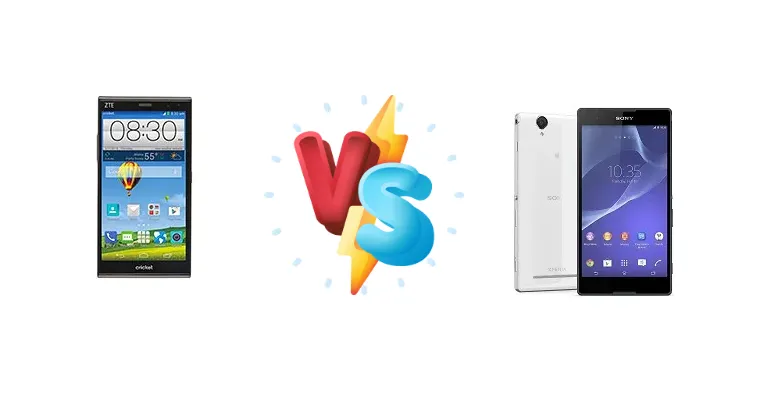
Released in a similar era of budget-focused Android devices, the ZTE Grand X Max+ and Sony Xperia T2 Ultra represent attempts to balance affordability with functionality. Both leverage Qualcomm's Snapdragon 400 platform, but diverge in their execution, particularly regarding battery life and subtle performance tweaks. This comparison dissects these differences to help you determine which device best suits your needs.
🏆 Quick Verdict
For the average user prioritizing longevity, the Sony Xperia T2 Ultra is the clear winner. Its 96-hour endurance rating, despite a similar chipset, suggests superior power management. However, the ZTE Grand X Max+ offers a marginally faster CPU clock speed, potentially benefiting light multitasking.
| Network |
|---|
| 2G bands | GSM 850 / 900 / 1800 / 1900 | GSM 850 / 900 / 1800 / 1900 - all versions |
| 3G bands | HSDPA 850 / 1900 - Z987 (Criket) | HSDPA 850 / 900 / 2100 - D5303 |
| 4G bands | 2, 4, 5, 17 - Z987 (Criket) | 1, 3, 5, 7, 8, 20 - D5303 |
| Speed | HSPA, LTE Cat4 150/50 Mbps | HSPA 42.2/5.76 Mbps, LTE Cat4 150/50 Mbps |
| Technology | GSM / HSPA / LTE | GSM / HSPA / LTE |
| | - | 2, 4, 7, 17 - D5306 |
| Launch |
|---|
| Announced | 2015, January. Released 2015, January | 2014, January. Released 2014, May |
| Status | Discontinued | Discontinued |
| Body |
|---|
| Dimensions | 162.1 x 83.1 x 7.9 mm (6.38 x 3.27 x 0.31 in) | 165.2 x 83.8 x 7.7 mm (6.50 x 3.30 x 0.30 in) |
| SIM | Micro-SIM | Micro-SIM |
| Weight | 171.8 g (6.07 oz) | 171.7 g (D5303)/ 172.4 g (D5306) (6.07 oz) |
| Display |
|---|
| Protection | Corning Gorilla Glass 3 | - |
| Resolution | 720 x 1280 pixels, 16:9 ratio (~245 ppi density) | 720 x 1280 pixels, 16:9 ratio (~245 ppi density) |
| Size | 6.0 inches, 99.2 cm2 (~73.7% screen-to-body ratio) | 6.0 inches, 99.2 cm2 (~71.7% screen-to-body ratio) |
| Type | IPS LCD | IPS LCD |
| | - | Triluminos display |
| Platform |
|---|
| CPU | Quad-core 1.2 GHz Cortex-A7 | Quad-core 1.4 GHz Cortex-A7 |
| Chipset | Qualcomm MSM8926 Snapdragon 400 (28 nm) | Qualcomm MSM8928 Snapdragon 400 (28 nm) |
| GPU | Adreno 305 | Adreno 305 |
| OS | Android 4.4.4 (KitKat) | Android 4.3 (Jelly Bean), upgradable to 5.1 (Lollipop) |
| Memory |
|---|
| Card slot | microSDHC (dedicated slot) | microSDHC (dedicated slot) |
| Internal | 16GB 2GB RAM | 8GB 1GB RAM |
| | - | eMMC 4.5 |
| Main Camera |
|---|
| Features | LED flash, HDR, panorama | LED flash, HDR |
| Single | 13 MP, AF | 13 MP, f/2.3, AF |
| Video | Yes | 1080p@30fps, HDR |
| Selfie camera |
|---|
| Single | 5 MP | 1.1 MP |
| Video | - | 720p@30fps |
| Sound |
|---|
| 3.5mm jack | - | Yes |
| 35mm jack | Yes | Yes |
| Loudspeaker | Yes | Yes |
| Comms |
|---|
| Bluetooth | 4.0, A2DP | 4.0, A2DP, aptX |
| Infrared port | Yes | - |
| NFC | No | Yes |
| Positioning | GPS | GPS, GLONASS |
| Radio | No | FM radio, RDS |
| USB | microUSB 2.0 | microUSB 2.0 (MHL TV-out), OTG |
| WLAN | Wi-Fi 802.11 b/g/n, hotspot | Wi-Fi 802.11 a/b/g/n, dual-band, Wi-Fi Direct, DLNA, hotspot |
| Features |
|---|
| Sensors | Accelerometer, proximity, compass | Accelerometer, gyro, proximity, compass |
| | - | ANT+ |
| Battery |
|---|
| Charging | 10W wired, QC1 | - |
| Music play | - | Up to 93 h |
| Stand-by | Up to 860 h | Up to 1071 h (2G) / Up to 1046 h (3G) |
| Talk time | Up to 6 h 30 min | Up to 14 h (2G) / Up to 24 h (3G) |
| Type | Li-Ion 3200 mAh, non-removable | Li-Ion 3000 mAh, non-removable |
| Misc |
|---|
| Colors | Black | Black, White, Purple |
| Models | Z987 | D5303, D5316 |
| Price | - | About 230 EUR |
| SAR | - | 1.22 W/kg (head) 1.10 W/kg (body) |
| SAR EU | - | 1.22 W/kg (head) 1.53 W/kg (body) |
| Tests |
|---|
| Audio quality | - |
Noise -90.5dB / Crosstalk -92.2dB |
| Battery life | - |
Endurance rating 96h
|
| Camera | - |
Photo / Video |
| Display | - |
Contrast ratio: 1287 (nominal), 1.740 (sunlight) |
| Loudspeaker | - |
Voice 74dB / Noise 66dB / Ring 75dB
|
ZTE Grand X Max+
- Slightly faster CPU clock speed (1.2 GHz vs 1.4 GHz)
- Supports Quick Charge 1.0 for faster charging (potentially)
- Potentially more responsive for basic tasks
- No published battery endurance rating
- Likely shorter battery life compared to the Xperia T2 Ultra
Sony Xperia T2 Ultra
- Exceptional 96-hour battery endurance rating
- Superior power management
- Ideal for users prioritizing long battery life
- Slightly slower CPU clock speed (1.4 GHz vs 1.2 GHz)
- Charging speed is unknown
Display Comparison
Both devices share a contrast ratio of 1287 (nominal) and 1.740 (sunlight), indicating similar outdoor visibility. However, detailed panel specifications like resolution and color gamut are missing. Given the market segment, both likely utilize IPS LCD panels. The shared contrast ratio suggests comparable viewing angles and black levels, but without further data, assessing color accuracy or peak brightness is impossible. The sunlight contrast ratio is a positive, suggesting decent usability in bright conditions.
Camera Comparison
Both phones list 'Photo / Video' capabilities, but lack specific details regarding sensor size, aperture, or image processing. Given the budget nature of these devices, image quality is likely to be average. The absence of details suggests neither phone boasts a standout camera system. It's reasonable to assume both feature a primary rear camera and a front-facing camera, but details beyond that are unavailable. The lack of OIS or advanced features is expected.
Performance
The Sony Xperia T2 Ultra features the Qualcomm MSM8928 Snapdragon 400 clocked at 1.4 GHz, while the ZTE Grand X Max+ uses the MSM8926 Snapdragon 400 at 1.2 GHz. This 200 MHz difference in CPU clock speed translates to a modest performance advantage for the ZTE device in CPU-bound tasks. Both utilize a quad-core Cortex-A7 architecture, meaning the performance gap won't be dramatic. Both devices likely feature 1GB of RAM, common for this era, limiting multitasking capabilities. Thermal management is unlikely to be a concern given the low TDP of the Snapdragon 400.
Battery Life
The Sony Xperia T2 Ultra’s standout feature is its impressive 96-hour endurance rating. This suggests highly efficient power management, potentially through software optimizations or a larger battery capacity (though the exact mAh is not specified). The ZTE Grand X Max+ lacks a published endurance rating, implying a shorter battery life. While the ZTE supports Quick Charge 1.0 (QC1) at 10W, the charging speed of the Xperia T2 Ultra is unknown. The Xperia’s endurance rating is a significant advantage for users prioritizing long-term use between charges.
Buying Guide
Buy the ZTE Grand X Max+ if you need a slightly more responsive experience for basic tasks like browsing and social media, and are comfortable with potentially shorter battery life. Buy the Sony Xperia T2 Ultra if you prioritize exceptional battery endurance above all else, and value a phone that can reliably last through multiple days on a single charge. This is the phone for travelers or those frequently away from power outlets.
Frequently Asked Questions
❓ Is the Snapdragon 400 in the Xperia T2 Ultra powerful enough for modern apps?
While the Snapdragon 400 is an older chipset, it's sufficient for basic Android tasks like calling, texting, browsing, and social media. However, demanding games or resource-intensive apps may experience lag or slowdowns. These phones were not designed for heavy multitasking.
❓ How does the battery life of the Xperia T2 Ultra hold up with typical usage?
The 96-hour endurance rating suggests the Xperia T2 Ultra can easily last two to three days with moderate use, including calls, browsing, and occasional media consumption. Heavy users may still achieve a full day of battery life, making it ideal for travel or situations where charging is infrequent.
❓ Does the ZTE Grand X Max+ support expandable storage?
While not explicitly stated in the provided data, phones in this price range often include microSD card slots for expandable storage. Checking online resources or user reviews would be necessary to confirm this feature for the Grand X Max+.