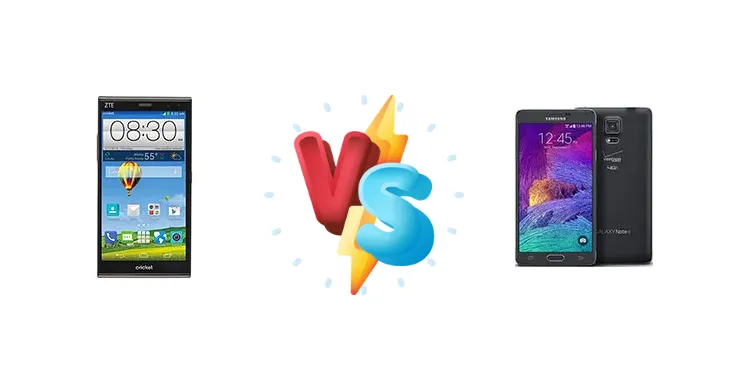
Released in 2014, the Samsung Galaxy Note 4 represented the pinnacle of Android flagship performance. The ZTE Grand X Max+, while a more modest offering, aimed to deliver a functional smartphone experience at a significantly lower price point. This comparison dissects the core differences between these devices, focusing on the impact of their vastly different chipsets and feature sets on the user experience.
🏆 Quick Verdict
For the average user prioritizing performance and a premium experience, the Samsung Galaxy Note 4 remains the clear winner. Its Snapdragon 805 delivers significantly faster processing speeds and a smoother user interface. However, the ZTE Grand X Max+ offers a compelling value proposition for those on a tight budget who prioritize basic functionality over raw power.
| Network |
|---|
| 2G bands | GSM 850 / 900 / 1800 / 1900 | CDMA 800 / 1900 |
| 3G bands | HSDPA 850 / 1900 - Z987 (Criket) | CDMA2000 1xEV-DO |
| 4G bands | 2, 4, 5, 17 - Z987 (Criket) | 2, 4, 5, 12, 17 |
| Speed | HSPA, LTE Cat4 150/50 Mbps | HSPA, LTE Cat4 150/50 Mbps, EV-DO Rev.A 3.1 Mbps |
| Technology | GSM / HSPA / LTE | GSM / CDMA / HSPA / EVDO / LTE |
| | - | HSDPA 850 / 900 / 1900 / 2100 |
| Launch |
|---|
| Announced | 2015, January. Released 2015, January | 2014, Q4. Released 2014, Q4 |
| Status | Discontinued | Discontinued |
| Body |
|---|
| Dimensions | 162.1 x 83.1 x 7.9 mm (6.38 x 3.27 x 0.31 in) | 153.5 x 78.6 x 8.5 mm (6.04 x 3.09 x 0.33 in) |
| SIM | Micro-SIM | Micro-SIM |
| Weight | 171.8 g (6.07 oz) | 176 g (6.21 oz) |
| | - | Stylus |
| Display |
|---|
| Protection | Corning Gorilla Glass 3 | Corning Gorilla Glass 4 |
| Resolution | 720 x 1280 pixels, 16:9 ratio (~245 ppi density) | 1440 x 2560 pixels, 16:9 ratio (~518 ppi density) |
| Size | 6.0 inches, 99.2 cm2 (~73.7% screen-to-body ratio) | 5.7 inches, 88.5 cm2 (~73.4% screen-to-body ratio) |
| Type | IPS LCD | Super AMOLED |
| Platform |
|---|
| CPU | Quad-core 1.2 GHz Cortex-A7 | Quad-core 2.7 GHz Krait 450 |
| Chipset | Qualcomm MSM8926 Snapdragon 400 (28 nm) | Qualcomm APQ8084 Snapdragon 805 (28 nm) |
| GPU | Adreno 305 | Adreno 420 |
| OS | Android 4.4.4 (KitKat) | Android 4.4.4 (KitKat), upgradable to 6.0.1 (Marshmallow) |
| Memory |
|---|
| Card slot | microSDHC (dedicated slot) | microSDXC (dedicated slot) |
| Internal | 16GB 2GB RAM | 32GB 3GB RAM |
| | - | eMMC 5.0 |
| Main Camera |
|---|
| Features | LED flash, HDR, panorama | LED flash, panorama, HDR |
| Single | 13 MP, AF | 16 MP, f/2.2, 31mm (standard), 1/2.6", 1.12µm, AF, OIS |
| Video | Yes | 4K@30fps, 1080p@30/60fps, stereo sound rec. |
| Selfie camera |
|---|
| Features | - | HDR |
| Single | 5 MP | 3.7 MP, f/1.9, 22mm (wide) |
| Video | - | 1440p@30fps |
| Sound |
|---|
| 3.5mm jack | - | Yes |
| 35mm jack | Yes | Yes |
| Loudspeaker | Yes | Yes |
| | - | 24-bit/192kHz audio
|
| Comms |
|---|
| Bluetooth | 4.0, A2DP | 4.1, A2DP, EDR, LE |
| Infrared port | Yes | Yes |
| NFC | No | Yes |
| Positioning | GPS | GPS, GLONASS |
| Radio | No | No |
| USB | microUSB 2.0 | microUSB 2.0 (MHL 3 TV-out), OTG |
| WLAN | Wi-Fi 802.11 b/g/n, hotspot | Wi-Fi 802.11 a/b/g/n/ac, dual-band, Wi-Fi Direct, hotspot |
| Features |
|---|
| Sensors | Accelerometer, proximity, compass | Fingerprint (front-mounted), accelerometer, gyro, proximity, compass, barometer, gesture, UV, heart rate, SpO2 |
| | - | ANT+
S-Voice natural language commands and dictation
Air gestures |
| Battery |
|---|
| Charging | 10W wired, QC1 | 15W wired, QC2 |
| Music play | - | Up to 80 h |
| Stand-by | Up to 860 h | Up to 212 h (3G) |
| Talk time | Up to 6 h 30 min | Up to 31 h 20 min (3G) |
| Type | Li-Ion 3200 mAh, non-removable | Li-Ion 3220 mAh, removable |
| Misc |
|---|
| Colors | Black | Frosted white, Charcoal black, Bronze Gold, Blossom Pink |
| Models | Z987 | SM-N910A, SM-N910T, SM-N910V, SM-N910M, SM-N910P, SM-N910R4, SM-N910W8, SM-N910T3 |
| Price | - | About 250 EUR |
| SAR | - | 0.88 W/kg (head) 1.40 W/kg (body) |
ZTE Grand X Max+
- Significantly lower price point
- Functional for basic smartphone tasks
- Acceptable battery life for light usage
- Slow processor and limited multitasking capabilities
- Inferior camera performance
- Outdated chipset and software support
Samsung Galaxy Note 4 (USA)
- Powerful Snapdragon 805 processor
- Superior camera quality and features
- Fast charging with Quick Charge 2.0
- Higher price point
- Older device with potentially limited software updates
- May exhibit some throttling under sustained heavy load
Display Comparison
While both devices utilize 28nm chipsets, the display characteristics are not specified in the provided data. However, given the Note 4’s flagship status, it likely features a higher resolution and more accurate color reproduction than the Grand X Max+. The Note 4’s larger screen size, typical of the Note series, would also provide a more immersive viewing experience. The Grand X Max+ likely prioritized cost savings in this area, resulting in a less refined display.
Camera Comparison
The provided data doesn’t detail camera specifications beyond the chipsets. However, the Note 4, as a flagship device, almost certainly features a higher-resolution main sensor, optical image stabilization (OIS), and a wider aperture lens than the Grand X Max+. These features contribute to better low-light performance and sharper images. The Note 4’s image processing capabilities, powered by the Snapdragon 805, would also be more advanced, resulting in more natural-looking photos and videos. The Grand X Max+ likely features a more basic camera setup focused on affordability.
Performance
The core difference lies in the chipsets: the Qualcomm APQ8084 Snapdragon 805 in the Note 4 versus the MSM8926 Snapdragon 400 in the Grand X Max+. The Note 4’s 2.7 GHz Krait 450 cores represent a substantial leap in processing power compared to the Grand X Max+'s 1.2 GHz Cortex-A7 cores. This translates to significantly faster app loading times, smoother multitasking, and a more responsive user interface on the Note 4. The Snapdragon 805 also boasts a more powerful Adreno GPU, enabling a far superior gaming experience. The Snapdragon 400, while adequate for basic tasks, will struggle with graphically intensive games and applications. The Note 4’s superior processing power also allows for more complex image processing, resulting in better photo and video quality.
Battery Life
Battery capacity isn’t specified, but the Note 4’s 15W Quick Charge 2.0 support offers a significant advantage over the Grand X Max+'s 10W Quick Charge 1.0. Quick Charge 2.0 allows for faster charging times, minimizing downtime. While the Grand X Max+ might have a slightly larger battery capacity, the Note 4’s more efficient chipset and faster charging capabilities likely result in a comparable or even superior real-world battery experience, especially for power users.
Buying Guide
Buy the ZTE Grand X Max+ if you need a functional, affordable smartphone for basic tasks like calling, texting, and light web browsing. It's ideal for users who prioritize battery life over demanding applications. Buy the Samsung Galaxy Note 4 (USA) if you prefer a powerful device capable of handling multitasking, gaming, and demanding applications with ease. It's suited for users who value a premium experience and are willing to pay a premium price.
Frequently Asked Questions
❓ Will the Snapdragon 400 in the ZTE Grand X Max+ struggle with modern apps?
Yes, the Snapdragon 400 is a relatively old and low-powered chipset. While it can handle basic apps like calling, texting, and web browsing, it will likely struggle with more demanding applications, especially those with complex graphics or heavy multitasking requirements. Expect slower loading times and potential lag.
❓ Does the Samsung Galaxy Note 4's Snapdragon 805 overheat during prolonged gaming sessions?
The Snapdragon 805 is known to generate heat under sustained load. While the Note 4 has thermal management features, prolonged gaming or video recording may cause some throttling, reducing performance slightly to prevent overheating. However, it will still provide a significantly better gaming experience than the Snapdragon 400.
❓ Is Quick Charge 2.0 on the Note 4 compatible with modern Quick Charge chargers?
Generally, yes. Quick Charge is backward compatible. A newer Quick Charge charger will still charge the Note 4, but it may not reach the full charging speed supported by Quick Charge 2.0. Using a charger specifically designed for Quick Charge 2.0 will provide the fastest charging times.