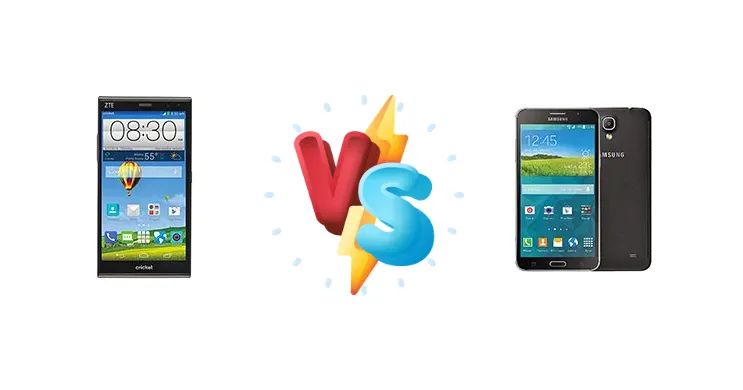
The ZTE Grand X Max+ and Samsung Galaxy Mega 2 represent a bygone era of truly large-screen, affordable smartphones. Released in similar timeframes, both aimed to deliver a big-screen experience without breaking the bank. This comparison dissects their core components to determine which offers the best value for users prioritizing screen size and basic functionality.
🏆 Quick Verdict
For the average user seeking a large-screen device for media consumption and light tasks, the Samsung Galaxy Mega 2 edges out the ZTE Grand X Max+. While both utilize Qualcomm Snapdragon 400-series chipsets, the Mega 2’s potential for a faster Exynos 4415 variant (depending on the model) provides a slight performance advantage, making it the more versatile option.
| Network |
|---|
| 2G bands | GSM 850 / 900 / 1800 / 1900 | GSM 850 / 900 / 1800 / 1900 |
| 3G bands | HSDPA 850 / 1900 - Z987 (Criket) | HSDPA 850 / 900 / 1900 / 2100 |
| 4G bands | 2, 4, 5, 17 - Z987 (Criket) | 1, 3, 5, 7, 8, 20 - SM-G750F |
| Speed | HSPA, LTE Cat4 150/50 Mbps | HSPA 42.2/11.5 Mbps, LTE Cat4 150/50 Mbps |
| Technology | GSM / HSPA / LTE | GSM / HSPA / LTE |
| | - | 1, 2, 3, 4, 5, 7, 17, 29 - SM-G750A |
| Launch |
|---|
| Announced | 2015, January. Released 2015, January | 2014, September. Released 2014, September |
| Status | Discontinued | Discontinued |
| Body |
|---|
| Dimensions | 162.1 x 83.1 x 7.9 mm (6.38 x 3.27 x 0.31 in) | 163.6 x 84.9 x 8.6 mm (6.44 x 3.34 x 0.34 in) |
| SIM | Micro-SIM | Micro-SIM |
| Weight | 171.8 g (6.07 oz) | 194 g (6.84 oz) |
| Display |
|---|
| Protection | Corning Gorilla Glass 3 | - |
| Resolution | 720 x 1280 pixels, 16:9 ratio (~245 ppi density) | 720 x 1280 pixels, 16:9 ratio (~245 ppi density) |
| Size | 6.0 inches, 99.2 cm2 (~73.7% screen-to-body ratio) | 6.0 inches, 99.2 cm2 (~71.5% screen-to-body ratio) |
| Type | IPS LCD | IPS LCD |
| Platform |
|---|
| CPU | Quad-core 1.2 GHz Cortex-A7 | Quad-core 1.5 GHz (SM-G750F)Quad-core 1.2 GHz Cortex-A53 (SM-G7508) |
| Chipset | Qualcomm MSM8926 Snapdragon 400 (28 nm) | Exynos 4415 (SM-G750F)Qualcomm MSM8916 Snapdragon 410 (28 nm) (SM-G7508) |
| GPU | Adreno 305 | Mali-400MP4 (SM-G750F)Adreno 306 (SM-G7508) |
| OS | Android 4.4.4 (KitKat) | Android 4.4.3 (KitKat) |
| Memory |
|---|
| Card slot | microSDHC (dedicated slot) | microSDXC (dedicated slot) |
| Internal | 16GB 2GB RAM | 16GB 1.5GB RAM |
| | - | eMMC 4.5 |
| Main Camera |
|---|
| Features | LED flash, HDR, panorama | LED flash, panorama, HDR |
| Single | 13 MP, AF | 8 MP, AF |
| Video | Yes | 1080p@30fps |
| Selfie camera |
|---|
| Single | 5 MP | 2.1 MP |
| Sound |
|---|
| 3.5mm jack | - | Yes |
| 35mm jack | Yes | Yes |
| Loudspeaker | Yes | Yes |
| Comms |
|---|
| Bluetooth | 4.0, A2DP | 4.0, A2DP, LE |
| Infrared port | Yes | - |
| NFC | No | Yes |
| Positioning | GPS | GPS, GLONASS |
| Radio | No | FM radio |
| USB | microUSB 2.0 | microUSB 2.0 |
| WLAN | Wi-Fi 802.11 b/g/n, hotspot | Wi-Fi 802.11 a/b/g/n, dual-band, Wi-Fi Direct, hotspot |
| Features |
|---|
| Sensors | Accelerometer, proximity, compass | Accelerometer, gyro, proximity, compass |
| Battery |
|---|
| Charging | 10W wired, QC1 | - |
| Stand-by | Up to 860 h | - |
| Talk time | Up to 6 h 30 min | - |
| Type | Li-Ion 3200 mAh, non-removable | Li-Ion 2800 mAh, removable |
| Misc |
|---|
| Colors | Black | White, Black |
| Models | Z987 | SM-G750F, SM-G7508, SM-G7508Q, SM-G750H, SM-G750A |
| Price | - | About 340 EUR |
| SAR EU | - | 0.21 W/kg (head) 0.37 W/kg (body) |
ZTE Grand X Max+
- Quick Charge 1.0 support for faster charging
- Reliable Qualcomm Snapdragon 400 chipset
- Simple and straightforward user experience
- Lower CPU clock speed compared to some Mega 2 variants
- Potentially less software support than Samsung
Samsung Galaxy Mega 2
- Potential for faster Exynos 4415 processor (SM-G750F)
- Larger 6.0-inch display for immersive viewing
- Samsung brand recognition and ecosystem
- Performance varies significantly based on chipset (Snapdragon 410 vs Exynos 4415)
- Standard charging speeds
Display Comparison
Neither device boasts a particularly impressive display. Both target the budget segment, so expect 720p resolution on large screens. While specific panel technology details are unavailable, the larger 6.0-inch screen of the Mega 2 offers a more immersive viewing experience. Bezels are likely substantial on both, typical for phones of this era. Color accuracy and brightness are expected to be average, prioritizing visibility over fidelity.
Camera Comparison
Camera performance on both devices will be basic. Details on sensor size and aperture are scarce, but both likely feature 8MP main cameras. Image quality will be acceptable in good lighting conditions, but struggle in low light. The presence of a 2MP macro camera on the Mega 2 is largely a marketing gimmick, offering minimal practical benefit. Image processing will be limited, resulting in soft details and muted colors. Expect similar front-facing camera performance.
Performance
The performance gap hinges on the Samsung Galaxy Mega 2’s chipset variation. The SM-G750F model features the Exynos 4415, a quad-core processor clocked at 1.5 GHz, built on a 28nm process. This offers a theoretical performance advantage over the ZTE Grand X Max+'s Qualcomm MSM8926 Snapdragon 400 (also 28nm) with its 1.2 GHz Cortex-A7 cores. However, the SM-G7508 variant of the Mega 2 uses the Snapdragon 410, a Cortex-A53 based chip clocked at 1.2 GHz, bringing it closer in performance to the ZTE. The Snapdragon 400 in the Grand X Max+ benefits from Qualcomm’s optimizations, potentially offering smoother performance in some applications despite the lower clock speed. Both phones likely feature 1GB or 2GB of RAM, limiting multitasking capabilities.
Battery Life
Battery life is a key consideration for phablet users. The ZTE Grand X Max+ benefits from 10W wired charging with Quick Charge 1.0 support, offering faster charging speeds compared to the standard charging on the Mega 2. While the Mega 2’s battery capacity is not specified, it’s likely comparable to the Grand X Max+. Real-world battery life will depend heavily on usage patterns, but both phones should provide a full day of moderate use. The Snapdragon 400’s power efficiency might give the Grand X Max+ a slight edge in longevity.
Buying Guide
Buy the ZTE Grand X Max+ if you need a simple, reliable device primarily for calls, texts, and basic app usage, and prioritize Qualcomm’s Quick Charge 1.0 support. Buy the Samsung Galaxy Mega 2 if you prefer a potentially more responsive user experience thanks to the Exynos 4415 option, and value the Samsung brand recognition and potentially wider software support, understanding that performance can vary based on the specific Snapdragon 410 or Exynos 4415 variant.
Frequently Asked Questions
❓ Does the Exynos 4415 chip in the Samsung Galaxy Mega 2 overheat during prolonged use?
The Exynos 4415 is a relatively power-efficient chip, and overheating is unlikely during typical usage scenarios like web browsing or video playback. However, demanding tasks like gaming may cause some heat buildup, but it shouldn't reach critical levels. The Snapdragon 410 variant will likely run cooler overall.
❓ Is the 2MP macro camera on the Samsung Galaxy Mega 2 actually useful for close-up shots?
Unfortunately, the 2MP macro camera on the Mega 2 is largely a marketing feature. The low resolution and lack of dedicated optics result in images with limited detail and sharpness. It's unlikely to provide significantly better close-up shots compared to using the main camera in standard mode.
❓ Can either of these phones handle modern mobile games like PUBG or Call of Duty?
While both phones can technically *run* these games, the experience will be far from optimal. The Snapdragon 400 and Exynos 4415 chipsets lack the processing power and graphics capabilities to deliver smooth frame rates at high settings. Expect significant lag and stuttering, and you'll likely need to play at the lowest possible settings.
❓ Which phone is more likely to receive software updates?
Samsung generally provides longer software support for its devices compared to ZTE. While neither phone is likely to receive major Android version updates at this point, the Mega 2 may receive security patches for a longer period.