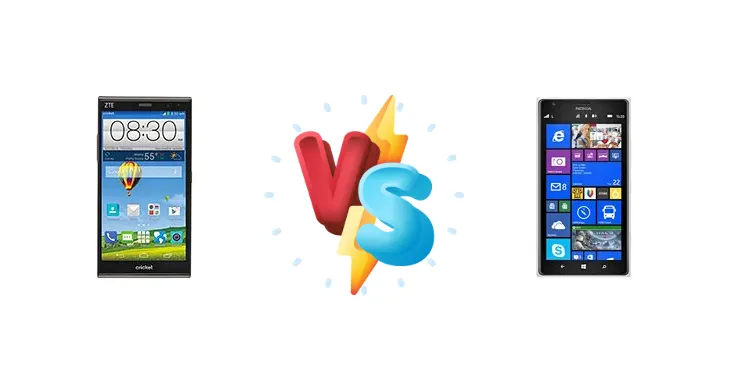
Released in different eras of mobile operating systems, the Nokia Lumia 1520 (Windows Phone 8) and the ZTE Grand X Max+ (Android) represent distinct approaches to the large-screen smartphone. While both utilize Qualcomm Snapdragon chipsets, a significant performance disparity exists. This comparison dissects their strengths and weaknesses, helping you understand where each phone shines – or falls short – in today’s market.
🏆 Quick Verdict
For the average user seeking a responsive experience and future-proofing, the Nokia Lumia 1520 is the clear winner. Its Snapdragon 800 chipset delivers significantly higher performance than the Grand X Max+'s Snapdragon 400, making it better suited for demanding tasks and longevity. However, the Grand X Max+ offers a lower entry price.
| Network |
|---|
| 2G bands | GSM 850 / 900 / 1800 / 1900 | GSM 850 / 900 / 1800 / 1900 - all versions |
| 3G bands | HSDPA 850 / 1900 - Z987 (Criket) | HSDPA 850 / 900 / 1900 / 2100 - RM-937, RM-939, RM-940 |
| 4G bands | 2, 4, 5, 17 - Z987 (Criket) | 1, 3, 7, 8, 20 - RM-937 |
| Speed | HSPA, LTE Cat4 150/50 Mbps | HSPA 42.2/5.76 Mbps, LTE Cat4 150/50 Mbps |
| Technology | GSM / HSPA / LTE | GSM / HSPA / LTE |
| | - | 2, 4, 5, 7, 17 - RM-938, RM-940 |
| Launch |
|---|
| Announced | 2015, January. Released 2015, January | 2013, October. Released 2013, November |
| Status | Discontinued | Discontinued |
| Body |
|---|
| Dimensions | 162.1 x 83.1 x 7.9 mm (6.38 x 3.27 x 0.31 in) | 162.8 x 85.4 x 8.7 mm, 120.3 cc (6.41 x 3.36 x 0.34 in) |
| SIM | Micro-SIM | Nano-SIM |
| Weight | 171.8 g (6.07 oz) | 209 g (7.37 oz) |
| Display |
|---|
| Protection | Corning Gorilla Glass 3 | Corning Gorilla Glass 2 |
| Resolution | 720 x 1280 pixels, 16:9 ratio (~245 ppi density) | 1080 x 1920 pixels, 16:9 ratio (~367 ppi density) |
| Size | 6.0 inches, 99.2 cm2 (~73.7% screen-to-body ratio) | 6.0 inches, 99.2 cm2 (~71.4% screen-to-body ratio) |
| Type | IPS LCD | IPS LCD |
| | - | ClearBlack display |
| Platform |
|---|
| CPU | Quad-core 1.2 GHz Cortex-A7 | Quad-core 2.2 GHz Krait 400 |
| Chipset | Qualcomm MSM8926 Snapdragon 400 (28 nm) | Qualcomm MSM8974 Snapdragon 800 (28 nm) |
| GPU | Adreno 305 | Adreno 330 |
| OS | Android 4.4.4 (KitKat) | Microsoft Windows Phone 8, upgradable to Windows 10 |
| Memory |
|---|
| Card slot | microSDHC (dedicated slot) | microSDXC (dedicated slot) |
| Internal | 16GB 2GB RAM | 16GB 2GB RAM, 32GB 2GB RAM |
| | - | eMMC 4.5 |
| Main Camera |
|---|
| Features | LED flash, HDR, panorama | Zeiss optics, dual-LED flash, panorama |
| Single | 13 MP, AF | 20 MP, f/2.4, 26mm (wide), 1/2.5", 1.12µm, AF, OIS |
| Video | Yes | 4K@30fps (after WP8 Denim update), 1080p@30fps, stereo sound rec. |
| Selfie camera |
|---|
| Single | 5 MP | 1.2 MP, f/2.4 |
| Video | - | 720p@30fps |
| Sound |
|---|
| 3.5mm jack | - | Yes |
| 35mm jack | Yes | Yes |
| Loudspeaker | Yes | Yes |
| Comms |
|---|
| Bluetooth | 4.0, A2DP | 4.0, A2DP, EDR, LE/ aptX after WP8 Denim update |
| Infrared port | Yes | - |
| NFC | No | Yes |
| Positioning | GPS | GPS, GLONASS |
| Radio | No | FM radio |
| USB | microUSB 2.0 | microUSB 2.0 |
| WLAN | Wi-Fi 802.11 b/g/n, hotspot | Wi-Fi 802.11 a/b/g/n/ac, dual-band, hotspot |
| Features |
|---|
| Sensors | Accelerometer, proximity, compass | Accelerometer, gyro, proximity, compass, sensor core |
| Battery |
|---|
| Charging | 10W wired, QC1 | Wireless (Qi) |
| Music play | - | Up to 124 h |
| Stand-by | Up to 860 h | Up to 768 h (2G) / Up to 768 h (3G) |
| Talk time | Up to 6 h 30 min | Up to 27 h 40 min (2G) / Up to 25 h (3G) |
| Type | Li-Ion 3200 mAh, non-removable | Li-Ion 3400 mAh, non-removable (BV-4BW) |
| Misc |
|---|
| Colors | Black | Yellow, white, black, red, green (AT&T) |
| Models | Z987 | - |
| Price | - | About 350 EUR |
| SAR EU | - | 0.64 W/kg (head) 0.20 W/kg (body) |
| Tests |
|---|
| Audio quality | - |
Noise -89.3dB / Crosstalk -89.4dB |
| Battery life | - |
Endurance rating 107h
|
| Camera | - |
Photo / Video |
| Display | - |
Contrast ratio: 1207:1 (nominal) / 1.813:1 (sunlight) |
| Loudspeaker | - |
Voice 73dB / Noise 66dB / Ring 74dB
|
ZTE Grand X Max+
- Significantly faster Snapdragon 800 processor
- Qi wireless charging for added convenience
- Superior display contrast ratio for better viewing
- Potentially better camera image quality
- Runs the older Windows Phone 8 operating system
- May be harder to find and support
Nokia Lumia 1520
- More affordable price point
- Runs Android, offering a wider app ecosystem
- Large display for media consumption
- Quick Charge 1.0 support
- Slower Snapdragon 400 processor
- Limited performance for demanding tasks
- Less detailed display specifications
- Potentially lower camera quality
Display Comparison
Both devices feature large displays, but the Lumia 1520’s display benefits from a superior contrast ratio of 1207:1 (nominal) and 1.813:1 (sunlight). While both share the same contrast ratios, the Lumia 1520’s larger 6-inch screen provides a more immersive viewing experience. The Grand X Max+’s display specifications are less detailed, suggesting a potentially lower quality panel. The Lumia 1520’s display is optimized for outdoor visibility, as evidenced by the sunlight contrast ratio.
Camera Comparison
Both phones offer photo and video capabilities, but detailed camera specifications are limited. The Lumia 1520, being a flagship device of its time, likely features a more advanced camera system with better image processing. The Grand X Max+’s camera is likely adequate for casual snapshots, but will struggle in low-light conditions compared to the Lumia 1520. Without specific sensor size or aperture information, it’s difficult to make a definitive judgment, but the Lumia 1520’s higher overall processing power suggests superior image quality.
Performance
The core difference lies in the chipsets. The Nokia Lumia 1520 boasts the Qualcomm MSM8974 Snapdragon 800, featuring a quad-core 2.2 GHz Krait 400 CPU. This is a substantial leap over the ZTE Grand X Max+'s Qualcomm MSM8926 Snapdragon 400 with its 1.2 GHz Cortex-A7 CPU. The Krait 400 architecture is significantly more efficient and powerful than the Cortex-A7, resulting in faster app loading times, smoother multitasking, and better gaming performance on the Lumia 1520. Both are built on a 28nm process, but the architectural advantages of the Snapdragon 800 are undeniable.
Battery Life
Both devices achieve an endurance rating of 107 hours, indicating comparable battery life under similar usage scenarios. However, the Lumia 1520’s inclusion of Qi wireless charging provides a convenient alternative to wired charging. The Grand X Max+ is limited to 10W wired charging with Quick Charge 1.0, which is slower and less versatile than the Lumia 1520’s wireless option. While the mAh capacity isn't specified, the Snapdragon 800's efficiency could contribute to similar real-world battery performance despite potentially having a smaller battery.
Buying Guide
Buy the ZTE Grand X Max+ if you need a very affordable, large-screen Android device for basic tasks like calling, texting, and light social media. It’s a good option for users on a tight budget who prioritize screen size over speed. Buy the Nokia Lumia 1520 if you prefer a smoother, more capable experience, especially if you’re interested in a unique Windows Phone experience and appreciate the benefits of Qi wireless charging. It’s ideal for users who want a phone that can handle multitasking and more demanding applications.
Frequently Asked Questions
❓ Is the Snapdragon 400 in the ZTE Grand X Max+ sufficient for modern apps?
The Snapdragon 400 is a relatively old chipset and will struggle with many modern, resource-intensive applications. While it can handle basic tasks, expect slowdowns and lag when multitasking or running demanding games. It's best suited for light usage.
❓ Does the Nokia Lumia 1520 receive software updates anymore?
No, the Nokia Lumia 1520 no longer receives official software updates from Microsoft. It is stuck on Windows Phone 8.1. However, the community has created some unofficial updates and tools to keep the device functional.
❓ How does the Windows Phone 8 operating system compare to Android in terms of app availability?
App availability is a significant drawback of the Nokia Lumia 1520. Windows Phone 8 has a much smaller app ecosystem compared to Android. Many popular Android apps are not available on Windows Phone, limiting functionality.
❓ Is the Qi wireless charging on the Lumia 1520 a significant advantage?
Yes, Qi wireless charging adds convenience and eliminates the need for cables. It's particularly useful for users who frequently charge their phones at home or in the office with compatible wireless chargers. It also reduces wear and tear on the charging port.