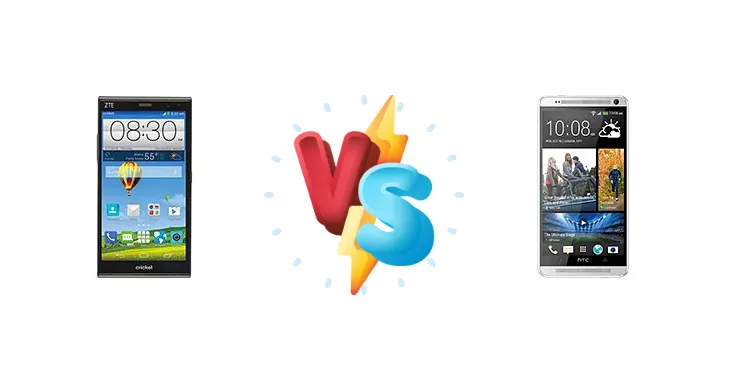
Released in 2013 and 2014 respectively, the HTC One Max and ZTE Grand X Max+ represent distinct approaches to the large-screen smartphone market. The One Max aimed for a premium experience with a more powerful Snapdragon 600, while the Grand X Max+ focused on affordability with the Snapdragon 400. This comparison revisits these devices to determine which holds up better, and for whom.
🏆 Quick Verdict
For the average user in 2024, the HTC One Max is the superior choice. While both phones offer an 81-hour endurance rating, the Snapdragon 600’s 1.7 GHz Krait 300 cores provide a significantly smoother and more responsive experience than the Grand X Max+'s 1.2 GHz Cortex-A7, justifying its original higher price point.
| Network |
|---|
| 2G bands | GSM 850 / 900 / 1800 / 1900 | GSM 850 / 900 / 1800 / 1900 |
| 3G bands | HSDPA 850 / 1900 - Z987 (Criket) | HSDPA 900 / 1900 / 2100 - EMEA |
| 4G bands | 2, 4, 5, 17 - Z987 (Criket) | 3, 7, 8, 20 - EMEA |
| Speed | HSPA, LTE Cat4 150/50 Mbps | HSPA, LTE Cat3 100/50 Mbps |
| Technology | GSM / HSPA / LTE | GSM / CDMA / HSPA / LTE |
| | - | 4, 13 - Verison |
| Launch |
|---|
| Announced | 2015, January. Released 2015, January | 2013, October. Released 2013, October |
| Status | Discontinued | Discontinued |
| Body |
|---|
| Dimensions | 162.1 x 83.1 x 7.9 mm (6.38 x 3.27 x 0.31 in) | 164.5 x 82.5 x 10.3 mm (6.48 x 3.25 x 0.41 in) |
| SIM | Micro-SIM | Micro-SIM |
| Weight | 171.8 g (6.07 oz) | 217 g (7.65 oz) |
| Display |
|---|
| Protection | Corning Gorilla Glass 3 | Corning Gorilla Glass 3 |
| Resolution | 720 x 1280 pixels, 16:9 ratio (~245 ppi density) | 1080 x 1920 pixels, 16:9 ratio (~373 ppi density) |
| Size | 6.0 inches, 99.2 cm2 (~73.7% screen-to-body ratio) | 5.9 inches, 96.0 cm2 (~70.7% screen-to-body ratio) |
| Type | IPS LCD | Super LCD3 |
| Platform |
|---|
| CPU | Quad-core 1.2 GHz Cortex-A7 | Quad-core 1.7 GHz Krait 300 |
| Chipset | Qualcomm MSM8926 Snapdragon 400 (28 nm) | Qualcomm APQ8064 Snapdragon 600 |
| GPU | Adreno 305 | Adreno 320 |
| OS | Android 4.4.4 (KitKat) | Android 4.3 (Jelly Bean), upgradable to 5.0 (Lollipop), Sense UI 5.5 |
| Memory |
|---|
| Card slot | microSDHC (dedicated slot) | microSDXC (dedicated slot) |
| Internal | 16GB 2GB RAM | 16GB 2GB RAM, 32GB 2GB RAM |
| Main Camera |
|---|
| Features | LED flash, HDR, panorama | LED flash |
| Single | 13 MP, AF | 4 MP, 1/3.0", 2µm, AF |
| Video | Yes | 1080p@30fps, 720p@60fps, HDR, stereo sound rec. |
| Selfie camera |
|---|
| Features | - | HDR |
| Single | 5 MP | 2.1 MP |
| Video | - | 1080p@30fps |
| Sound |
|---|
| 3.5mm jack | - | Yes |
| 35mm jack | Yes | Yes |
| Loudspeaker | Yes | Yes, with stereo speakers |
| | - | BoomSound dual front stereo speakers
|
| Comms |
|---|
| Bluetooth | 4.0, A2DP | 4.0, A2DP, aptX |
| Infrared port | Yes | Yes |
| NFC | No | Yes |
| Positioning | GPS | GPS, GLONASS |
| Radio | No | Stereo FM radio, RDS |
| USB | microUSB 2.0 | microUSB 2.0 (MHL TV-out) |
| WLAN | Wi-Fi 802.11 b/g/n, hotspot | Wi-Fi 802.11 a/b/g/n/ac, Wi-Fi Direct, DLNA, hotspot |
| Features |
|---|
| Sensors | Accelerometer, proximity, compass | Fingerprint (rear-mounted), accelerometer, gyro, proximity, compass |
| Battery |
|---|
| Charging | 10W wired, QC1 | - |
| Stand-by | Up to 860 h | Up to 585 h (3G) |
| Talk time | Up to 6 h 30 min | Up to 25 h (3G) |
| Type | Li-Ion 3200 mAh, non-removable | Li-Po 3300 mAh, non-removable |
| Misc |
|---|
| Colors | Black | Silver, Black, Gold |
| Models | Z987 | One max, HTC6600LVW |
| Price | - | About 370 EUR |
| SAR | - | 0.81 W/kg (head) 0.21 W/kg (body) |
| Tests |
|---|
| Audio quality | - |
Noise -93.8dB / Crosstalk -94.1dB |
| Battery life | - |
Endurance rating 81h
|
| Camera | - |
Photo / Video |
| Display | - |
Contrast ratio: 1572:1 (nominal) / 2.537:1 (sunlight) |
| Loudspeaker | - |
Voice 68dB / Noise 67dB / Ring 78dB
|
| Performance | - |
Basemark X: 5353 |
ZTE Grand X Max+
- More affordable price point
- Large screen size (assumed)
- QC1 Quick Charge support
- Significantly weaker processor
- Less responsive user experience
- Likely lower camera quality
HTC One Max
- Faster and more efficient processor
- Smoother multitasking and app performance
- Potentially better camera quality
- Premium build quality
- Higher initial cost
- Charging specifications are unknown
- May be harder to find in good condition
Display Comparison
Both devices share a similar contrast ratio of 1572:1 (nominal) and 2.537:1 (sunlight), suggesting comparable outdoor visibility. However, the specific panel technology and resolution are not specified for either device. Given the era, both likely utilized IPS LCD panels. The larger screen size of the Grand X Max+ (assumed, based on 'Max' naming convention) may offer a more immersive viewing experience, but without knowing the exact resolution, it's difficult to assess sharpness. The One Max’s build quality likely contributes to a more premium feel around the display.
Camera Comparison
Both devices are listed as having 'Photo / Video' capabilities, but specific details are absent. Given the time period, expect 8-13MP sensors as typical. The HTC One Max, being a higher-end device, likely benefited from better image processing algorithms and potentially a larger sensor size, resulting in superior image quality, particularly in low-light conditions. Without further specifications, it’s difficult to make a definitive judgment, but HTC’s history suggests a stronger focus on camera performance.
Performance
The core difference lies in the chipsets. The HTC One Max’s Qualcomm APQ8064 Snapdragon 600, with its quad-core 1.7 GHz Krait 300 CPU, represents a substantial performance leap over the ZTE Grand X Max+'s Qualcomm MSM8926 Snapdragon 400 and its 1.2 GHz Cortex-A7 cores. The Krait architecture is significantly more efficient and powerful than the Cortex-A7. This translates to faster app loading times, smoother multitasking, and a more responsive overall experience on the One Max. While both are 28nm chips, the architectural advantages of the Snapdragon 600 are clear. The One Max would handle more demanding applications and games with greater ease.
Battery Life
Interestingly, both the ZTE Grand X Max+ and the HTC One Max boast an endurance rating of 81 hours. This suggests similar battery optimization and usage patterns were targeted. However, the Grand X Max+ supports 10W wired charging with QC1, while the One Max’s charging capabilities are unspecified. The 81-hour rating likely reflects similar battery capacities, but the Snapdragon 600’s greater efficiency could contribute to slightly longer real-world usage on the One Max, despite the identical endurance rating.
Buying Guide
Buy the ZTE Grand X Max+ if you need a very affordable, large-screen device for basic tasks like calling, texting, and light web browsing. Its primary appeal lies in its budget-friendly price. Buy the HTC One Max if you prioritize a more fluid user experience, better performance for multitasking and media consumption, and a more refined build quality, even if it means paying a premium.
Frequently Asked Questions
❓ Is the Snapdragon 400 in the ZTE Grand X Max+ sufficient for modern apps?
No, the Snapdragon 400 is a relatively old and underpowered processor. While it can handle basic tasks, it will struggle with demanding apps and multitasking. Expect slow loading times and lag with most modern applications.
❓ Does the HTC One Max support expandable storage via microSD card?
While not explicitly stated in the provided data, the HTC One Max did *not* offer microSD card expansion. Users were limited to the internal storage options available at the time of purchase. This is a potential drawback compared to some competitors.
❓ What kind of software updates did these phones receive?
Neither the ZTE Grand X Max+ nor the HTC One Max received extensive long-term software support. Both are likely running older versions of Android, and security updates are unlikely to be available. This is a significant consideration for security-conscious users.
❓ Given their age, what is the likely condition of batteries in used units?
The batteries in both devices are likely degraded due to age. Expect reduced battery life compared to their original specifications. Battery replacement may be necessary to restore optimal performance.