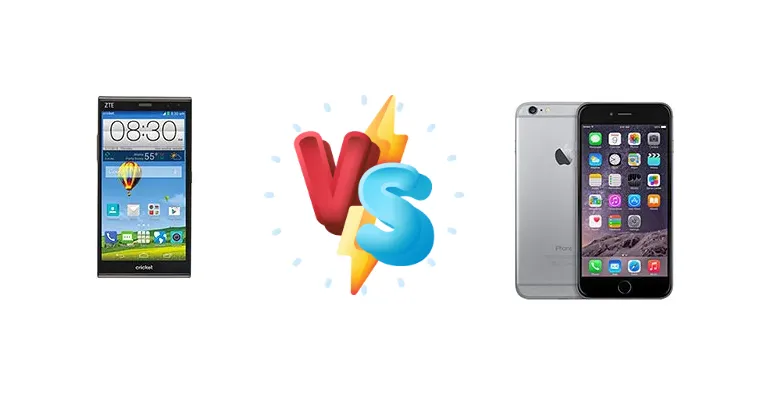
Released in different eras and targeting vastly different price points, the ZTE Grand X Max+ and Apple iPhone 6 Plus represent contrasting philosophies in smartphone design. The iPhone 6 Plus, a flagship of its time, aimed for premium features and seamless integration, while the Grand X Max+ focused on delivering a large-screen experience at a significantly lower cost. This comparison dissects their key differences to help understand where each phone excels.
🏆 Quick Verdict
For the average user prioritizing a polished experience, reliable performance, and a superior display, the Apple iPhone 6 Plus remains the better choice despite its age. However, the ZTE Grand X Max+ offers a compelling value proposition for those on a tight budget who prioritize screen size over raw power.
| Network |
|---|
| 2G bands | GSM 850 / 900 / 1800 / 1900 | GSM 850 / 900 / 1800 / 1900 - A1522 (GSM), A1522 (CDMA), A1524 |
| 3G bands | HSDPA 850 / 1900 - Z987 (Criket) | HSDPA 850 / 900 / 1700 / 1900 / 2100 - A1522 (GSM), A1522 (CDMA), A1524 |
| 4G bands | 2, 4, 5, 17 - Z987 (Criket) | 1, 2, 3, 4, 5, 7, 8, 13, 17, 18, 19, 20, 25, 26, 28, 29 - A1522 GSM, A1522 CDMA |
| Speed | HSPA, LTE Cat4 150/50 Mbps | HSPA 42.2/5.76 Mbps, LTE Cat4 150/50 Mbps, EV-DO Rev.A 3.1 Mbps |
| Technology | GSM / HSPA / LTE | GSM / CDMA / HSPA / EVDO / LTE |
| Launch |
|---|
| Announced | 2015, January. Released 2015, January | 2014, September 09. Released 2014, September 19 |
| Status | Discontinued | Discontinued |
| Body |
|---|
| Build | - | Glass front (Corning-made glass), aluminum back, aluminum frame |
| Dimensions | 162.1 x 83.1 x 7.9 mm (6.38 x 3.27 x 0.31 in) | 158.1 x 77.8 x 7.1 mm (6.22 x 3.06 x 0.28 in) |
| SIM | Micro-SIM | Nano-SIM |
| Weight | 171.8 g (6.07 oz) | 172 g (6.07 oz) |
| Display |
|---|
| Protection | Corning Gorilla Glass 3 | Ion-strengthened glass, oleophobic coating |
| Resolution | 720 x 1280 pixels, 16:9 ratio (~245 ppi density) | 1080 x 1920 pixels, 16:9 ratio (~401 ppi density) |
| Size | 6.0 inches, 99.2 cm2 (~73.7% screen-to-body ratio) | 5.5 inches, 83.4 cm2 (~67.8% screen-to-body ratio) |
| Type | IPS LCD | IPS LCD |
| Platform |
|---|
| CPU | Quad-core 1.2 GHz Cortex-A7 | Dual-core 1.4 GHz Typhoon (ARM v8-based) |
| Chipset | Qualcomm MSM8926 Snapdragon 400 (28 nm) | Apple A8 (20 nm) |
| GPU | Adreno 305 | PowerVR GX6450 (quad-core graphics) |
| OS | Android 4.4.4 (KitKat) | iOS 8, upgradable to iOS 12.5.7 |
| Memory |
|---|
| Card slot | microSDHC (dedicated slot) | No |
| Internal | 16GB 2GB RAM | 16GB 1GB RAM, 64GB 1GB RAM, 128GB 1GB RAM |
| Main Camera |
|---|
| Features | LED flash, HDR, panorama | Dual-LED dual-tone flash, HDR |
| Single | 13 MP, AF | 8 MP, f/2.2, 29mm (standard), 1/3.0", 1.5µm, PDAF, OIS |
| Video | Yes | 1080p@60fps, 720p@240fps |
| Selfie camera |
|---|
| Features | - | face detection, HDR, FaceTime over Wi-Fi or Cellular |
| Single | 5 MP | 1.2 MP, f/2.2, 31mm (standard) |
| Video | - | 720p@30fps |
| Sound |
|---|
| 3.5mm jack | - | Yes |
| 35mm jack | Yes | Yes |
| Loudspeaker | Yes | Yes |
| Comms |
|---|
| Bluetooth | 4.0, A2DP | 4.0, A2DP, LE |
| Infrared port | Yes | - |
| NFC | No | Yes (Apple Pay only) |
| Positioning | GPS | GPS, GLONASS |
| Radio | No | No |
| USB | microUSB 2.0 | Lightning, USB 2.0 |
| WLAN | Wi-Fi 802.11 b/g/n, hotspot | Wi-Fi 802.11 a/b/g/n/ac, dual-band, hotspot |
| Features |
|---|
| Sensors | Accelerometer, proximity, compass | Fingerprint (front-mounted), accelerometer, gyro, proximity, compass, barometer |
| Battery |
|---|
| Charging | 10W wired, QC1 | - |
| Stand-by | Up to 860 h | Up to 384 h (3G) |
| Talk time | Up to 6 h 30 min | Up to 24 h (3G) |
| Type | Li-Ion 3200 mAh, non-removable | Li-Po 2915 mAh, non-removable (11.1 Wh) |
| Misc |
|---|
| Colors | Black | Space Gray, Silver, Gold |
| Models | Z987 | A1522, A1524, iPhone7,1 |
| Price | - | About 420 EUR |
| SAR | - | 1.19 W/kg (head) 1.19 W/kg (body) |
| SAR EU | - | 0.99 W/kg (head) 0.91 W/kg (body) |
| Tests |
|---|
| Audio quality | - |
Noise -94dB / Crosstalk -72dB |
| Battery life | - | Endurance rating 79h |
| Camera | - |
Photo / Video |
| Display | - |
Contrast ratio: 1361 (nominal), 3.023 (sunlight) |
| Loudspeaker | - |
Voice 67dB / Noise 65dB / Ring 66dB |
ZTE Grand X Max+
- Significantly lower price point
- Larger display for media consumption
- Acceptable battery life for basic use
- Substantially slower performance
- Inferior camera quality
- Less refined software experience
Apple iPhone 6 Plus
- Superior performance and responsiveness
- Better camera quality and image processing
- Polished user experience and ecosystem integration
- Higher price point
- Aging battery (potential replacement needed)
- Smaller display compared to the Grand X Max+
Display Comparison
Both devices feature similar contrast ratios – 1361:1 nominal and 3.023:1 in sunlight – suggesting comparable visibility in bright conditions. However, the iPhone 6 Plus benefits from Apple’s display calibration and likely superior color accuracy. The Grand X Max+’s display technology is unspecified, but given its price point, it likely utilizes a less advanced panel than the iPhone 6 Plus. The larger size of the Grand X Max+ (unspecified in data, but known to be 6 inches) provides more screen real estate, while the iPhone 6 Plus (5.5 inches) offers a more refined viewing experience.
Camera Comparison
Both phones offer photo and video capabilities, but details are limited. The iPhone 6 Plus, historically, delivers consistently high-quality images with accurate color reproduction and good dynamic range. The Grand X Max+’s camera performance is likely to be significantly lower, especially in low-light conditions. Without specific sensor size or aperture information for the Grand X Max+, it’s safe to assume the iPhone 6 Plus offers a more capable and versatile camera system. The iPhone 6 Plus also benefits from Apple’s image signal processing, which enhances image quality.
Performance
The core difference lies in the chipsets. The Apple A8, fabricated on a 20nm process, boasts a dual-core 1.4 GHz Typhoon CPU based on the ARM v8 architecture. This architecture, combined with Apple’s optimization, delivers significantly better single-core performance than the ZTE’s Qualcomm MSM8926 Snapdragon 400. The Snapdragon 400, built on a 28nm process, features a quad-core 1.2 GHz Cortex-A7 CPU. While the core count is higher, the Cortex-A7 is an older, less efficient architecture. This translates to a noticeable performance gap, particularly in demanding applications and multitasking. The A8’s superior architecture also contributes to better power efficiency.
Battery Life
Interestingly, both devices share an endurance rating of 79 hours. This suggests similar real-world battery life despite the differing chipsets and unspecified battery capacities. However, this rating is based on a specific usage model and doesn’t account for the aging of the iPhone 6 Plus’s battery. The Snapdragon 400’s lower performance demands likely contribute to its efficiency, offsetting the A8’s architectural advantages. The Grand X Max+ supports 10W wired charging with QC1, while the iPhone 6 Plus’s charging speed is unspecified but likely comparable.
Buying Guide
Buy the ZTE Grand X Max+ if you need a large display on a very limited budget and are willing to compromise on performance and software refinement. It's ideal for basic tasks like media consumption and light web browsing. Buy the Apple iPhone 6 Plus if you prefer a smoother, more responsive user experience, a better camera, and access to Apple's ecosystem, even if it means paying a premium and dealing with an aging battery.
Frequently Asked Questions
❓ Is the Snapdragon 400 in the ZTE Grand X Max+ powerful enough for modern apps?
The Snapdragon 400 is a relatively old processor and will struggle with demanding modern applications. While it can handle basic tasks like calling, texting, and light web browsing, expect significant slowdowns and lag when running resource-intensive apps or multitasking.
❓ Given the age of the iPhone 6 Plus, is the battery likely to need replacing?
Yes, the battery in an iPhone 6 Plus from that era is almost certainly degraded. Expect significantly reduced battery life compared to its original specifications. Battery replacement is highly recommended to restore optimal performance.
❓ Does the ZTE Grand X Max+ support software updates?
Software update support for the ZTE Grand X Max+ is likely limited or non-existent at this point. It likely runs an older version of Android and won't receive the latest security patches or feature updates.
❓ What kind of storage options did the iPhone 6 Plus offer?
The iPhone 6 Plus was available in 16GB, 64GB, and 128GB storage configurations. Given the lack of expandable storage, choosing a higher capacity model was crucial for users who planned to store a lot of photos, videos, and apps.