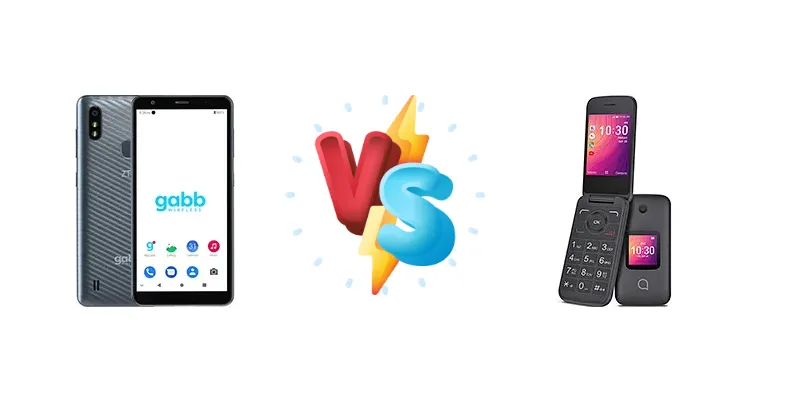
In a market saturated with complex smartphones, the ZTE Gabb Z2 and alcatel Go Flip 3 cater to a specific niche: users prioritizing simplicity and ease of use. Both are flip phones offering 4G connectivity, but beneath the familiar form factor lie significant differences in processing power and efficiency. This comparison dissects those differences to determine which device best suits your needs.
🏆 Quick Verdict
For most users seeking a straightforward, reliable flip phone, the ZTE Gabb Z2 emerges as the better choice. Its Mediatek Helio A22 chipset, built on a more modern 12nm process, provides a noticeable performance advantage over the alcatel Go Flip 3’s older Snapdragon 210, translating to a smoother user experience, even if both are limited by their basic feature sets.
| Network |
|---|
| 2G bands | GSM 850 / 900 / 1800 / 1900 | GSM 850 / 900 / 1800 / 1900 |
| 3G bands | HSDPA 850 / 900 / 1900 / 2100 | HSDPA 850 / 1700(AWS) / 1900 |
| 4G bands | 2, 4, 5, 12, 13 | 2, 4, 5, 12, 25, 26, 41, 66, 71 |
| Speed | HSPA, LTE Cat4 150/50 Mbps | HSPA, LTE |
| Technology | GSM / HSPA / LTE | GSM / CDMA / HSPA / LTE |
| | - | CDMA 800 / 1900 |
| Launch |
|---|
| Announced | 2020, August. Released 2020, August | 2019, September 19. Released 2019, September 19 |
| Status | Discontinued | Discontinued |
| Body |
|---|
| Build | Glass front, plastic frame, plastic back | - |
| Dimensions | 147 x 71 x 9.7 mm (5.79 x 2.80 x 0.38 in) | 104.9 x 53.1 x 20.1 mm (4.13 x 2.09 x 0.79 in) |
| SIM | Nano-SIM | Nano-SIM |
| Weight | 162 g (5.71 oz) | 118 g (4.16 oz) |
| Display |
|---|
| Resolution | 720 x 1440 pixels, 18:9 ratio (~295 ppi density) | 240 x 320 pixels, 4:3 ratio (~143 ppi density) |
| Size | 5.45 inches, 76.7 cm2 (~73.4% screen-to-body ratio) | 2.8 inches, 24.3 cm2 (~43.6% screen-to-body ratio) |
| Type | TFT LCD | TN TFT LCD |
| | - | Second external TN TFT display, 1.44 inches, 128 x 128 pixels |
| Platform |
|---|
| CPU | Quad-core 2.0 GHz Cortex-A53 | Quad-core 1.1 GHz Cortex-A7 |
| Chipset | Mediatek MT6761 Helio A22 (12 nm) | Qualcomm MSM8909 Snapdragon 210 (28 nm) |
| GPU | PowerVR GE8320 | Adreno 304 |
| OS | Android 10 | KaiOS 2.5.2 |
| Memory |
|---|
| Card slot | microSDXC | microSDHC (dedicated slot) |
| Internal | 32GB 2GB RAM | 4GB 512MB RAM |
| | eMMC 5.1 | - |
| Main Camera |
|---|
| Features | Dual-LED flash | - |
| Single | 8 MP, AF | 2 MP |
| Video | 1080p@30fps | 720p@30fps |
| Selfie camera |
|---|
| Single | 5 MP | - |
| Video | 720p@30fps | - |
| Sound |
|---|
| 3.5mm jack | Yes | Yes |
| 35mm jack | Yes | Yes |
| Loudspeaker | Yes, with dual speakers | Yes |
| Comms |
|---|
| Bluetooth | 4.2, A2DP | 4.2, A2DP |
| NFC | No | No |
| Positioning | GPS | No |
| Radio | FM radio | FM radio |
| USB | USB Type-C 2.0 | microUSB 2.0 |
| WLAN | Wi-Fi 802.11 b/g/n/ac, Wi-Fi Direct | Wi-Fi 802.11 b/g/n, hotspot |
| Features |
|---|
| Sensors | Fingerprint (rear-mounted), accelerometer | - |
| Battery |
|---|
| Type | Li-Ion 2650 mAh, removable | Li-Ion 1350 mAh, removable |
| Misc |
|---|
| Colors | Black | Prime Black |
| Price | About 140 EUR | About 80 EUR |
| SAR | - | 1.28 W/kg (head) 1.16 W/kg (body) |
ZTE Gabb Z2
- More powerful and efficient Mediatek Helio A22 chipset
- Potentially longer battery life due to 12nm process
- Smoother user interface and faster app loading
- Likely slightly higher price point
- Still a basic feature phone with limited functionality
alcatel Go Flip 3
- Most affordable option
- Simple and easy to use
- Reliable for basic calling and texting
- Older and less efficient Snapdragon 210 chipset
- Slower performance and potentially shorter battery life
- May struggle with even basic multitasking
Display Comparison
Neither phone boasts a particularly impressive display. Both utilize relatively small screens typical of flip phones, and detailed specifications regarding panel type (TFT vs. IPS) or resolution are unavailable. However, the focus here isn't display quality, but usability. The Gabb Z2’s screen size is likely similar to the Go Flip 3, but the more powerful processor could contribute to faster UI rendering, making text and icons appear slightly sharper in practice. Bezels are expected to be substantial on both devices, a common characteristic of this form factor.
Camera Comparison
Camera performance is unlikely to be a deciding factor for either phone. Both are equipped with basic cameras intended for occasional snapshots. Detailed sensor information is unavailable, but given the target market, image quality will be limited. The focus should be on ease of use rather than photographic fidelity. It's safe to assume both cameras will perform adequately in well-lit conditions but struggle in low light.
Performance
The core difference lies in the chipsets. The ZTE Gabb Z2’s Mediatek MT6761 Helio A22 (12nm) is a significant upgrade over the alcatel Go Flip 3’s Qualcomm MSM8909 Snapdragon 210 (28nm). The 12nm fabrication process of the Helio A22 is far more efficient, resulting in lower power consumption and potentially better thermal management. While both CPUs are quad-core, the Gabb Z2’s Cortex-A53 cores run at 2.0 GHz, compared to the Go Flip 3’s 1.1 GHz Cortex-A7 cores. This higher clock speed, combined with the newer architecture, translates to faster app loading times and a more responsive user interface. The Snapdragon 210, being older, will struggle more with even basic multitasking.
Battery Life
Battery capacity details are not provided for either device. However, the Gabb Z2’s more efficient Mediatek Helio A22 chipset should result in longer battery life compared to the alcatel Go Flip 3’s power-hungry Snapdragon 210. The 28nm process of the Snapdragon 210 inherently consumes more power. While charging wattage is also unknown, the Gabb Z2’s efficiency advantage will likely translate to fewer charges per day, even with similar battery capacities.
Buying Guide
Buy the ZTE Gabb Z2 if you need a slightly more responsive experience and appreciate a more modern chipset architecture, even within the constraints of a feature phone. This is ideal for users who occasionally use apps or want a phone that feels less sluggish. Buy the alcatel Go Flip 3 if your absolute priority is minimizing cost and you only require basic calling and texting functionality; its Snapdragon 210 is sufficient for these core tasks, and it represents the most affordable option.
Frequently Asked Questions
❓ Will the ZTE Gabb Z2 handle basic apps like WhatsApp or Facebook?
While the Gabb Z2's Helio A22 chipset is more capable than the Snapdragon 210 in the Go Flip 3, it's still a low-end processor. WhatsApp and Facebook *may* function, but expect slow loading times and a potentially laggy experience. These apps are not optimized for feature phones and will push the hardware to its limits.
❓ Is the alcatel Go Flip 3 a good choice for someone completely unfamiliar with smartphones?
Absolutely. The Go Flip 3's simplicity is its greatest strength. Its physical buttons, straightforward interface, and lack of complex features make it ideal for users who are intimidated by smartphones or simply prefer a more basic mobile experience. It excels at core functions like calling and texting.
❓ Does the ZTE Gabb Z2 support 4G LTE for faster data speeds?
Yes, the Mediatek Helio A22 chipset in the Gabb Z2 includes integrated 4G LTE connectivity. This allows for faster data speeds compared to 3G, enabling basic web browsing and app usage (though performance will still be limited by the processor).
❓ How does the older Snapdragon 210 in the alcatel Go Flip 3 affect its longevity?
The Snapdragon 210 is an older chipset, meaning software updates and app compatibility may become increasingly limited over time. While it will continue to function for basic calling and texting, its ability to support newer apps or services will likely diminish faster than the Gabb Z2.