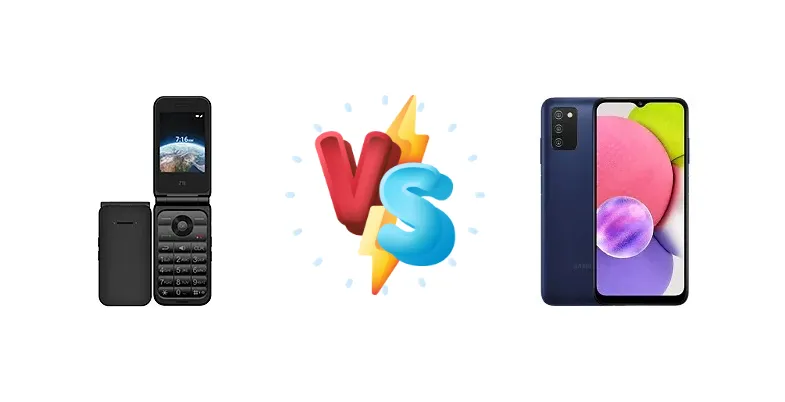
The ZTE Cymbal U and Samsung Galaxy A03s represent the extreme end of the smartphone price spectrum. Both aim to deliver essential functionality at a minimal cost, but they take different approaches. The Cymbal U relies on Qualcomm's aging Snapdragon 215, while the A03s opts for MediaTek's Helio P35. This comparison dissects these choices, revealing which phone offers the best value for users prioritizing affordability.
🏆 Quick Verdict
For the average user needing basic smartphone functionality, the Samsung Galaxy A03s is the better choice. Its octa-core Helio P35 chipset provides a significantly smoother experience than the Cymbal U’s quad-core Snapdragon 215, making everyday tasks and light multitasking noticeably more responsive. While both offer similar battery endurance, the A03s’s brighter display and faster charging add to its overall appeal.
| Network |
|---|
| 2G bands | GSM 850 / 1900 | GSM 850 / 900 / 1800 / 1900 |
| 3G bands | HSDPA 850 / 1700(AWS) / 1900 | HSDPA 850 / 900 / 2100 |
| 4G bands | 2, 4, 5, 12, 41, 66, 71 | 1, 3, 5, 7, 8, 20, 28, 38, 40, 41 |
| Speed | HSPA, LTE Cat4 150/50 Mbps | HSPA 42.2/5.76 Mbps, LTE Cat4 150/50 Mbps |
| Technology | GSM / HSPA / LTE | GSM / HSPA / LTE |
| | - | 2, 4, 5, 7, 12, 13, 14, 25, 26, 41, 66, 71 - SM-A037U |
| Launch |
|---|
| Announced | 2021, January | 2021, August 18 |
| Status | Available. Released 2021, January | Available. Released 2021, August 18 |
| Body |
|---|
| Build | - | Glass front, plastic frame, plastic back |
| Dimensions | 109.2 x 55.9 x 19.5 mm (4.30 x 2.20 x 0.77 in) | 164.2 x 75.9 x 9.1 mm (6.46 x 2.99 x 0.36 in) |
| SIM | Nano-SIM | Nano-SIM + Nano-SIM |
| Weight | - | 196 g (6.91 oz) |
| Display |
|---|
| Resolution | 240 x 320 pixels, 4:3 ratio (~143 ppi density) | 720 x 1600 pixels, 20:9 ratio (~270 ppi density) |
| Size | 2.8 inches, 24.3 cm2 (~39.8% screen-to-body ratio) | 6.5 inches, 102.0 cm2 (~81.8% screen-to-body ratio) |
| Type | TFT LCD | PLS LCD |
| | Cover display:
TFT LCD, 1.70 inches | - |
| Platform |
|---|
| CPU | Quad-core 1.3 GHz Cortex-A53 | Octa-core (4x2.35 GHz Cortex-A53 & 4x1.8 GHz Cortex-A53) |
| Chipset | Qualcomm QM215 Snapdragon 215 (28 nm) | Mediatek MT6765 Helio P35 (12 nm) |
| GPU | Adreno 308 | PowerVR GE8320 |
| OS | Proprietary | Android 11, upgradable to Android 13, One UI 5.1 Core |
| Memory |
|---|
| Card slot | microSDHC (dedicated slot) | microSDXC (dedicated slot) |
| Internal | 8GB 1GB RAM | 32GB 2GB RAM, 32GB 3GB RAM, 32GB 4GB RAM, 64GB 3GB RAM, 64GB 4GB RAM |
| | - | eMMC 5.1 |
| Main Camera |
|---|
| Features | - | LED flash |
| Single | 2 MP | 5 MP, f/2.2 |
| Triple | - | 13 MP, f/2.2, (wide), AF
2 MP (macro)
Auxiliary lens |
| Video | 720p@30fps | 1080p@30fps |
| Selfie camera |
|---|
| Single | - | 5 MP, f/2.2 |
| Video | - | 1080p@30fps |
| Sound |
|---|
| 3.5mm jack | Yes | Yes |
| 35mm jack | Yes | Yes |
| Loudspeaker | Yes | Yes |
| Comms |
|---|
| Bluetooth | 4.2, A2DP | 5.0, A2DP |
| NFC | No | Yes (market/region dependent) |
| Positioning | GPS | GPS, GLONASS, GALILEO, BDS |
| Radio | FM Radio | No |
| USB | microUSB 2.0 | USB Type-C 2.0 |
| WLAN | Wi-Fi 802.11 b/g/n, hotspot | Wi-Fi 802.11 b/g/n, Wi-Fi Direct |
| Features |
|---|
| Sensors | - | Fingerprint (side-mounted), accelerometer, proximity |
| Battery |
|---|
| Charging | - | 15W wired |
| Type | Li-Ion 1600 mAh, removable | Li-Po 5000 mAh |
| Misc |
|---|
| Colors | Black | Black, Blue, White |
| Models | - | SM-A037F, SM-A037F/DS, SM-A037M, SM-A037G, SM-A037U, SM-S134DL, SM-A037W, SM-A037U1, SM-S135DL |
| Price | About 70 EUR | $ 65.65 / £ 82.99 / ₹ 10,800 |
| SAR EU | - | 0.36 W/kg (head) 1.09 W/kg (body) |
| Tests |
|---|
| Battery life | - |
Endurance rating 122h
|
| Camera | - |
Photo / Video |
| Display | - |
Contrast ratio: 1718:1 (nominal) |
| Loudspeaker | - |
-27.4 LUFS (Good)
|
| Performance | - |
AnTuTu: 103465 (v8), 101299 (v9)
GeekBench: 889 (v5.1)
GFXBench: 5.5fps (ES 3.1 onscreen) |
ZTE Cymbal U
- Lowest possible price point
- Acceptable battery life
- Functional for basic tasks
- Significantly slower performance
- Likely lower display quality
- Slower charging (assumed)
Samsung Galaxy A03s
- Faster and more responsive performance
- Brighter and more visible display
- 15W fast charging
- Better multitasking capabilities
- Slightly higher price
- Camera quality likely limited
- Still an entry-level device
Display Comparison
The Samsung Galaxy A03s boasts a superior display experience. While both phones share a 1718:1 contrast ratio, the A03s achieves a measured peak brightness of 488 nits, significantly outshining the Cymbal U (brightness data unavailable, but expected to be lower given the chipset and price point). This translates to better visibility in direct sunlight. The lack of detailed display specifications for the Cymbal U suggests a more basic panel, likely with lower color accuracy and viewing angles. The A03s’s brighter screen is a clear advantage for media consumption and outdoor use.
Camera Comparison
Both phones feature 'Photo / Video' capabilities, but detailed camera specifications are lacking. Given the price points, image quality is unlikely to be a strong suit for either device. The absence of information regarding sensor size, aperture, or image stabilization suggests both rely on basic camera modules. The Cymbal U’s camera is likely to be even more limited due to the weaker processing power of the Snapdragon 215. Any claims of advanced features on either phone should be viewed with skepticism.
Performance
The performance gap between these two devices is substantial. The Samsung Galaxy A03s’s MediaTek Helio P35, with its octa-core configuration (4x2.35 GHz Cortex-A53 & 4x1.8 GHz Cortex-A53), offers a considerable advantage over the ZTE Cymbal U’s quad-core 1.3 GHz Cortex-A53 processor and Snapdragon 215 chipset. The Helio P35’s higher clock speeds and additional cores enable smoother multitasking, faster app loading times, and a more responsive user interface. The Snapdragon 215, built on a 28nm process, is significantly less efficient than the Helio P35’s 12nm node, potentially leading to more heat generation and throttling under sustained load. This difference is critical for even basic tasks.
Battery Life
Both the ZTE Cymbal U and Samsung Galaxy A03s achieve an endurance rating of 122 hours, indicating comparable battery life under similar usage conditions. However, the A03s benefits from 15W wired charging, allowing for faster replenishment of the battery compared to the Cymbal U (charging speed data unavailable, but likely slower). While both will likely last a full day with moderate use, the A03s’s faster charging is a convenience factor that the Cymbal U lacks.
Buying Guide
Buy the ZTE Cymbal U if you absolutely need the lowest possible price and are willing to accept significant performance limitations. It’s suitable for users who primarily make calls, send texts, and occasionally browse the web. Buy the Samsung Galaxy A03s if you prefer a more responsive user experience, a brighter display for outdoor visibility, and the convenience of 15W fast charging. It’s ideal for users who engage in light social media, streaming, and casual gaming.
Frequently Asked Questions
❓ Will the Helio P35 in the Galaxy A03s struggle with demanding games like PUBG?
While the Helio P35 can run PUBG Mobile, expect to play at lower graphics settings and frame rates to maintain a stable experience. It's not a gaming-focused chipset, and demanding titles will likely exhibit frame drops and lag. The Cymbal U’s Snapdragon 215 would struggle even more significantly.
❓ Is the 2MP macro camera on the Galaxy A03s worth using?
Generally, 2MP macro cameras on budget phones offer limited utility. Image quality is often soft and lacks detail. It can be fun for experimentation, but don't expect professional-looking macro shots. The primary camera on the A03s will deliver far superior results in most scenarios.
❓ Does the Snapdragon 215 in the ZTE Cymbal U support modern app updates?
The Snapdragon 215 is an older chipset, and some newer app updates may not be fully optimized or even compatible. While most essential apps will function, you might encounter performance issues or limited features with more demanding applications over time.
❓ How long does it realistically take to fully charge the Samsung Galaxy A03s with the 15W charger?
With the included 15W charger, the Samsung Galaxy A03s should fully charge from 0% to 100% in approximately 2.5 to 3 hours. This is significantly faster than the charging time expected for the ZTE Cymbal U, which likely lacks fast charging support.