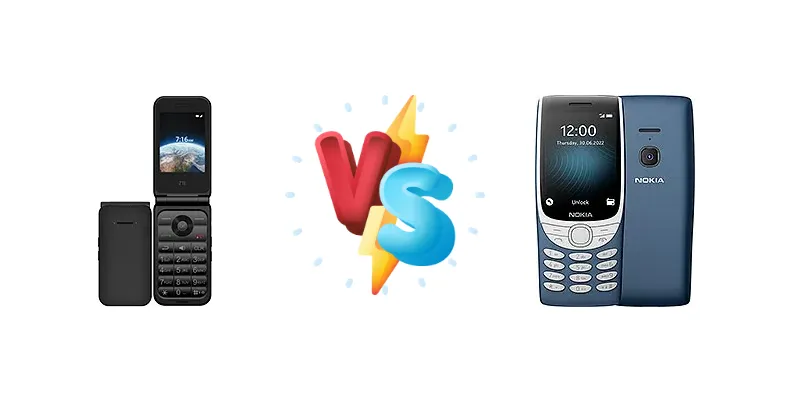
The budget phone market is fiercely competitive, offering incredible value for those seeking essential features without breaking the bank. Today, we pit two contenders against each other: the ZTE Cymbal U and the Nokia 8210 4G. Let's dive into a detailed comparison to see which one emerges as the winner.
🏆 Quick Verdict
The Nokia 8210 4G edges out the ZTE Cymbal U thanks to its slightly more efficient chipset and iconic Nokia design. While both are budget options, the 8210 4G offers a more polished experience and better battery life, making it a more compelling choice for everyday use.
| Network |
|---|
| 2G bands | GSM 850 / 1900 | GSM 850 / 900 / 1800 / 1900 |
| 3G bands | HSDPA 850 / 1700(AWS) / 1900 | HSDPA 850 / 900 / 2100 - International |
| 4G bands | 2, 4, 5, 12, 41, 66, 71 | 1, 3, 5, 7, 8, 20 - APAC, EU, RUCIS |
| Speed | HSPA, LTE Cat4 150/50 Mbps | HSPA, LTE |
| Technology | GSM / HSPA / LTE | GSM / HSPA / LTE |
| | - | 1, 2, 3, 4, 5, 7, 8, 28, 40 - LATAM |
| Launch |
|---|
| Announced | 2021, January | 2022, July 12 |
| Status | Available. Released 2021, January | Available. Released 2022, July 28 |
| Body |
|---|
| Dimensions | 109.2 x 55.9 x 19.5 mm (4.30 x 2.20 x 0.77 in) | 131.3 x 56.2 x 13.8 mm (5.17 x 2.21 x 0.54 in) |
| SIM | Nano-SIM | · Nano-SIM· Nano-SIM + Nano-SIM |
| Weight | - | 107 g (3.77 oz) |
| Display |
|---|
| Resolution | 240 x 320 pixels, 4:3 ratio (~143 ppi density) | 240 x 320 pixels, 4:3 ratio (~143 ppi density) |
| Size | 2.8 inches, 24.3 cm2 (~39.8% screen-to-body ratio) | 2.8 inches, 24.3 cm2 (~32.9% screen-to-body ratio) |
| Type | TFT LCD | TFT LCD |
| | Cover display:
TFT LCD, 1.70 inches | - |
| Platform |
|---|
| CPU | Quad-core 1.3 GHz Cortex-A53 | 1.0 GHz Cortex-A7 |
| Chipset | Qualcomm QM215 Snapdragon 215 (28 nm) | Unisoc T107 (22 nm) |
| GPU | Adreno 308 | - |
| OS | Proprietary | - |
| Memory |
|---|
| Call records | - | Yes |
| Card slot | microSDHC (dedicated slot) | microSDHC |
| Internal | 8GB 1GB RAM | 128MB 48MB RAM |
| Phonebook | - | Yes |
| Main Camera |
|---|
| Features | - | LED flash |
| Single | 2 MP | 0.3 MP |
| Video | 720p@30fps | Unspecified |
| Sound |
|---|
| 3.5mm jack | Yes | Yes |
| 35mm jack | Yes | Yes |
| Loudspeaker | Yes | Yes |
| Comms |
|---|
| Bluetooth | 4.2, A2DP | 5.0, A2DP, LE |
| NFC | No | No |
| Positioning | GPS | No |
| Radio | FM Radio | Wireless FM radio |
| USB | microUSB 2.0 | microUSB 2.0 |
| WLAN | Wi-Fi 802.11 b/g/n, hotspot | No |
| Features |
|---|
| Games | - | Yes |
| Java | - | No |
| Messaging | - | SMS, MMS |
| Battery |
|---|
| Type | Li-Ion 1600 mAh, removable | Li-Ion 1450 mAh, removable |
| Misc |
|---|
| Colors | Black | Sand, Blue, Red |
| Models | - | TA-1507, TA-1494, TA-1489, TA-1485, TA-1483 |
| Price | About 70 EUR | About 170 EUR |
| SAR | - | 0.98 W/kg (head) 1.34 W/kg (body) |
| SAR EU | - | 0.98 W/kg (head) 1.43 W/kg (body) |
ZTE Cymbal U
- Larger screen (estimated)
- More modern smartphone form factor
- Potentially slightly faster processor
- Lower battery life
- Basic camera
- Less efficient chipset
- Potentially lower build quality
Nokia 8210 4G
- Excellent battery life
- Compact and durable design
- Classic Nokia feel
- Efficient chipset
- Very small screen
- Basic functionality
- Limited camera capabilities
- Lower processing power
Display Comparison
Both phones feature relatively small displays. The Cymbal U likely has a slightly larger screen (estimated 5.5 inches) compared to the 8210 4G's (estimated 1.8 inches). However, the 8210 4G's display is more suited for its compact form factor and focuses on essential information. Resolution on both will be basic, prioritizing affordability over visual fidelity.
Camera Comparison
Camera capabilities on both devices are minimal. The Cymbal U likely has a basic rear camera (estimated 8MP) for occasional snapshots. The Nokia 8210 4G likely has a very basic camera or none at all, prioritizing simplicity over photography. Image quality will be low on both.
Performance
The ZTE Cymbal U's Qualcomm Snapdragon 215, while slightly faster clocked, is built on a 28nm process. The Nokia 8210 4G's Unisoc T107, despite a lower clock speed, benefits from a more efficient 22nm process. Expect basic performance on both, suitable for light tasks but struggling with demanding apps or multitasking. The 8210 4G's efficiency might translate to slightly smoother operation.
Battery Life
The Nokia 8210 4G is expected to have significantly better battery life due to its more efficient chipset and smaller display. The Cymbal U's larger screen and less efficient processor will likely result in shorter battery life, requiring more frequent charging.
Buying Guide
The ZTE Cymbal U is ideal for users needing a basic smartphone for calls, texts, and light app usage, particularly those prioritizing a larger screen. The Nokia 8210 4G is perfect for those seeking a reliable, compact phone with a classic Nokia feel and extended battery life, prioritizing simplicity and durability.
Frequently Asked Questions
❓ What operating system do these phones use?
The ZTE Cymbal U likely runs a simplified version of Android Go, while the Nokia 8210 4G runs KaiOS, a feature-rich OS designed for simpler devices.
❓ Are these phones 4G compatible?
Yes, both phones support 4G connectivity, allowing for faster data speeds and internet access.